Advertisements
Online Mock Tests
Chapters
2: Chemical Bonding
3: Acids, Bases and Salts
4: Analytical Chemistry
5: Mole concept and Stoichiometry
6: Electrolysis
7: Metallurgy
▶ 8: Study of Compounds A. Hydrogen Chloride
9: Study of Compounds B. Ammonia
10: Study of Compounds C. Nitric Acid
11: Study of Compounds D. Sulphuric Acid
12: Organic Chemistry
13: Practical Work
![S.P. Singh solutions for कन्साइस केमिस्ट्री [इंग्रजी] इयत्ता १० आयसीएसई chapter 8 - Study of Compounds A. Hydrogen Chloride - Shaalaa.com](/images/concise-chemistry-english-class-10-icse_6:7b16b8cbeb0b4ebab074df2efa4502e0.jpg "S.P. Singh solutions for कन्साइस केमिस्ट्री [इंग्रजी] इयत्ता १० आयसीएसई chapter 8 - Study of Compounds A. Hydrogen Chloride")
Advertisements
Solutions for Chapter 8: Study of Compounds A. Hydrogen Chloride
Below listed, you can find solutions for Chapter 8 of CISCE S.P. Singh for कन्साइस केमिस्ट्री [इंग्रजी] इयत्ता १० आयसीएसई.
S.P. Singh solutions for कन्साइस केमिस्ट्री [इंग्रजी] इयत्ता १० आयसीएसई 8 Study of Compounds A. Hydrogen Chloride EXERCISE-8 [Pages 156 - 158]
MULTIPLE CHOICE TYPЕ: (Choose the correct answer from the options given below).
Hydrogen chloride molecule is ______.
Polar covalent
Non polar
Ionic
Co-ordinate
Hydrogen chloride gas, being highly soluble in water, is dried by ______.
Anhydrous calcium chloride
Phosphorous pentaoxide
Quick time
Concentrated sulphuric acid
The aim of the Fountain experiment is to prove that ______.
HCl turns blue litmus red.
HCl is denser than air.
HCl is highly soluble in water.
HCl fumes in moist air.
HCl dissolves in toluene (C6H5CH3) and the solution:
P contains hydronium ions.
Q can produce carbon dioxide on reacting with sodium carbonate.
R does not show any acidic property.
Which of the following holds true?
Only P
Only Q
Only R
Both P and Q
The following questions are Assertion-Reason based questions. Choose the answer from the options given below.
Assertion (A): HCI is produced by the reaction of hydrogen and chlorine in diffused sunlight.
Reason (R): This reaction is explosive in sunlight.
- Both A and R are true and R is the correct explanation of A.
- Both A and R are true but R is not the correct explanation of A.
- A is true but R is false.
- A is false but R is true.
(1)
(2)
(3)
(4)
Assertion (A): The Fountain experiment is used to demonstrate the high solubility of HCl gas.
Reason (R): Red litmus solution turns blue in Fountain experiment.
- Both A and R are true and R is the correct explanation of A.
- Both A and R are true but R is not the correct explanation of A.
- A is true but R is false.
- A is false but R is true.
(1)
(2)
(3)
(4)
Assertion (A): HCI gas is collected by downward delivery.
Reason (R): HCl gas is heavier than air.
- Both A and R are true and R is the correct explanation of A.
- Both A and R are true but R is not the correct explanation of A.
- A is true but R is false.
- A is false but R is true.
(1)
(2)
(3)
(4)
Assertion (A): HCl gas fumes in moist air.
Reason (R): HCI gas is highly soluble in water.
- Both A and R are true and R is the correct explanation of A.
- Both A and R are true but R is not the correct explanation of A.
- A is true but R is false.
- A is false but R is true.
(1)
(2)
(3)
(4)
Assertion (A): HCl gas dissolves in water as well as organic compounds like toluene.
Reason (R): HCI is a polar covalent compound.
- Both A and R are true and R is the correct explanation of A.
- Both A and R are true but R is not the correct explanation of A.
- A is true but R is false.
- A is false but R is true.
(1)
(2)
(3)
(4)
Assertion (A): HCl gas is used in the preparation of chlorine and chlorides.
Reason (R): Lead chloride is not produced from HCl.
- Both A and R are true and R is the correct explanation of A.
- Both A and R are true but R is not the correct explanation of A.
- A is true but R is false.
- A is false but R is true.
(1)
(2)
(3)
(4)
Assertion (A): Few drops of dilute hydrochloric acid is added to a solution of iron sulphide, a colourless gas is formed with a rotten egg odour.
Reason (R): The gas formed does not turn moist lead acetate paper silvery black.
- Both A and R are true and R is the correct explanation of A.
- Both A and R are true but R is not the correct explanation of A.
- A is true but R is false.
- A is false but R is true.
(1)
(2)
(3)
(4)
VERY SHORT ANSWER TYPE:
Quicklime is not used to dry HCI gas because Cao is ______.
alkaline
acidic
neutral
When sodium chloride is heated with concentrated sulphuric acid below 200°C, one of the products formed is ______.
sodium hydrogen sulphate
sodium sulphate
chlorine
A solution of hydrogen chloride in water is prepared. The following substances are added to separate portions of the solution:
| S. No. | Substances added | Gas evolved | Odour |
| 1. | Calcium carbonate | _________ | _________ |
| 2. | Magnesium ribbon | _________ | _________ |
| 3. | Manganese (IV) oxide with heating | _________ | _________ |
| 4. | Sodium sulphide | _________ | _________ |
Complete the table by writing the gas evolved in each case and its odour.
Name a black metallic oxide which reacts with hydrochloric acid to give a coloured solution.
Name two colourless gases, which when mixed, produce a white solid.
Name two gases which chemically combine to form a liquid.
Name the chemical in which gold can be dissolved.
Name the experiment which demonstrates that hydrogen chloride is soluble in water.
Name the gas produced when chlorine water is exposed to sunlight.
Name the acid which on mixing with silver nitrate solution, produces a white precipitate which is soluble in excess of ammonium hydroxide.
Name two gases which give dense white fumes with ammonia.
Name an element which reacts with hydrogen to form a compound which is strongly acidic in water.
Match the following reactions in column A with the gas evolved in column B:
| Column A | Column B | ||
| (a) | Potassium sulphite is treated with dilute hydrochloric acid. | A. | Cl2 |
| (b) | Concentrated hydrochloric acid is made to react with manganese dioxide. | B. | H2S |
| (c) | Iron sulphide reacts with dil. HCl. | C. | SO2 |
| (d) | Calcium carbonate is added to dil. HCl. | D. | CO2 |
Solution A reacts with an acid B (which gives greenish yellow gas on reacting with oxidizing agents like Pb3O4) to give white precipitate C insoluble in nitric acid but soluble in ammonium hydroxide. Name A, B and C.
State the composition of aqua regia. State which component is the oxidizing agent in aqua regia.
MnO2, PbO2 and red lead react with conc. HCl acid to liberate Cl2.
What is the common property being shown by these metal oxides?
SHORT ANSWER TYPE:
Complete and balance the following reaction, state whether dilute or conc. acid is used.
\[\ce{NH4OH + HCl -> }\]
Complete and balance the following reaction, state whether dilute or conc. acid is used.
\[\ce{NaHSO3 + HCl ->}\]
Complete and balance the following reaction, state whether dilute or conc. acid is used.
\[\ce{Pb(NO3)2 + HCl ->}\]
Complete and balance the following reaction, state whether dilute or conc. acid is used.
\[\ce{Pb3O4 + HCl ->}\]
How will the action of dilute hydrochloric acid enable you to distinguish between sodium carbonate and sodium sulphite?
How will the action of dilute hydrochloric acid enable you to distinguish between sodium thiosulphate and sodium sulphite?
Write an equation for the reaction of hydrochloric acid on the silver nitrate solution.
Write an equation for the reaction of hydrochloric acid on magnesium foil.
Write an equation for the reaction of hydrochloric acid on caustic soda solution.
Write an equation for the reaction of hydrochloric acid on zinc carbonate.
Write an equation for the reaction of hydrochloric acid on manganese (IV) oxide.
Write an equation for the reaction of hydrochloric acid on copper oxide.
Explain why anhydrous HCl is a poor conductor while aqueous HCl is an excellent conductor.
Explain why when the stopper of a bottle full of hydrogen chloride gas is opened, there are fumes in the air.
Explain why a solution of hydrogen chloride in water turns blue litmus red and conducts electricity, while a solution of the same gas in toluene:
- has no effect on litmus, and
- does not conduct electricity.
Explain why dry hydrogen chloride gas does not affect a dry strip of blue litmus paper but it turns red in the presence of a drop of water.
Explain why dilute hydrochloric acid cannot be concentrated by boiling beyond 22.2%.
Give a balanced equation with condition, if any, for the following conversion.
\[\ce{Sodium chloride -> Hydrogen chloride}\]
Give a balanced equation with condition, if any, for the following conversion.
\[\ce{Hydrogen chloride -> Iron (II) chloride}\]
Give a balanced equation with condition, if any, for the following conversion.
\[\ce{Hydrogen chloride -> Ammonium chloride}\]
Give a balanced equation with condition, if any, for the following conversion.
\[\ce{Hydrogen chloride -> Lead chloride}\]
Write a balanced chemical equation.
Sodium thiosulphate is reacted with dilute hydrochloric acid.
Write a balanced chemical equation.
Calcium bicarbonate reacts with dilute hydrochloric acid.
Write a balanced equation for the action of dilute hydrochloric acid on sodium sulphide.
Write a balanced chemical equation for the action of hydrochloric acid on sodium bicarbonate.
Write the balanced equation for the reaction of dilute hydrochloric acid with the following:
Iron
Write the balanced equation for the reaction of dilute hydrochloric acid with the following:
Sodium hydrogen carbonate
Write the balanced equation for the reaction of dilute hydrochloric acid with the following:
Iron (II) sulphide
Write the balanced equation for the reaction of dilute hydrochloric acid with the following:
Magnesium sulphite
By the addition of only one solution, how would you distinguish between dilute hydrochloric acid and dilute nitric acid?
State one appropriate observation when copper sulphide is treated with dilute hydrochloric acid.
State one appropriate observation of the following:
A few drops of dilute hydrochloric acid are added to silver nitrate solution, followed by the addition of ammonium hydroxide solution.
Write observation:
Lead nitrate solution is mixed with dilute hydrochloric acid and heated.
Write observation:
A small piece of zinc is added to dilute hydrochloric acid.
State your observation of the following case:
When dilute hydrochloric acid is added to sodium carbonate crystals.
State the observation for the following:
When manganese dioxide reacts with concentrated HCl.
Distinguish by using HCl.
Lead nitrate solution and silver nitrate solution.
Distinguish by using HCl.
Potassium sulphite and potassium sulphide.
LONG ANSWER TYPE:
The given set up in the figure is for the preparation of an acid.
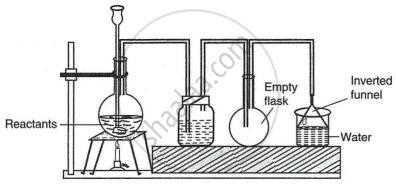
- Name the acid prepared by this method.
- Name the reactants used.
- Why an empty flask is used?
- What is the drying agent used? Why is this drying agent chosen?
- What is the role of the inverted funnel in the arrangement?
The following questions pertain to the laboratory preparation of hydrogen chloride gas.
- Write the equation for its preparation, mentioning the condition required.
- Name the drying agent used in the above preparation and give a reason for the choice.
- State a safety precaution you would take during the preparation of hydrochloric acid.
How will you prove that hydrochloric acid contains
- hydrogen
- chlorine?
Write equations for the reactions.
Give three distinct test [apart from using an indicator] you would carry out with solution of HCl to illustrate the typical properties of an acid.
Convert two soluble metallic nitrates to insoluble metallic chlorides using dil. HCl.
Convert:
Insoluble iron (II) oxide to a soluble compound.
Convert:
Insoluble metal carbonate to a soluble chloride.
Convert:
Metal sulphide to an offensive smelling gas.
Study the flow chart and give balanced equations with conditions for the conversions A, B, C, D and E.
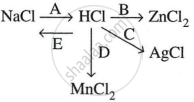
Study the figure given below and answer the questions which follow:
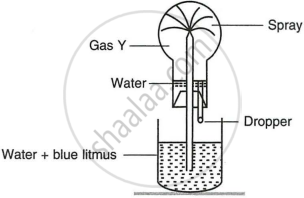
- Identify the gas Y.
- What property of gas Y does this experiment demonstrate?
- Name another gas which has the same property and can be demonstrated through this experiment.
Identify the gas evolved and give the chemical test in the following case:
Dilute hydrochloric acid reacts with iron (II) sulphide.
Identify the gas evolved and give the chemical test in the following case:
Dilute hydrochloric acid reacts with sodium sulphite.
State your observation:
HCl gas is passed through lead nitrate solution and the mixture is heated.
State what is observed when hydrochloric acid is added to silver nitrated solution.
State your observation:
Ammonium hydroxide solution is added to the resultant product of part (b).
Refer to the diagram given below and write balanced equations with conditions, if any, for the following conversions P to S.
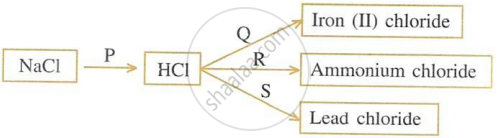
Solutions for 8: Study of Compounds A. Hydrogen Chloride
S.P. Singh solutions for कन्साइस केमिस्ट्री [इंग्रजी] इयत्ता १० आयसीएसई chapter 8 - Study of Compounds A. Hydrogen Chloride
Shaalaa.com has the CISCE Mathematics कन्साइस केमिस्ट्री [इंग्रजी] इयत्ता १० आयसीएसई CISCE solutions in a manner that help students grasp basic concepts better and faster. The detailed, step-by-step solutions will help you understand the concepts better and clarify any confusion. S.P. Singh solutions for Mathematics कन्साइस केमिस्ट्री [इंग्रजी] इयत्ता १० आयसीएसई CISCE 8 (Study of Compounds A. Hydrogen Chloride) include all questions with answers and detailed explanations. This will clear students' doubts about questions and improve their application skills while preparing for board exams.
Further, we at Shaalaa.com provide such solutions so students can prepare for written exams. S.P. Singh textbook solutions can be a core help for self-study and provide excellent self-help guidance for students.
Concepts covered in कन्साइस केमिस्ट्री [इंग्रजी] इयत्ता १० आयसीएसई chapter 8 Study of Compounds A. Hydrogen Chloride are Concept of Hydrogen Chloride, General Preparation of Hydrogen Chloride Gas, Recognition and Identification of Gases, Physical Properties of Hydrogen Chloride Gas, Chemical Properties of Hydrogen Chloride Gas, Hydrochloric Acid, Laboratory Method of Preparation of Hydrochloric Acid, Properties of Hydrochloric Acid > Physical Properties, Properties of Hydrochloric Acid > Chemical Properties, Uses of Hydrochloric Acid, Tests for Hydrogen Chloride and Hydrochloric Acid, Concept of Hydrogen Chloride, General Preparation of Hydrogen Chloride Gas, Recognition and Identification of Gases, Physical Properties of Hydrogen Chloride Gas, Chemical Properties of Hydrogen Chloride Gas, Hydrochloric Acid, Laboratory Method of Preparation of Hydrochloric Acid, Properties of Hydrochloric Acid > Physical Properties, Properties of Hydrochloric Acid > Chemical Properties, Uses of Hydrochloric Acid, Tests for Hydrogen Chloride and Hydrochloric Acid, Concept of Hydrogen Chloride, General Preparation of Hydrogen Chloride Gas, Recognition and Identification of Gases, Physical Properties of Hydrogen Chloride Gas, Chemical Properties of Hydrogen Chloride Gas, Hydrochloric Acid, Laboratory Method of Preparation of Hydrochloric Acid, Properties of Hydrochloric Acid > Physical Properties, Properties of Hydrochloric Acid > Chemical Properties, Uses of Hydrochloric Acid, Tests for Hydrogen Chloride and Hydrochloric Acid.
Using S.P. Singh कन्साइस केमिस्ट्री [इंग्रजी] इयत्ता १० आयसीएसई solutions Study of Compounds A. Hydrogen Chloride exercise by students is an easy way to prepare for the exams, as they involve solutions arranged chapter-wise and also page-wise. The questions involved in S.P. Singh Solutions are essential questions that can be asked in the final exam. Maximum CISCE कन्साइस केमिस्ट्री [इंग्रजी] इयत्ता १० आयसीएसई students prefer S.P. Singh Textbook Solutions to score more in exams.
Get the free view of Chapter 8, Study of Compounds A. Hydrogen Chloride कन्साइस केमिस्ट्री [इंग्रजी] इयत्ता १० आयसीएसई additional questions for Mathematics कन्साइस केमिस्ट्री [इंग्रजी] इयत्ता १० आयसीएसई CISCE, and you can use Shaalaa.com to keep it handy for your exam preparation.
