Advertisements
Online Mock Tests
Chapters
2: Chemical Bonding
3: Acids, Bases and Salts
4: Analytical Chemistry
5: Mole concept and Stoichiometry
6: Electrolysis
7: Metallurgy
8: Study of Compounds A. Hydrogen Chloride
9: Study of Compounds B. Ammonia
▶ 10: Study of Compounds C. Nitric Acid
11: Study of Compounds D. Sulphuric Acid
12: Organic Chemistry
13: Practical Work
![S.P. Singh solutions for कन्साइस केमिस्ट्री [इंग्रजी] इयत्ता १० आयसीएसई chapter 10 - Study of Compounds C. Nitric Acid - Shaalaa.com](/images/concise-chemistry-english-class-10-icse_6:7b16b8cbeb0b4ebab074df2efa4502e0.jpg "S.P. Singh solutions for कन्साइस केमिस्ट्री [इंग्रजी] इयत्ता १० आयसीएसई chapter 10 - Study of Compounds C. Nitric Acid")
Advertisements
Solutions for Chapter 10: Study of Compounds C. Nitric Acid
Below listed, you can find solutions for Chapter 10 of CISCE S.P. Singh for कन्साइस केमिस्ट्री [इंग्रजी] इयत्ता १० आयसीएसई.
S.P. Singh solutions for कन्साइस केमिस्ट्री [इंग्रजी] इयत्ता १० आयसीएसई 10 Study of Compounds C. Nitric Acid lntext Questions [Pages 177 - 178]
Fill in the blank:
Cold, dilute nitric acid reacts with copper to give ______.
Sulphur dioxide
Nitrogen dioxide
Nitric oxide
Sulphuric acid
Hydrogen
What is aqua fortis?
What is aqua regia?
What is the fixation of Nitrogen?
During thunderstorm, rain water contains nitric acid. Explain with reactions.
Ammonia is used in the Ostwald process.
Give the sources of reactants used in this process.
Ammonia is used in the Ostwald process.
Name the catalyst used in the process.
Ammonia is used in the Ostwald process.
Name the oxidising agent used in this process.
Ammonia is used in the Ostwald process.
What is the ratio of ammonia and air taken in this process?
Ammonia is used in the Ostwald process.
Why is quartz used in this process?
- Write a balanced chemical equation for the laboratory preparation of nitric acid.
- In the preparation of nitric acid from KNO3, concentrated hydrochloric acid is not used in place of concentrated sulphuric acid. Explain why?
- Conc. nitric acid prepared in the laboratory is yellow in colour. Why? How is this colour removed?
- Give reasons for the following:
In the laboratory preparation of nitric acid, the mixture of concentrated sulphuric acid and sodium nitrate should not be heated very strongly above 200°C.
Nitric acid cannot be concentrated beyond 68% by the distillation of a dilute solution of HNO3. State the reason.
What is passive iron?
How is passivity removed?
Name the products formed when carbon and conc. nitric acid is heated.
Name the products formed when dilute HNO3 is added to copper.
Give two chemical equations for the following:
Reactions of nitric acid with non-metals.
Give two chemical equations for the following:
Nitric acid showing as acidic character.
Give two chemical equations for the following:
Nitric acid acting as the oxidizing agent.
Write a balanced equation and name the products formed when sodium hydrogen carbonate is added to nitric acid.
Write a balanced equation and name the products formed when cupric oxide reacts with nitric acid.
Write a balanced equation and name the products formed when zinc reacts with dilute nitric acid.
Write a balanced equation and name the products formed when concentrated nitric acid is heated.
How will you prepare the following from nitric acid?
Sodium nitrate
How will you prepare the following from nitric acid?
copper nitrate
How will you prepare the following from nitric acid?
Lead nitrate
How will you prepare the following from nitric acid?
Magnesium nitrate
How will you prepare the following from nitric acid?
Ferric nitrate
How will you prepare the following from nitric acid?
Aqua regia
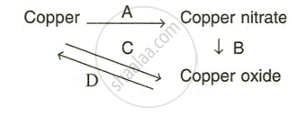
Write an equation for the following conversions A, B, C and D.
Correct the following, if required:
HNO3 is a strong reducing agent.
Correct the following, if required:
NaNO3 gives NO2 and O2 on heating.
Correct the following, if required:
Constant boiling nitric acid contains 80% nitric acid by weight.
Correct the following, if required:
Nitric acid remains colourless even when exposed to light.
Correct the statement:
Magnesium reacts with nitric acid to liberate hydrogen gas.
S.P. Singh solutions for कन्साइस केमिस्ट्री [इंग्रजी] इयत्ता १० आयसीएसई 10 Study of Compounds C. Nitric Acid EXERCISE-10 [Pages 179 - 182]
MULTIPLE CHOICE TYPЕ: (Choose the correct answer from the options given below).
The nitrate salt which does not give a mixture of NO2 and O2 on heating is ______.
AgNO3
KNO3
Cu(NO3)2
Zn(NO3)2
The chemical used in the brown ring test is ______.
CuSO4
FeSO4
Fe2(SO4)3
ZnSO4
Lead nitrate decomposes on heating to give ______.
NO
N2O
NO2
N2O5
In the laboratory preparation of nitric acid, nitre is heated with ______.
conc. HCl
conc. H2SO4
dil. H2SO4
conc. H3PO4
Nitric acid is manufactured by ______.
Bayer’s process
Haber’s process
Ostwald process
Contact process
The catalyst used in the manufacture of HNO3 is ______.
Pt
V2O5
Fe
Pd
Cold and dilute HNO3 reacts with Cu to give ______.
NO2
NO
N2
O2
The brown ring test is used for the detection of ______.
\[\ce{CO^2-_3}\]
Cl−
\[\ce{NO^-_3}\]
\[\ce{SO^2-_3}\]
Sulphur reacts with conc. HNO3 to give ______.
SO2
H2
H2SO4
H2S
The solvent for NO is ______.
Freshly prepared FeSO4
Fe2(SO4)3
FeCl3
FeCl2
The acid which can be used to etch designs on brassware is ______.
HCl
HNO3
H2SO4
H2CO3
HNO3 is kept in reagent bottles because it is ______.
an oxidising agent
a reducing agent
hygroscopic in nature
decomposed in the presence of light
The nitrate which does not leave any residue behind on heating is ______.
NaNO3
NH4NO3
AgNO3
Ca(NO3)2
On heating zinc nitrate, the products formed are zinc oxide, nitrogen dioxide and oxygen. Zinc oxide is:
P a black solid
Q brown when hot, yellow when cold
R yellow when hot, white when cold
Which of the following is true?
Only P
Only Q
Only R
Both Q and R
The following questions are Assertion-Reason based questions. Choose the answer based on the options given below.
Assertion (A): KNO3 and conc. H2SO4 are the reactants for the preparation of nitric acid.
Reason (R): Conc. H2SO4 being a non volatile acid is used in the preparation of volatile acids.
- Both A and R are true and R is the correct explanation of A.
- Both A and R are true but R is not the correct explanation of A.
- A is true but R is false.
- A is false but R is true.
(1)
(2)
(3)
(4)
Assertion (A): Nitric acid prepared in the laboratory is yellow in colour.
Reason (R): Brown gas is used in its preparation.
- Both A and R are true and R is the correct explanation of A.
- Both A and R are true but R is not the correct explanation of A.
- A is true but R is false.
- A is false but R is true.
(1)
(2)
(3)
(4)
Assertion (A): Catalytic oxidation of Ammonia does not require any external heat in Oswald process.
Reason (R): Catalytic oxidation of ammonia is an endothermic process.
- Both A and R are true and R is the correct explanation of A.
- Both A and R are true but R is not the correct explanation of A.
- A is true but R is false.
- A is false but R is true.
(1)
(2)
(3)
(4)
Assertion (A): The yellow colour of nitric acid is removed by using carbon dioxide gas or dry air.
Reason (R): Carbon dioxide gas or dry air drives away NO2 gas from the warm nitric acid.
- Both A and R are true and R is the correct explanation of A.
- Both A and R are true but R is not the correct explanation of A.
- A is true but R is false.
- A is false but R is true.
(1)
(2)
(3)
(4)
Assertion (A): Nitric acid reacts with NaOH/KOH to form salt and water.
Reason (R): Alkalies react with acids to form salt and water.
- Both A and R are true and R is the correct explanation of A.
- Both A and R are true but R is not the correct explanation of A.
- A is true but R is false.
- A is false but R is true.
(1)
(2)
(3)
(4)
Assertion (A): Cold and dilute nitric acid oxidise metals to their nitrates and nitric oxide.
Reason (R): Hot and concentrated nitric acid liberates nitrogen dioxide.
- Both A and R are true and R is the correct explanation of A.
- Both A and R are true but R is not the correct explanation of A.
- A is true but R is false.
- A is false but R is true.
(1)
(2)
(3)
(4)
VERY SHORT ANSWER TYPE:
Match the following:
| Column I | Column II | ||
| (a) | A substance which gives off only oxygen when heated. | (i) | Zinc nitrate |
| (b) | A substance which on heating decomposes into nitrous oxide and steam. | (ii) | Sodium nitrate |
| (c) | A substance which gives off oxygen and nitrogen dioxide when heated. | (iii) | Lead nitrate |
| (d) | A substance which on heating leaves yellow residue. | (iv) | Ammonium nitrate |
Choose the most appropriate option from the list given below to fill in the blanks.
[NO, Nessler’s reagent, NO2, Iron, brown ring, magnesium, Haber’s, Ostwald, Iron (II) sulphate, Hydrogen, Iron (III) sulphate]
A yellow non-metal, sulphur reacts with nitric acid to liberate ______.
Choose the most appropriate option from the list given below to fill in the blanks.
[NO, Nessler’s reagent, NO2, Iron, brown ring, magnesium, Haber’s, Ostwald, Iron (II) sulphate, Hydrogen, Iron (III) sulphate]
______ test is used to identify the nitrate radical.
Choose the most appropriate option from the list given below to fill in the blanks.
[NO, Nessler’s reagent, NO2, Iron, brown ring, magnesium, Haber’s, Ostwald, Iron (II) sulphate, Hydrogen, Iron (III) sulphate]
Dilute HNO3 reacts with copper evolving ______ gas.
Choose the most appropriate option from the list given below to fill in the blanks.
[NO, Nessler’s reagent, NO2, Iron, brown ring, magnesium, Haber’s, Ostwald, Iron (II) sulphate, Hydrogen, Iron (III) sulphate]
Nitric acid is obtained on a large scale by the process and the catalyst used is ______.
Choose the most appropriate option from the list given below to fill in the blanks.
[NO, Nessler’s reagent, NO2, Iron, brown ring, magnesium, Haber’s, Ostwald, Iron (II) sulphate, Hydrogen, Iron (III) sulphate]
In ______ test, freshly prepared ______ solution is used.
Choose the most appropriate option from the list given below to fill in the blanks.
[NO, Nessler’s reagent, NO2, Iron, brown ring, magnesium, Haber’s, Ostwald, Iron (II) sulphate, Hydrogen, Iron (III) sulphate]
Nitric acid in a very dilute form reacts with ______ to form ______.
Name a nitrate of metal which on heating does not give nitrogen dioxide.
Name a nitrate which on heating leaves no residue behind.
Name a metal nitrate which on heating is changed into metal oxide.
Name a metal nitrate which on heating is changed into metal.
Name a solution which absorbs nitric oxide.
Name the oxide of nitrogen which turns brown on exposure to air.
Name the gas produced when copper reacts with conc. HNO3.
Identify the gas evolved when sulphur is treated with concentrated nitric acid.
Identify the gas evolved when a few crystals of KNO3 are heated in a hard glass test tube.
Identify the acid.
Which is used for the preparation of non-volatile acid.
The acid which is prepared by catalytic oxidation of ammonia.
Complete the table:
| Name of Process | Inputs | Equation | Output |
| Ammonia + Air | Nitric acid |
What is the property of nitric acid which allows it to react with copper?
SHORT ANSWER TYPE:
Explain why only all-glass apparatus should be used for the preparation of nitric acid by heating concentrated sulphuric acid and potassium nitrate.
Explain why nitric acid is kept in a reagent bottle for a long time.
Iron is rendered passive with fuming HNO3. Give reason.
Explain the following:
Dil. HNO3 is generally considered a typical acid but not so in the reaction with metals.
Explain the following:
Concentrated nitric acid appears yellow when it is left standing in a glass bottle.
A dilute acid B does not normally give hydrogen when reacted with metals but does give a gas when it reacts with copper. Identify B. Write the equation with copper.
State one observation for the following:
Concentrated nitric acid is reacted with sulphur.
State one observation for the following:
Lead nitrate is heated strongly in a test tube.
State observation:
Zinc nitrate crystals are strongly heated.
State one relevant observation for the following:
When crystals of copper nitrate are heated in a test tube.
Give the balanced equation for dilute nitric acid and copper carbonate.
Give a balanced equation for the following:
Oxidation of carbon with conc. nitric acid.
Give a balanced chemical equation for Laboratory preparation of Nitric acid.
Write a balanced equation for the action of heat on a mixture of copper and concentrated nitric acid.
LONG ANSWER TYPE:
X, Y and Z are three crystalline solids that are soluble in water and have a common anion.
To help you to identify X, Y and Z, you are provided with the following experimental observations. Copy and complete the corresponding inferences in (a) to (e).
- A reddish-brown gas is obtained when X, Y and Z are separately warmed with concentrated sulphuric acid and copper turning added to the mixture.
INFERENCE 1: The common anion is the ______ ion. - When X is heated, it melts and gives off only one gas which re-lights a glowing splint.
INFERENCE 2: The cation in X is either ______ or ______. - The action of heat on Y produces a reddish-brown gas and yellow residue which fuses with a glass of the test tube.
INFERENCE 3: The metal ion present in Y is the ______ ion. - When Z is heated, it leaves no residue. Warming Z with sodium hydroxide solution liberates a gas which turns moist red litmus paper blue.
INFERENCE 4: Z contains the ______ cation. - Write the equations for the following reactions:
- X and concentrated sulphuric acid (below 200°C). (One equation only for either of the cations given in INFERENCE 2)
- The action of heat on Y.
- Concentrated nitric acid is added to copper turnings kept in a beaker.
The diagram given below is a representation of the Industrial preparation of Nitric acid by Ostwald’s process. With respect to the process answer the following questions:

- Write the temperature and the catalyst required during the catalytic oxidation of ammonia.
- Give balanced chemical equation for the reaction occurring duringthe conversion of nitrogen dioxide to nitric acid.
Mention three important uses of nitric acid. Give the property of nitric acid involved in the use.
Explain with the help of a balanced equation the brown ring test for nitric acid.
Why is freshly prepared ferrous sulphate solution used for testing the nitrate radical in the brown ring test?
The action of heat on the blue crystalline solid X gives a reddish brown gas Y, a gas which re-lights a glowing splint and leaves a black residue. When gas Z, which has a rotten egg smell, is passed through a solution of X, a black ppt. is formed.
- Identify X, Y and Z.
- Write the equation for the action of heat on X.
- Write the equation between solution X and gas Z.
Dilute nitric acid is generally considered a typical acid except for its reaction with metals. In what way is dilute nitric acid different from other acids when it reacts with metals?
Write the equation for the reaction of dilute nitric acid with copper.
Write the equation for the reaction of conc. nitric acid with copper.
The figure given below illustrates the apparatus used in the laboratory preparation of nitric acid.

- Name A (a liquid), B (a solid), and C (a liquid). (Do not give the formulae.)
- Write an equation to show how nitric acid undergoes decomposition.
- Write the equation for the reaction in which copper is oxidised by concentrated nitric acid.
With respect to the brown ring test for nitrates, explain:
- Freshly prepared ferrous sulphate is used.
- Brown ring disappears if the test tube is disturbed.
- Lead nitrate does not respond properly to the brown ring test.
Hint: Salt solutions forming insoluble sulphates interfere with the result of the Brown ring test. - What is the name and formula of the brown ring formed?
Solutions for 10: Study of Compounds C. Nitric Acid
S.P. Singh solutions for कन्साइस केमिस्ट्री [इंग्रजी] इयत्ता १० आयसीएसई chapter 10 - Study of Compounds C. Nitric Acid
Shaalaa.com has the CISCE Mathematics कन्साइस केमिस्ट्री [इंग्रजी] इयत्ता १० आयसीएसई CISCE solutions in a manner that help students grasp basic concepts better and faster. The detailed, step-by-step solutions will help you understand the concepts better and clarify any confusion. S.P. Singh solutions for Mathematics कन्साइस केमिस्ट्री [इंग्रजी] इयत्ता १० आयसीएसई CISCE 10 (Study of Compounds C. Nitric Acid) include all questions with answers and detailed explanations. This will clear students' doubts about questions and improve their application skills while preparing for board exams.
Further, we at Shaalaa.com provide such solutions so students can prepare for written exams. S.P. Singh textbook solutions can be a core help for self-study and provide excellent self-help guidance for students.
Concepts covered in कन्साइस केमिस्ट्री [इंग्रजी] इयत्ता १० आयसीएसई chapter 10 Study of Compounds C. Nitric Acid are Concept of Nitric Acid, Laboratory Preparation of Nitric Acid, Manufacture of Nitric Acid, Physical Properties of Nitric Acid, Chemical Properties of Nitric Acid, Uses of Nitric Acid, Tests for Nitric Acid and Nitrates, Effects of Heat on Nitrates, Concept of Nitric Acid, Laboratory Preparation of Nitric Acid, Manufacture of Nitric Acid, Physical Properties of Nitric Acid, Chemical Properties of Nitric Acid, Uses of Nitric Acid, Tests for Nitric Acid and Nitrates, Effects of Heat on Nitrates, Concept of Nitric Acid, Laboratory Preparation of Nitric Acid, Manufacture of Nitric Acid, Physical Properties of Nitric Acid, Chemical Properties of Nitric Acid, Uses of Nitric Acid, Tests for Nitric Acid and Nitrates, Effects of Heat on Nitrates.
Using S.P. Singh कन्साइस केमिस्ट्री [इंग्रजी] इयत्ता १० आयसीएसई solutions Study of Compounds C. Nitric Acid exercise by students is an easy way to prepare for the exams, as they involve solutions arranged chapter-wise and also page-wise. The questions involved in S.P. Singh Solutions are essential questions that can be asked in the final exam. Maximum CISCE कन्साइस केमिस्ट्री [इंग्रजी] इयत्ता १० आयसीएसई students prefer S.P. Singh Textbook Solutions to score more in exams.
Get the free view of Chapter 10, Study of Compounds C. Nitric Acid कन्साइस केमिस्ट्री [इंग्रजी] इयत्ता १० आयसीएसई additional questions for Mathematics कन्साइस केमिस्ट्री [इंग्रजी] इयत्ता १० आयसीएसई CISCE, and you can use Shaalaa.com to keep it handy for your exam preparation.
