Advertisements
Advertisements
प्रश्न
Lead nitrate decomposes on heating to give ______.
पर्याय
NO
N2O
NO2
N2O5
Advertisements
उत्तर
Lead nitrate decomposes on heating to give NO2.
Explanation:
On heating, lead nitrate (Pb(NO3)2) decomposes to form lead oxide (PbO), nitrogen dioxide (NO2), and oxygen (O2).
\[\ce{2Pb(NO3)2 −> 2PbO + 4NO2 + O2}\]
APPEARS IN
संबंधित प्रश्न
Write a balanced equation for the action of heat on a mixture of copper and concentrated nitric acid.
Give the chemical name and formula of the substance formed as a brown ring in the test for nitrate radical.
Give reason for the following:
Aluminum does not react with nitric acid of any concentration.
What do you observe when?
Concentrated nitric acid is dropped on a hot surface?
What happen when (Given balanced equation):
Nitric acid is added to washing soda and the resulting gas is passed through a freshly prepared lime water?
Choose the correct answer from the option given below :
When treated with nitric acid which of the following liberate hydrogen?
The first step in the manufacture of nitric acid is the catalytic oxidation of ammonia. What is the name of the catalyst?
The figure given below illustrates the apparatus used in the laboratory preparation of nitric acid: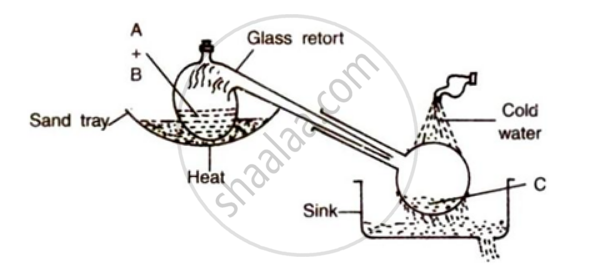
(i) Name A (a liquid), B( a Solid) and C(a liquid).
(ii) write the balanced chemical equation to show how nitric acid undergoes decomposition.
(iii) Write the balanced chemical equation for the reaction in which copper is oxidized by concentrated nitric acid.
State, what is observe when nitric acid is kept in a reagent bottle for a long time.
From the following list of substances, choose one substance in the case which matches the description given below:
Ammonium nitrate, calcium hydrogen carbonate, copper carbonate, lead nitrate, potassium nitrate, sodium carbonate, sodium hydrogen carbonate, zinc carbonate.
A Substance that gives off only oxygen when heated.
