Advertisements
Advertisements
प्रश्न
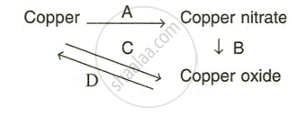
Write an equation for the following conversions A, B, C and D.
Advertisements
उत्तर
A: Copper can be converted into copper nitrate.
\[\ce{Cu + 4HNO3 -> \underset{Copper nitrate}{Cu(NO3)2} + 2H2O + 2NO2}\]
B: \[\ce{\underset{Blue crystalline}{2Cu(NO3)2} ->[\Delta] \underset{Black}{2CuO} + 4NO2 + O2}\]
C: \[\ce{\underset{Strong heating}{2Cu + O2} ->[\Delta] \underset{Black}{2CuO}}\]
D: By reduction,
\[\ce{CuO + H2 ->[\Delta] Cu + H2O}\]
APPEARS IN
संबंधित प्रश्न
How will you prepare the following from nitric acid?
Sodium nitrate
How will you prepare the following from nitric acid?
copper nitrate
How will you prepare the following from nitric acid?
Aqua regia
How is nitric acid prepared in a laboratory?
Write the equations involved in Ostwald process.
Give reason for the following:
Concentrated nitric acid is a stronger oxidizing agent.
Fill in the blank with appropriate word/words.
Aqua regia is a mixture of _______ and________
Give the name of a soluble lead salt and write the equation for the action of heat on this salt.
Account for the yellow colour that appears in concentrated nitric acid when it is left standing in an ordinary glass bottle.
Copy and complete the following table relating to important industrial processes output refers to the product of the process not the intermediate steps.
| Name of process | Inputs | Catalyst | Equation for catalysed reaction | Output |
| Haber process | Hydrogen + | |||
|
Ammonia + |
Nitric acid |
