Advertisements
Advertisements
Question
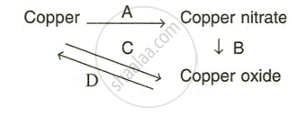
Write an equation for the following conversions A, B, C and D.
Advertisements
Solution
A: Copper can be converted into copper nitrate.
\[\ce{Cu + 4HNO3 -> \underset{Copper nitrate}{Cu(NO3)2} + 2H2O + 2NO2}\]
B: \[\ce{\underset{Blue crystalline}{2Cu(NO3)2} ->[\Delta] \underset{Black}{2CuO} + 4NO2 + O2}\]
C: \[\ce{\underset{Strong heating}{2Cu + O2} ->[\Delta] \underset{Black}{2CuO}}\]
D: By reduction,
\[\ce{CuO + H2 ->[\Delta] Cu + H2O}\]
APPEARS IN
RELATED QUESTIONS
Write balanced chemical equations for Action of hot and concentrated Nitric acid on copper
Name the Following:
Product obtained by heating concentrated nitric acid.
What is the purpose of Conc. H2SO4 in the above preparation?
Give reason for the following:
In laboratory preparation of nitric acid all the apparatus including cork should be made up of glass.
Give reason for the following:
Commercial nitric acid is yellow in colour, but when it is diluted with water, it turns colourless.
Fill in the blank with appropriate word/words.
Aqua regia is a mixture of _______ and________
Complete and balance the following equation:
Cu + HNO3 → NO2 + ________+ _________
Copy and complete the following table relating to important industrial processes output refers to the product of the process not the intermediate steps.
| Name of process | Inputs | Catalyst | Equation for catalysed reaction | Output |
| Haber process | Hydrogen + | |||
|
Ammonia + |
Nitric acid |
Write a balanced equation for following :
Laboratory preparation nitric acid.
Lead nitrate decomposes on heating to give ______.
