Advertisements
Advertisements
प्रश्न
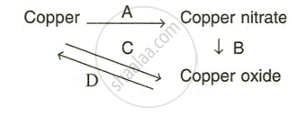
Write an equation for the following conversions A, B, C and D.
Advertisements
उत्तर
A: Copper can be converted into copper nitrate.
\[\ce{Cu + 4HNO3 -> \underset{Copper nitrate}{Cu(NO3)2} + 2H2O + 2NO2}\]
B: \[\ce{\underset{Blue crystalline}{2Cu(NO3)2} ->[\Delta] \underset{Black}{2CuO} + 4NO2 + O2}\]
C: \[\ce{\underset{Strong heating}{2Cu + O2} ->[\Delta] \underset{Black}{2CuO}}\]
D: By reduction,
\[\ce{CuO + H2 ->[\Delta] Cu + H2O}\]
APPEARS IN
संबंधित प्रश्न
Ammonia is used in the Ostwald process.
Give the sources of reactants used in this process.
Name the Following:
Gas obtained by treating manganese with 1% nirtric acid.
Give reason for the following:
Lighting is a blessing in disguise.
Write balanced equation and name the product formed when :
Concentrated nitric acid is heated.
Choose the correct answer from the option given below :
When treated with nitric acid which of the following liberate hydrogen?
Complete and balance the following equation:
Cu + HNO3 → NO2 + ________+ _________
Name (formula is not acceptable) the gas produced in the following reaction:
By the action of concentrated nitric acid on copper.
Identify the gas evolved when sulphur is treated with concentrated nitric acid.
The figure given below illustrates the apparatus used in the laboratory preparation of nitric acid.

- Name A (a liquid), B (a solid), and C (a liquid). (Do not give the formulae.)
- Write an equation to show how nitric acid undergoes decomposition.
- Write the equation for the reaction in which copper is oxidised by concentrated nitric acid.
What is the property of nitric acid which allows it to react with copper?
