Advertisements
Advertisements
प्रश्न
Describe what you see when concentrated nitric acid is added to copper.
Advertisements
उत्तर
When concentrated nitric acid is added to copper brown fumes of nitrogen dioxide are observed.
APPEARS IN
संबंधित प्रश्न
Name the Following:
Product obtained by heating concentrated nitric acid.
In which ratio reactants are taken in Ostwald process?
Explain with the help of a balanced equation, the brown ring test for nitric acid.
Give reason for the following:
Aluminum does not react with nitric acid of any concentration.
Fill in the blank with appropriate word/words.
Aqua regia is a mixture of _______ and________
State the conditions for the oxidation of ammonia to nitrogen monoxide [nitric oxide], in the manufacture of nitric acid by Ostwald's process. Write the balanced equcation for the reaction.
The figure given below illustrates the apparatus used in the laboratory preparation of nitric acid: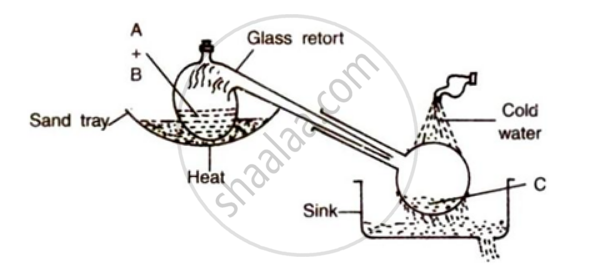
(i) Name A (a liquid), B( a Solid) and C(a liquid).
(ii) write the balanced chemical equation to show how nitric acid undergoes decomposition.
(iii) Write the balanced chemical equation for the reaction in which copper is oxidized by concentrated nitric acid.
Balanced equation of oxidation of carbon with concentrated HNO3
X, Y and Z are three crystalline solids that are soluble in water and have a common anion.
To help you to identify X, Y and Z, you are provided with the following experimental observations. Copy and complete the corresponding inferences in (a) to (e).
- A reddish-brown gas is obtained when X, Y and Z are separately warmed with concentrated sulphuric acid and copper turning added to the mixture.
INFERENCE 1: The common anion is the ______ ion. - When X is heated, it melts and gives off only one gas which re-lights a glowing splint.
INFERENCE 2: The cation in X is either ______ or ______. - The action of heat on Y produces a reddish-brown gas and yellow residue which fuses with a glass of the test tube.
INFERENCE 3: The metal ion present in Y is the ______ ion. - When Z is heated, it leaves no residue. Warming Z with sodium hydroxide solution liberates a gas which turns moist red litmus paper blue.
INFERENCE 4: Z contains the ______ cation. - Write the equations for the following reactions:
- X and concentrated sulphuric acid (below 200°C). (One equation only for either of the cations given in INFERENCE 2)
- The action of heat on Y.
- Concentrated nitric acid is added to copper turnings kept in a beaker.
Explain why only all-glass apparatus should be used for the preparation of nitric acid by heating concentrated sulphuric acid and potassium nitrate.
