Advertisements
Advertisements
प्रश्न
What do you see when concentrated nitric acid is added to copper?
Advertisements
उत्तर
When concentrated nitric acid is added to copper brown fumes of nitrogen dioxide are observed.
APPEARS IN
संबंधित प्रश्न
Name the Following:
Salt used in the laboratory to prepare nitric acid
Complete and balance the following equation :
FeSO4 + NO + H2O → ______________
Give reason for the following:
In the laboratory preparation of nitric acid, the mixture of concentrated sulphuric acid and sodium nitatre should not be heated very strongly, above 200°C
Name (formula is not acceptable) the gas produced in the following reaction:
By the action of concentrated nitric acid on copper.
When nitric acid is prepared by the action of concentrated sulphuric acid on potassium nitrate. what is the special feature of the apparatus used?
The figure given below illustrates the apparatus used in the laboratory preparation of nitric acid: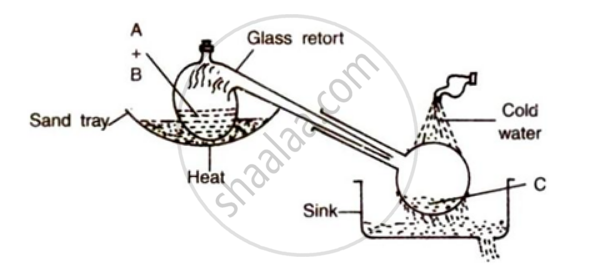
(i) Name A (a liquid), B( a Solid) and C(a liquid).
(ii) write the balanced chemical equation to show how nitric acid undergoes decomposition.
(iii) Write the balanced chemical equation for the reaction in which copper is oxidized by concentrated nitric acid.
What is the special feature of the apparatus that is used in the laboratory preparation of nitric acid?
Explain the following :
An all glass apparatus is used in the laboratory preparation of nitric acid.
A dilute acid B does not normally give hydrogen when reacted with metals but does give a gas when it reacts with copper. Identify B. Write the equation with copper.
What is the property of nitric acid which allows it to react with copper?
