Definitions [16]
Refracted light is the part of light enters into the other medium and travels in a straight path but in a direction different from its initial direction and is called the refracted light.
Define the following terms used in the study of reflection of light by drawing a labelled ray-diagram:
- Incident ray
- Point of incidence
- Normal
- Reflected ray
- Angle of incidence
- Angle of reflection
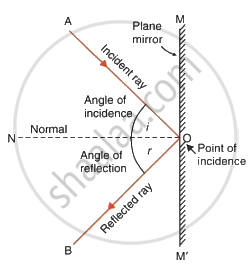
- Incident ray: The ray of light which falls on the mirror surface is called the incident ray.
- Point of incidence: The point at which the incident ray falls on the mirror is called the point of incidence.
- Normal: The normal is a line at right angles to the mirror surface at the point of incidence.
- Reflected ray: The ray of light which is sent back by the mirror is called the reflected ray.
- Angle of incidence: The angle of incidence is the angle made by the incident ray with the normal at the point of incidence.
- Angle of reflection: The angle of reflection is the angle made by the reflected ray with the normal at the point of incidence.
Define the principal focus of a concave mirror.
Light rays that are parallel to the principal axis of a concave mirror converge at a specific point on its principal axis after reflecting from the mirror. This point is known as the principal focus of the concave mirror.
The change in the direction of the path of light when it passes from one transparent medium to another transparent medium is called refraction. The refraction of light is essentially a surface phenomenon.
or
When light passes from one transparent medium to another, its speed and direction change. This is called refraction.
When travelling obliquely from one medium to another, the direction of propagation of light in the second medium changes. This phenomenon is known as refraction of light.
OR
Light changes its direction when going from one transparent medium to another transparent medium. This is called the refraction of light.
OR
The bending of the light ray from its path in passing from one medium to the other medium is called 'refraction' of light.
OR
When a ray of light impinges on a polished, smooth, shiny surface, the rebounding of light within the same medium is called reflection of light.
A normal is an imaginary line drawn perpendicular to the boundary at the point of incidence.
The ray that enters the second medium after crossing the boundary is called the refracted ray.
The refractive index of second medium with respect to the first medium is defined as the ratio of the sine of the angle of incidence in the first medium to the sine of the angle of refraction in the second medium.
The light rays coming from a distant object appear to be coming from the image of the object inside the ground. This is called a mirage.
The phenomenon of splitting of white light by a prism into its constituent colours is known as dispersion.
OR
The splitting of light into its component colours is called dispersion.
OR
The process of separation of light into its component colours while passing through a medium is called the dispersion of light.
OR
The phenomenon in which white light splits into its constituent colours when it passes through a prism or another medium is called dispersion of light.
The angular separation between the two extreme rays of a dispersed beam of light is called angular dispersion.
On passing white light through a prism, the band of colours seen on a screen is called the spectrum.
or
The band of the coloured components of a light beam is called its spectrum.
Define the term dispersion of light.
The phenomenon of the splitting of white light by a prism into its constituent colours is known as dispersion of light.
When a beam of white light or composite light is refracted through any transparent media such as glass or water, it is split into its component colours. This phenomenon is called ‘dispersion of light’.
When light enters a rarer medium from a denser medium, it gets partially reflected i.e. part of the light gets reflected and comes back into the denser medium as per laws of reflection. This is called partial reflection.
For a particular value of i, the value of r becomes equal to 90°. This value of i is called the critical angle.
For angles of incidence larger than the critical angle, the angle of refraction is larger than 90°. Such rays return to the denser medium. Thus, all the light gets reflected back into the dense medium. This is called total internal reflection.
Formulae [1]
The refractive index of medium 2 w.r.to medium 1:
\[n_{21} = \frac{\text{Speed of light in medium 1}}{\text{Speed of light in medium 2}} = \frac{v_1}{v_2}\]
The refractive index of medium 1 w.r.to medium 2:
\[n_{12}=\frac{\text{Speed of light in medium 2}}{\text{Speed of light in medium 1}}=\frac{v_{2}}{v_{1}}\]
The refractive index of the medium nm is given by:
\[n_{m} = \frac{\text{Speed of light in air}}{\text{Speed of light in the medium}} = \frac{c}{v}\]
OR
\[\frac {\text{sin i}}{\text{sin r}}\] = constant = n
n is called the refractive index of the second medium with respect to the first medium.
Theorems and Laws [3]
The laws of refraction are fundamental for board examinations and objective tests.
First law
The incident ray, the refracted ray, and the normal at the point of incidence all lie in the same plane.
Second law
For a given pair of media, the ratio of the sine of the angle of incidence to the sine of the angle of refraction remains constant.
\[\frac {\text {sin i}}{\text {sin r}}\] = constant
This constant is called the refractive index of the second medium with respect to the first medium.
-
First Law: Incident ray, refracted ray, and normal to the interface at the point of incidence all lie in the same plane.
-
Second Law (Snell's Law): \[\frac{\sin i}{\sin r}=\mathrm{constant}=\frac{\mu_2}{\mu_1}\]
Extended Snell's Law: \[\frac{\sin i}{\sin r}=\frac{\mu_2}{\mu_1}=_1\mu_2=\frac{v_1}{v_2}=\frac{\lambda_1}{\lambda_2}\]
- The incident ray, the refracted ray and the normal at the point of incidence, all lie in the same plane.
- The ratio of the sine of the angle of incidence i to the sine of the angle of refraction r is constant for the pair of given media. i.e., mathematically
\[\frac {\text{sin i}}{\text{sin r}}\] = constant = n
Where:
- i = angle of incidence
- r = angle of refraction
- n = refractive index of the second medium with respect to the first
This ratio is constant for a given pair of media and is known as the refractive index.
Note: If a light ray is incident along the normal (i = 0∘), it passes undeviated into the second medium (r = 0∘).
Key Points
- Mirage: Looks like water on a hot road; caused by light bending in hot, less dense air.
- Shaking Objects Near Fire: Hot air near the fire bends light unevenly, making objects look like they are moving.
- Star Twinkling: Stars twinkle because their light bends through moving air layers in the atmosphere.
- Planets Don’t Twinkle: Planets are closer and appear bigger, so changes in light cancel out.
- Early Sunrise & Late Sunset: We see the Sun even before it rises and after it sets because of light bending in the atmosphere.
- Dispersion is the splitting of white light into seven colours (VIBGYOR) when it passes through a prism or similar transparent medium.
- Human eyes can detect light with wavelengths ranging from 400 nm (violet) to 700 nm (red).
- Different colours travel at different speeds in a medium like glass, so each colour has a different refractive index.
- Violet light bends the most, and red light bends the least, as it passes through a prism, producing a spectrum.
- A rainbow is formed due to dispersion, refraction, and internal reflection of sunlight by raindrops acting as tiny prisms.
- Light going from a denser to a rarer medium partly reflects and partly bends away from the normal.
- If we keep increasing the angle of incidence, the refracted ray becomes 90° at a certain point — this is the critical angle.
- Beyond the critical angle, all light reflects back into the denser medium — this is total internal reflection.
- A rainbow forms due to refraction, dispersion, and total internal reflection of sunlight in raindrops.
- Snell’s law explains how the angle of refraction depends on the angle of incidence and the refractive index.
Important Questions [12]
- Explain how the formation of a rainbow occurs.
- The Phenomenon of Change in the Direction of Light When It Passes from One Transparent Medium to Another is Called ___________
- We can see the sun even when it is little below the horizon because of ______.
- Match the Columns
- What is refraction of light?
- ______ colour is deviated the least in the spectrum of white light obtained with a glass prism.
- State True or False: "Wavelength of red light is close to 700 nm.”
- Observe the given diagram and answer the questions: (a) Name the process shown in the figure. (b) Name the colour that deviates the most. (c) Name the colour that deviates the least. (d) Name any one
- Fill in the Blank and Rewrite the Completed Statement: the Phenomenon of Splitting of Light into Its Component Colours is ___________ .
- Draw a Labelled Diagram: Dispersion of Light Through a Prism.
- Answer the Following: What Do You Mean by Dispersion? Name the Different Colours of Light in the Proper Sequence in the Spectrum of Light.
- Match the Columns: Column ‘A’ Column ‘B’ The wavelength of red light (a) 600 nm (b) 700 nm (c) 500 nm
