Definitions [54]
Electric charge is an intrinsic property of certain fundamental particles (like electrons and protons) that gives rise to electric and magnetic forces, causing them to experience a force when placed in an electromagnetic field.
OR
Electric charge is the physical property of matter that causes it to experience a force when placed in an electric field.
Key facts:
- SI Unit: Coulomb (C)
- Dimensional Formula: [A T] (Ampere × Time)
- Two types exist: positive and negative
A charged body whose size is negligibly small compared to the distance between the charges under consideration, is called a point charge.
OR
A charged body is treated as a point charge when its physical size is negligible compared to the distance between it and other charges under consideration.
The smallest unit of electric charge, denoted by e, is called the elementary charge.
OR
The smallest unit of free electric charge, denoted e, with value e ≈ 1.602 × 10⁻¹⁹ C.
A positively charged particle found inside the nucleus, composed of quarks, is called a proton.
The process by which a free neutron (outside the nucleus) transforms, occurring with a defined half-life, is called beta decay.
The force that binds protons and neutrons together in the nucleus, overcoming the electrostatic repulsion between protons, is called the strong nuclear force.
A negatively charged ion, formed when an atom gains one or more electrons, is called an anion.
A positively charged ion, formed when an atom loses one or more electrons, is called a cation.
A charged atom, formed when a neutral atom gains or loses electrons, is called an ion.
Atoms of the same element that have the same atomic number but different numbers of neutrons (and hence different mass numbers) are called isotopes.
The total number of protons and neutrons present in the nucleus of an atom is called the mass number (A).
The number of protons present in the nucleus of an atom, which uniquely identifies a chemical element, is called the atomic number (Z).
A negatively charged fundamental particle that orbits the nucleus in shells/orbitals and determines the atom's chemical behaviour is called an electron.
An electrically neutral particle found inside the nucleus, comparable in mass to the proton, is called a neutron.
The dense central core of an atom, containing protons and neutrons and holding nearly all of the atomic mass, is called the nucleus.
Conductors are those through which electric charge can easily flow. Metals, human body, earth, mercury and electrolytes are conductors of electricity.
OR
The material through which electric charge can flow easily is called a conductor.
Those substances in which electric charge cannot flow are called ‘insulators' (or dielectrics). Glass, hard-rubber, plastics and dry wood are insulators. Insulators have practically no free electrons.
OR
The material in which electrons are tightly bound to the nucleus and thus not available for conductance is called an insulator.
OR
Substances which offer high resistance to the passage of electricity and do not allow electricity to pass through them easily, are called insulators.
Substances whose resistance to the movement of charges is intermediate between conductors and insulators, are called semiconductors.
Process of creating an imbalance between protons and electrons in a body, giving it a net electric charge.
A ranked list of materials based on their tendency to gain or lose electrons on contact.
Charging by direct physical contact between a charged and an uncharged conductor.
Charging that occurs when two different materials are rubbed together, causing electron transfer.
Charging without direct contact, caused by the redistribution of charge due to a nearby charged body.
Charging by friction is the process by which two different insulating (dielectric) materials become electrically charged — equal in magnitude but opposite in sign — when rubbed against each other, due to the transfer of electrons from one surface to the other.
The process of transferring electric charge from a charged object to a neutral (or oppositely charged) conductor through direct physical contact, until electrostatic equilibrium is reached.
Key idea: Electrons flow from the region of higher electron concentration to lower, until both bodies reach the same electric potential.
The process of charging a neutral conductor without any direct contact with a charged object, by redistributing charges within the conductor through electrostatic influence.
Define a unit charge.
One coulomb is the amount of charge which, when placed at a distance of one metre from another charge of the same magnitude in vacuum, experiences a force of 9.0 × 10⁹ N.
The total electrostatic force on any charge in a system of multiple charges is the vector sum of the forces exerted on it individually by each of the other charges, with each pairwise force being unaffected by the presence of the remaining charges.
A charge is said to be in equilibrium when the net electrostatic force acting on it due to all other charges in the system is zero.
A group of two or more point charges arranged in space such that they exert forces on one another.
A force that acts to bring a displaced charge back toward its original equilibrium position.
Define electric field.
The region in which the charge experiences an electric force is the electric field around the charge.
The electric field intensity at any point is the strength of the electric field at that point.
- It is defined as the force experienced by a unit positive charge placed at that point.
\[\vec{E}=\frac{\vec{F}}{q_0}=\frac{kq}{r^2}\hat{r}=\frac{kq}{r^3}\vec{r}\]
- The SI unit of E is NC−1 (newtons per coulomb).
The space surrounding an electric charge q in which another charge q0 experiences a (electrostatic) force of attraction or repulsion, is called the electric field of the charge q.
OR
Electric field due to a charge Q at a point in space may be defined as the force that a unit positive charge would experience if placed at that point.
OR
The region surrounding an electric charge or a group of charges in which another charge experiences a force is called an electric field.
The charge q that tests the effect of the source charge is called the test charge.
The charge Q that produces the electric field is called the source charge.
Electric line of force is an imaginary curve drawn in an electric field such that the tangent at any point on it gives the direction of the electric field at that point.
- It represents the path along which a unit positive test charge would tend to move if free to do so.
- Lines are imaginary — they have no physical existence; they are a visualization tool only.
“The line joining the two charges, pointing from the negative charge to the positive charge. This is known as the ‘direction of dipole axis’.”
OR
The line passing through both charges +q and −q is called the dipole axis (also called the axial line or axis of the dipole).
Electric dipole moment \[\vec p\] is a vector quantity defined as the product of the magnitude of either charge and the separation between them.
Mathematical definition: \[\vec p\] = q × 2a
| Symbol | \[\vec p\] |
| Magnitude | p = q × 2a |
| Direction | From −q to +q (along the dipole axis) |
| SI Unit | Coulomb-metre (C·m) |
| Dimensional Formula | [M0L1T1A1] |
An electric dipole is a pair of equal and opposite point charges placed at a short distance apart.
OR
A system formed by two equal and opposite point charges placed at a small distance apart is called an electric dipole.
OR
A system of two equal and opposite point charges +q and −q separated by a small fixed distance 2a is called an electric dipole.
- The total charge of an electric dipole is zero
- Zero net charge does not mean zero electric field - the field exists because the charges are spatially separated
- The midpoint of the line joining −q and +q is called the centre of the dipole
The midpoint of the line joining the two charges is called the centre of the dipole.
The line passing through the centre of the dipole and perpendicular to the dipole axis is called the equatorial line.
OR
The plane passing through the centre of the dipole and perpendicular to the dipole axis is called the equatorial plane; the line along which the equatorial field is evaluated is the equatorial line (perpendicular bisector).
Define electric dipole moment.
The electric dipole moment is defined as the product of the magnitude of one of the charges and the distance between the two equal and opposite charges.
A system consisting of two equal and opposite point charges (+q and −q) separated by a small distance (2a) is called an electric dipole.
The straight line passing through both charges, +q and −q, of a dipole is called the dipole axis.
The vector quantity equal to the product of the magnitude of either charge and the distance between the two charges, directed from −q to +q, is called the dipole moment.
Equilibrium of a charged body in a uniform electric field occurs when the electric force on the charge exactly balances the gravitational force (weight) acting on it, resulting in zero net force.
Area Vector is a vector quantity used to represent a planar (or elemental) surface area, having a magnitude equal to the area and a direction along the normal to the surface.
Magnetic flux (ΦB) is the total number of magnetic field lines passing normally through a given area.
Flux of a vector field through a surface is defined as the total number of field lines passing normally through that surface. Mathematically, it is the scalar (dot) product of the field vector and the area vector.
Electric flux (ΦE) through a surface is the measure of the electric field lines passing through that surface.
An imaginary, arbitrary closed three-dimensional surface chosen to calculate the electric flux due to a charge distribution using Gauss's law.
Valid Gaussian surfaces: sphere, cylinder, cube (all closed surfaces).
Invalid Gaussian surfaces: disc, square, open hemisphere (not closed).
Electric field intensity just outside a charged conductor is the strength of the electric field at a point infinitesimally close to (but outside) the surface of a charged conductor, arising due to the surface charge density on the conductor.
A uniformly charged sphere is a sphere in which charge q is distributed evenly throughout its volume (non conducting/insulating) or over its surface (conducting), with uniform volume charge density ρ = \[\frac{q}{\frac{4}{3}\pi R^3}.\]
Formulae [9]
Relationship between mass number, atomic number, and neutron number:
A = Z + N
where
- A = mass number,
- Z = atomic number (number of protons),
- N = number of neutrons.
\[\rho=\frac{\text{mass of nucleus}}{\text{volume of nucleus}}\]
\[\vec{E}=\frac{1}{4\pi\varepsilon_0}\frac{Q}{r^2}\hat{r}\]
The dimensional formula of the electric field E is:
E = \[\frac {F}{q_0}\] = \[\frac{[LMT^{-2}]}{[IT]}=[MLT^{-3}I^{-1}]\]
For a point charge q at distance r:
E = \[\frac{1}{4\pi\varepsilon_0}\cdot\frac{q}{r^2}\]
where \[\dfrac{1}{4\pi\varepsilon_0} = 9 \times 10^9 \, \text{N·m}^2/\text{C}^2\]
\[\vec A\] = A\[\hat n\]
- \[\vec A\] = area vector
- A = magnitude of the surface area (scalar)
- \[\hat n\] = unit vector normal (perpendicular) to the surface
For a uniform field \[\vec F\] passing through a flat surface of area A, inclined at angle θ to the field:
For electric flux specifically:
For a non-uniform field or curved surface, flux is expressed as a surface integral:
\[\Phi_E=\int_A\vec{E}\cdot d\vec{A}\]
For a closed surface (used in Gauss's Law):
\[\Phi_E=\oint\vec{E}\cdot d\vec{A}=\frac{q_{enc}}{\varepsilon_0}\]
E = \[\dfrac{\sigma}{\varepsilon_0} \]
- Directed outward (away from surface) if the conductor is positively charged
- Directed inward (toward the surface) if the conductor is negatively charged
- σ = surface charge density (C/m²); ε0 = permittivity of free space
Theorems and Laws [5]
Coulomb's Law: The electrostatic force of interaction between two stationary point charges is directly proportional to the product of the magnitudes of the charges and inversely proportional to the square of the distance between them. The force acts along the straight line joining the two charges.
Derivation (Step-by-Step)
Step 1: Force is directly proportional to the product of charge magnitudes:
Step 2: Force is inversely proportional to the square of the separation distance:
Step 3: Combining Steps 1 and 2:
Step 4: Introducing the proportionality constant k:
F = k ⋅ \[\frac {q_1q_2}{r^2}\]
where k = 1/(4πε0) ≈ 9 × 10⁹ N·m2/C2 (in vacuum/air)
Statement
The electrostatic force acting between two stationary point charges is given by a vector quantity whose magnitude obeys Coulomb’s law and whose direction is along the line joining the two charges. The force on each charge is equal in magnitude and opposite in direction.
Explanation / Mathematical Form
Let two point charges q1 and q2 be located at position vectors \[\vec {r_1}\] and \[\vec {r_2}\] respectively.
The force on charge q1 due to charge q2 is:
\[\vec F_{12}\] = \[\frac{1}{4\pi\varepsilon_0}\frac{q_1q_2}{r_{12}^2}\hat{r}_{12}\]
Similarly, the force on q2 due to q1 is:
\[\vec F_{21}\] = \[\frac{1}{4\pi\varepsilon_0}\frac{q_1q_2}{r_{12}^2}\hat{r}_{21}\]
where
\[\hat r _{12}\] and \[\hat r_{21}\] are unit vectors along the line joining the charges and
Hence,
\[\vec F_{21}\] = −\[\vec F_{12}\]
This relation is valid for both like and unlike charges, representing repulsion or attraction respectively.
Conclusion
The vector form of Coulomb’s law shows that:
- Electrostatic force is a central force acting along the line joining the charges.
- Forces between two charges are equal and opposite, satisfying Newton’s third law.
- The direction of force is clearly specified, unlike the scalar form.
Statement
The principle of superposition states that the net electric force acting on a given charge due to a number of other charges is equal to the vector sum of the individual forces exerted on it by each charge taken separately, assuming the other charges are absent.
Explanation / Mathematical Form
Consider a system of nnn point charges q1,q2,q3,…,qn.
The force acting on charge q1 due to the other charges is:
where
\[\vec F_{12}\] is the force on q1 due to q2,
\[\vec F_{13}\] is the force due to q3, and so on.
According to Coulomb’s law, the force on q1 due to q2 is:
\[\vec F_{12}\] = \[\frac{1}{4\pi\varepsilon_0}\frac{q_1q_2}{r_{12}^2}\hat{r}_{12}\]
Similarly, forces due to other charges can be written, and their vector sum gives the resultant force on q1.
Thus, the force between any two charges is independent of the presence of other charges.
Conclusion
The principle of superposition shows that:
- Electric forces obey vector addition.
- Each pair of charges interacts independently.
- The net force on a charge in a multi-charge system is found by adding all individual Coulomb forces vectorially.
Statement:
The total electric flux through any closed surface is equal to \[\frac{1}{\varepsilon_0}\] times the net electric charge enclosed by that surface.
This holds true regardless of the shape or size of the closed surface, and irrespective of the position of the charge within it.
Mathematical Formulation
In free space (vacuum/air):
- \[\vec{E}\] = electric field vector
- \[d\vec{A}\] = outward area vector element of the surface
- q = net charge enclosed by the surface
- ε0 = 8.85 × 10⁻¹² C2/(N m2)
State Gauss’ Law.
The electric flux (ΦE) through any closed surface is equal to `1/in_0` times the ‘net’ change q enclosed by the surface.
ΦE = `oint vec E d vec A`
= `q/in_0`
∈0 = Permittivity of free space.
Gauss’ theorem states that the net electric flux over a closed surface is `1/epsilon_0` times the net electric charge enclosed by the surface.
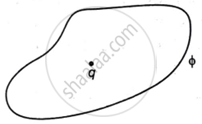
Φ = `oint vec E * d vec A`
= `q/epsilon_0`
Key Points
- Law of Conservation of Charge: Charge can neither be created nor destroyed; it can only be transferred from one body to another.
- Additivity: If a system has charges q1, q2, q3, ... qn, the total charge is:
Q = q1 + q2 + q3 + ... +qn
Analogy: Think of charge like money in a closed economy — it only moves between accounts (bodies); no new "charge currency" is printed or destroyed.
- Quantisation of charge: Electric charge exists in discrete packets, and the charge on any body is given by
q = ±ne
where n is an integer and e = 1.6 × 10⁻¹⁹ C is the elementary charge. - No fractional charge: Charge cannot exist as a fraction of e (like 0.5e or 2.3e); hence, electric charge is atomic in nature.
- Conservation of charge: The total electric charge of an isolated system remains constant; charge can neither be created nor destroyed, only transferred.
- Experimental support: Processes such as rubbing, pair production and annihilation, and radioactive decay always conserve the net charge of the system.
- Invariance of charge: The value of electric charge does not change with velocity, unlike mass, which varies with speed.
- Atom = Nucleus (protons + neutrons) + Electrons (in shells/orbitals around the nucleus).
- Proton: positive charge, composed of quarks, stable.
- Neutron: neutral charge, comparable mass to proton; free neutron undergoes beta decay.
- Electron: negative charge, fundamental particle, governs chemical behaviour.
- Atomic number (Z) = number of protons.
- Mass number (A) = number of protons + number of neutrons (A = Z + N).
- Isotopes: same Z, different N (and hence different A).
- Ions: cation formed by electron loss; anion formed by electron gain; proton count unchanged.
- Nuclear density is extremely high, e.g., copper nucleus ≈ 3.72 × 10¹⁸ kg m−3.
- Conductors allow charge to flow easily; insulators resist it strongly.
- In metals, free electrons carry charge; in electrolytes, ions carry it.
- Charge spreads across a conductor's surface but stays localized on an insulator.
- Semiconductors lie between the two and are sensitive to heat/doping.
- Insulators can still polarize under an electric field without conducting current.
- Charging results from electron transfer, not proton movement.
- Three methods: Friction, Conduction, Induction.
- Charge follows the Law of Conservation of Charge — total charge in an isolated system remains constant.
- Triboelectric series predicts polarity of charge when two materials are rubbed.
- Losing electrons → positive charge, slight mass decrease.
- Gaining electrons → negative charge, slight mass increase.
- Conduction requires direct contact; induction does not.
- The neutral body acquires the same sign of charge as the charging body.
- Charge is shared, not duplicated — total charge before and after contact is conserved.
- For identical spheres, final charge splits equally; for unequal spheres, distribution depends on size/capacitance.
- Grounding (earthing) can neutralize the object by providing/removing electrons via the earth.
- Induction charges a conductor without contact, via internal charge redistribution.
- The conductor always acquires a charge opposite in sign to the inducing charge.
- Order of operations matters: ground → disconnect earth → remove charged object.
- Charging by induction is permanent only if grounding is done correctly.
- Distinguish clearly from conduction (contact, same-sign charge) and friction (rubbing, opposite charges on two bodies).
- A charge creates an electric field around it, and the field exists even if the charge is removed because the space has already been modified.
- The electric field exists at every point in three-dimensional space and does not depend on the test charge used to measure it (if the test charge is very small).
- For a positive source charge, the electric field is directed radially outward, while for a negative source charge, it is directed radially inward.
- The strength of the electric field decreases as the distance from the charge increases, and at equal distances from a point charge, the field has the same magnitude.
- The force on a charge in an electric field is given by \[\vec F\](r) = q\[\vec E\](r), and the SI unit of electric field is N/C.
- Electric field intensity: \[\vec{E}=\frac{1}{4\pi\varepsilon_0}\frac{q}{r^2}\hat{r}\].
- It is a vector quantity, directed outward for +q and inward for −q.
- Follows an inverse-square law with distance.
- Independent of the test charge used to measure it.
- For multiple charges, use vector superposition.
- In a medium, divide by dielectric constant K.
- Continuous charge distributions require integration, not simple addition.
- Three types exist: linear (λ), surface (σ), and volume (ρ).
- The general method: apply Coulomb's Law to an element dq, then integrate over the full body.
- \[\hat r_{21}\] varies across the body — always check symmetry before integrating.
- Gauss's Law is the preferred shortcut for symmetric distributions.
- Charged particle in uniform field → constant force → constant acceleration
- Velocity along field → straight-line, uniformly accelerated motion
- Velocity perpendicular to field → parabolic path (projectile analogy)
- Master formula for trajectory: y = \[\frac {qE}{2mv_0^2}\]x2
- Gravity is neglected unless explicitly stated (charge-to-mass ratio is usually very high)
- ΦE = q/ε0 (vacuum); ΦE = q/(ε0K) (dielectric medium)
- Flux depends only on net enclosed charge, not surface shape/size.
- Useful for symmetric bodies: sphere, cylinder, infinite sheet.
- Derived from Coulomb's Law — a generalized statement of it.
Important Questions [13]
- What is meant by the statement: "Relative permittivity of water is 81"?
- In case of an infinite line charge, how does intensity of electric field at a point change, if at all, when. charge on it is doubled? distance of the point is halved?
- The Intensity of the Electric Field at a Point at a Perpendicular Distance ‘R’ from an Infinite Line Charge, Having Linear Charge Density ‘λ’ is Given By:
- A Charged Oil Drop Weighing 1.6 X 10⁻¹⁵ N is Found to Remain Suspended in a Uniform Electric Field of Intensity 2 X 10³ Nc-1. Find the Charge on the Drop.
- The Intensity of the Electric Field at a Perpendicular Distance of 0·5 M from an Infinitely Long Line Charge Having Linear Charge Density (λ) is 3-6 × 10³ Vm-1. Find the Value of λ.
- In an electric dipole, what is the locus of a point having zero potential?
- Two Point Charges Q1 = 400 μC and Q2 = 100 μC Are Kept Fixed, 60 Cm Apart in Vacuum. Find Intensity of the Electric Field at Midpoint of the Line Joining Q1 and Q2.
- Derive an Expression for the Intensity of Electric Field at a Point in Broadside Position Or on [4) an Equatorial Line of an Electric Dipole.
- A Short Electric Dipole (Which Consists of Two Point Charges, +Q and -q) is Placed at the Centre 0 and Inside a Large Cube (Abcdefgh) of Length L, as Shown in Figure 1. the Electric Flux, Emanating Through the Cube Is:
- In an Electric Dipole, at Which Point is the Electric Potential Zero ?
- Show that intensity of electric field at a point in broadside position of an electric dipole is given by: E = (1/4𝜋𝜀0)p/(r2+𝑙2)3/2 Where the terms have their usual meaning.
- State Gauss’ Law.
- A Closed Surface in Vacuum Encloses Charges –Q and +3q. the Total Electric Flux Emerging Out of the Surface
Concepts [34]
- Electric Charges
- Properties of Electric Charge
- Simple Atomic Structure
- Conductors and Insulators
- Mechanism of Charging of an Object
- Charging by Friction
- Charging by Conduction
- Charging by Induction
- Coulomb's Law (Scalar Form): Force Between Two Point-Charges
- Coulomb's Law in Vector Form
- Forces Between Multiple Charges: Superposition Principle
- Equilibrium of System of Charges
- Electric Field
- Intensity of Electric Field
- Electric Field Intensity Due to a Point-Charge
- Intensity of Electric Field due to a Continuous Charge Distribution
- Electric Lines of Force
- Electric Dipole
- Electric Field due to an Electric Dipole
- Motion of an Electric Dipole in a Uniform Electric Field
- Effect of a Uniform Electric Field on the Motion of a Charged Particle
- Equilibrium of a Charged Body in a Uniform Electric Field
- Introduction to Gauss' Theorem of Electrostatics
- Area Vector
- Flux of a Vector Field
- Gauss' Theorem
- Gaussian Surface and its Properties
- Applications of Gauss' Theorem > Electric Field due to a Point Charge
- Applications of Gauss' Theorem > Electric Field due to an Infinite Line of Charge
- Applications of Gauss' Theorem > Electric Field due to an Infinite Plane Sheet of Charge
- Applications of Gauss' Theorem > Electric Field due to Two Infinite Parallel Sheets of Charge
- Applications of Gauss' Theorem > Electric Field Intensity Just Outside a Charged Conductor
- Applications of Gauss' Theorem > Electric Field due to a Uniformly Charged Thin Spherical Shell
- Applications of Gauss' Theorem > Electric Field due to a Uniformly Charged Sphere
