Advertisements
Advertisements
Question
The intensity of the electric field at a perpendicular distance of 0·5 m from an infinitely long line charge having linear charge density (λ) is 3-6 × 10³ Vm-1. Find the value of λ.
Advertisements
Solution
λ =n E.2π∈0r where E =3.6 ×10³ Vm-1, R= 5m
∴ λ = 3.6 × 103 ×05 ×2 ×3.14 × 8.85 ×10-12
= 3.6 × 103 ×3.14 ×8.85 ×10-12
= 100× 10-9
=10-7 Cm-1
∴ λ = 10-7 Cm-1
APPEARS IN
RELATED QUESTIONS
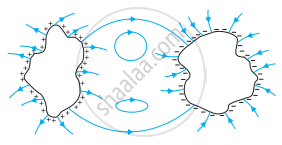
Which among the curves shown in the fig. cannot possibly represent electrostatic field lines?
(a)
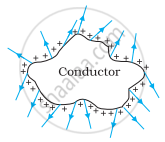
(b)
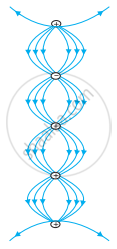
(c)
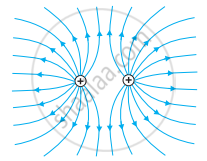
(d)
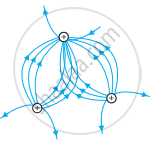
(e)
(a) Derive an expression for the electric field E due to a dipole of length '2a' at a point distant r from the centre of the dipole on the axial line.
(b) Draw a graph of E versus r for r >> a.
(c) If this dipole were kept in a uniform external electric field E0, diagrammatically represent the position of the dipole in stable and unstable equilibrium and write the expressions for the torque acting on the dipole in both the cases.
Two bar magnets are quickly moved towards a metallic loop connected across a capacitor ‘C’ as shown in the figure. Predict the polarity of the capacitor.

Draw the pattern of electric field lines, when a point charge –Q is kept near an uncharged conducting plate.
Answer the following question.
Draw the pattern of electric field lines when a point charge +q is kept near an uncharged conducting plate.
Explain why two field lines never cross each other at any point?
A point positive charge is brought near an isolated conducting sphere (figure). The electric field is best given by ______.
Which of the following figures represent the electric field lines due to a single negative charge?
Figure shows the electric field lines around three point charges A, B and C.

- Which charges are positive?
- Which charge has the largest magnitude? Why?
- In which region or regions of the picture could the electric field be zero? Justify your answer.
(i) near A, (ii) near B, (iii) near C, (iv) nowhere.
The magnitude of the electric field due to a point charge object at a distance of 4.0 m is 9 N/C. From the same charged object the electric field of magnitude, 16 N/C will be at a distance of ______.
