Advertisements
Advertisements
Question
The intensity of the electric field at a point at a perpendicular distance ‘r’ from an infinite line charge, having linear charge density ‘λ’ is given by:
Options
E = `(1/(4π∈_0))λ/r`
E = `(1/(4π∈_0)) (2λ)/r`
E = `(1/(4π∈_0)) λ/r^2`
E = `(1/(4π∈_0)) (2λ)/r^2`
Advertisements
Solution
E = `(1/(4π∈_0)) (2λ)/r`
The intensity of the electric field at a point at a perpendicular distance ‘r’ from an infinite line charge, having linear charge density ‘λ’ is given by: E = `(1/(4π∈_0)) (2λ)/r`
APPEARS IN
RELATED QUESTIONS
A charge is distributed uniformly over a ring of radius 'a'. Obtain an expression for the electric intensity E at a point on the axis of the ring. Hence, show that for points at large distance from the ring, it behaves like a point charge.
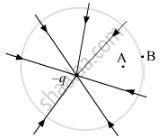
The field lines of a negative point charge are as shown in the figure. Does the kinetic energy of a small negative charge increase or decrease in going from B to A?
The bob of a simple pendulum has a mass of 40 g and a positive charge of 4.0 × 10⁻⁶ C. It makes 20 oscillations in 45 s. A vertical electric field pointing upward and of magnitude 2.5 × 10⁴ NC−1 is switched on. How much time will it now take to complete 20 oscillations?
A solid sphere of radius R has a charge Q distributed in its volume with a charge density ρ = kra, where k and a are constants and r is the distance from its centre. If the electric field at r = `"R"/2` is `1/8` times that at r = R, the value of a is ______.
An electron falls from rest through a vertical distance h in a uniform and vertically upward directed electric field E. The direction of electric field is now reversed, keeping its magnitude the same. A proton is allowed to fall from rest in it through the same vertical distance h. The time of fall of the electron, in comparison to the time of fall of the proton is ______.
Let there be a spherically symmetric charge distribution with charge density varying as `rho("r") = rho_0(5/4 - "r"/"R")` upto r = R, and `rho("r") = 0` for r > R, where r is the distance from the origin. The electric field at a distance r(r < R) from the origin is given by _________.
A charge Q is placed at the centre of the line joining two point charges +q and +q as shown in the figure. The ratio of charges Q and q is ______.

Electric lines of force about negative point charge are ______
Consider two identical point charges located at points (0, 0) and (a, 0).
Is there a point on the line joining them at which the electric potential is zero?
In case of an infinite line charge, how does intensity of electric field at a point change, if at all, when.
- charge on it is doubled?
- distance of the point is halved?
