Advertisements
Advertisements
प्रश्न
The intensity of the electric field at a point at a perpendicular distance ‘r’ from an infinite line charge, having linear charge density ‘λ’ is given by:
पर्याय
E = `(1/(4π∈_0))λ/r`
E = `(1/(4π∈_0)) (2λ)/r`
E = `(1/(4π∈_0)) λ/r^2`
E = `(1/(4π∈_0)) (2λ)/r^2`
Advertisements
उत्तर
E = `(1/(4π∈_0)) (2λ)/r`
The intensity of the electric field at a point at a perpendicular distance ‘r’ from an infinite line charge, having linear charge density ‘λ’ is given by: E = `(1/(4π∈_0)) (2λ)/r`
APPEARS IN
संबंधित प्रश्न
A charge is distributed uniformly over a ring of radius 'a'. Obtain an expression for the electric intensity E at a point on the axis of the ring. Hence, show that for points at large distance from the ring, it behaves like a point charge.
The field lines of a negative point charge are as shown in the figure. Does the kinetic energy of a small negative charge increase or decrease in going from B to A?
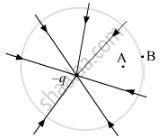
What is the function of uniform radial field and how is it produced?
A solid sphere of radius R has a charge Q distributed in its volume with a charge density ρ = kra, where k and a are constants and r is the distance from its centre. If the electric field at r = `"R"/2` is `1/8` times that at r = R, the value of a is ______.
A charge Q is placed at the centre of the line joining two point charges +q and +q as shown in the figure. The ratio of charges Q and q is ______.

Electric field at a point varies as r° for ______.
Consider two identical point charges located at points (0, 0) and (a, 0).
Is there a point on the line joining them at which the electric potential is zero?
An isolated point charge particle produces an electric field `vecE` at a point 3 m away from it. The distance of the point at which the field is `vecE/4` will be ______.
In case of an infinite line charge, how does intensity of electric field at a point change, if at all, when.
- charge on it is doubled?
- distance of the point is halved?
