Advertisements
Advertisements
प्रश्न
Write balanced chemical equations for action of ammonia on - acetone
Advertisements
उत्तर

APPEARS IN
संबंधित प्रश्न
How are the following compounds prepared?
benzaldehyde from benzene
Write the products formed when CH3CHO reacts with the following reagents : H2N – OH
What is meant by the following term? Give an example of the reaction in the following case.
Acetal
What is meant by the following term? Give an example of the reaction in the following case.
Hemiacetal
What is meant by the following term? Give an example of the reaction in the following case.
Oxime
What is meant by the following term? Give an example of the reaction in the following case.
Ketal
What is meant by the following term? Give an example of the reaction in the following case.
Imine
What is meant by the following term? Give an example of the reaction in the following case.
Schiff’s base
Acetaldehyde, Acetone, Di-tert-butyl ketone, Methyl tert-butyl ketone (reactivity towards HCN)
Give plausible explanation for the following:
There are two −NH2 groups in semicarbazide. However, only one is involved in the formation of semicarbazones.
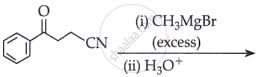
Complete the synthesis by giving missing starting material, reagent or product.

Write balanced chemical equations for action of ammonia on - acetaldehyde
Write the structure of Phenylmethanamine.
Give a simple chemical test to distinguish between 
Write the main product formed when propanal reacts with the following reagents:
2 moles of 3 CH OH in presence of dry HCl
How will you convert benzoic acid to m-bromobenzoic acid?
The pH of blood does not appreciably change by a small addition of acid or base because
Which one of the following gives only one monochloro derivative?
Paraldehyde is formed as a result of polymerisation:-
What happens when ethanal is treated with excess ethanol and acid?
Write the structure of the product formed when acetone reacts with 2, 4 DNP reagent.
Draw structure of the following derivative.
Acetaldehydedimethylacetal
Why dissociation of HCN is suppressed by the addition of HCL?
Draw structures of the following derivative.
The ethylene ketal of hexan-3-one
Draw structure of the following derivative.
The ethylene ketal of hexan-3-one
Draw the structure of the following derivative.
Acetaldehydedimethylacetal
Draw structure of the following derivative.
The ethylene ketal of hexan-3-one
Draw structure of the following derivative.
The ethylene ketal of hexan-3-one
The major product of the following reaction is: