Advertisements
Advertisements
प्रश्न
Acetaldehyde, when treated with which among the following reagents does NOT undergo addition reaction?
(A) Ammonia
(B) Hydroxylamine
(C) Ammoniacal silver nitrate
(D) Semicarbazide
Advertisements
उत्तर
(C) Ammoniacal silver nitrate
APPEARS IN
संबंधित प्रश्न
Write balanced chemical equations for action of ammonia on - formaldehyde
Write the structures of the main products when acetone (CH3 − CO − CH3) reacts with the following reagent :
H2N − NHCONH2/H+
Write the products formed when CH3CHO reacts with the following reagents : H2N – OH
What is meant by the following term? Give an example of the reaction in the following case.
Hemiacetal
What is meant by the following term? Give an example of the reaction in the following case.
Ketal
What is meant by the following term? Give an example of the reaction in the following case.
Imine
Predict the products formed when cyclohexanecarbaldehyde reacts with the following reagents.
Excess ethanol and acid
Complete the synthesis by giving missing starting material, reagent or product.
\[\ce{C6H5CHO ->[H2NCONHNH2]}\]
What is the action of the following reagents on ethanoic acid?
1) `LiAlH_4"/"H_3O^+`
2) `PCl_3 , "heat"`
3) `P_2O_5, "heat"`
How will you convert sodium acetate to methane?
Give a simple chemical test to distinguish between 
Which of the following is the correct representation for intermediate of nucleophilic addition reaction to the given carbonyl compound (A):
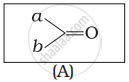
(i) 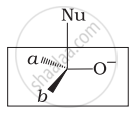
(ii) 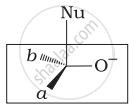
(iii) 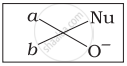
(iv) 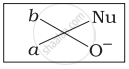
Identify the compounds A, B and C in the following reaction.
\[\ce{CH3 - Br ->[Mg/ether] (A) ->[(i) CO][(ii) Water] (B) ->[CH3OH/H+][Δ] (C)}\]
Reaction of aqueous sodium hydroxide on chlorobenzene gives which of the following products?
Which one of the following gives only one monochloro derivative?
Grignard reagent on reaction with acetone forms.
A Idol condensation will not be observed in
Arrange the following in the increasing order of their property indicated:
Ethanal, Propanone, Propanal, Butanone (reactivity towards nucleophilic addition)
What happens when propanone is treated with CH3MgBr and then hydrolysed?
Write the structure of the product formed when acetone reacts with 2, 4 DNP reagent.
Draw structures of the following derivative.
The ethylene ketal of hexan-3-one
Draw the structure of the following derivative.
Acetaldehydedimethylacetal
Draw the structure of the following derivative.
The ethylene ketal of hexan-3-one
Draw structures of the following derivatives.
Acetaldehydedimethylacetal
Draw structure of the following derivative.
The ethylene ketal of hexan-3-one
Draw structure of the following derivative.
The ethylene ketal of hexan-3-one
Give an example of the reaction in the following case.
Oxime
Give an example of the reaction in the following case.
Imine
