Advertisements
Advertisements
प्रश्न
What is the meaning of the line “Both wry with the laboured ease of loss”.
Advertisements
उत्तर
The context of the above lines is the mother’s recollection of her childhood days and the poet’s recollection of her mother’s laughing face.
The mother has fond memories of her past but there is a sense of loss in recalling those moments as they make her realise that the good old times of her childhood will never come back. For the poet, the ‘loss’ refers to the loss of her mother. She has fond memories of her dead mother but she misses her laughter and her presence that will never return to the poet. Thus, both remember their pasts with a laugh that conceals sadness as none can re-live those lost moments.
APPEARS IN
संबंधित प्रश्न
What caused a blow to man’s ego ?
Briefly explain the following statement from the text.
Gangadharpant could not help comparing the country he knew with what he was witnessing around him.
This short story revolves around a single important event. Discuss how the narrative is woven around this central fact.
What do you think are the reasons for the references made to the English people and the British monarchy?
Fill in the blank.
“Hybrids need more _____________”, said Devu Handa.
An acrostic is a poem or a write· up in which the first letter of each line forms a word. when it is read vertically.
For example,
Faithful
Reliable
Inspiring
Encouraging
Noble
Dedicated
With your benchmate / group, complete the acrostic of BELIEVE and FAITH.
(Please note that the words / phrases should be more or less related to the topic. You can use a thesaurus.)
Be certain of
E ......................
L ......................
I ......................
E ......................
V ......................
E ......................
F ......................
A ......................
I ......................
T ......................
H ......................
Find from the story one word for the following.
a low constant sound made by cats ______
Find evidence from the lesson and write in your own words.
In Israel, the media have a positive outlook and self-respect.
Think and answer in your own words.
'Beauty' in stanza 5 to 6 can refer to a beautiful maiden as well as nature itself. Explain when and how nature ‘dances’ and also 'smiles'.
Select a season of your choice and give the following details:
- Time of the year -
- Characteristics- crops, festivals, etc.
- Features/changes - climate/weather/temperature etc.
- Advantages/Disadvantages -
Fill in the gap, choosing a word from the bracket to make an appropriate comparison.
(tall / quiet / humble / merry / busy / slippery / fast / sly / slow / big)
as ______ as a lark
Do as directed. (Make sure you do not change the meaning and tense of the sentence).
I am proud of you. (Rewrite using the noun form of the underlined word).
Akbar thought he was greater than God.
Read the passage and answer the following question:
What makes Indra’s vajra or weapon invincible?
List the four elements of drama.
Read aloud with the leader: Form groups of five. Read the passage aloud in groups. The leader begins every sentence and stops after a few words. The other members complete the sentence, reading it aloud in the chorus.
Talk about your strengths.
Form groups of 4. Find all the references to the time given in the passage. Then make a chart to show the events described in the passage along with the time when they occur. Example:
| All night long: | The crew stayed on their feet. |
| Near midnight: | ________________________ |
| At 12.53: | ________________________ |
(Use as many lines as you need.)
Write in your own words.
How does the poet glorify his home in the first stanza?
Fill in the blank choosing the appropriate word/idiom from the lesson.
The ______ solved the mysterious crime.
Read the story ‘Lord Emsworth and the Girl Friend’ by P. G. Wodehouse.
Imagine the following and write about it in your own words:
What the world looks like to a baby.
What did the husband want to buy?
What did the husband want to do with the extra milk?
List 5 of the sounds that you like.
Read the poem and answer the following.
What are the two different ways of eating strawberries?
Find the meaning of the following word.
abused
Describe Gulliver’s walk around the city.
Guess the meaning of the following word.
finely
Give an instance that shows the pathetic condition of the young bird.
Answer the question in a paragraph of about 100 – 150 word.
Write a detailed character sketch of Prospero.
What was the grandfather wearing?
What were Chulongs plans for the bird?
Who is wise according to you?
The weather is always too hot or cold; Summer and winter alike they scold. Nothing goes right with the folks you meet Down on that gloomy Complaining Street.
Pick out the rhyming words and identify the rhyme scheme of the above lines.
What values did the child learn?
What did Usha see while walking to the bazaar?
Usha went to visit her______ house after shopping in the market.
Identify the character/speaker.
Go to my cottage and fetch my gloves and fan.
He preferred handling mail by himself.
Read the following lines and answer the questions.
It isn’t an instantaneous thing
Born of despair with a sudden spring
- What does ‘it’ refer to?
- What does ‘born of despair mean’?
What is the poem about?
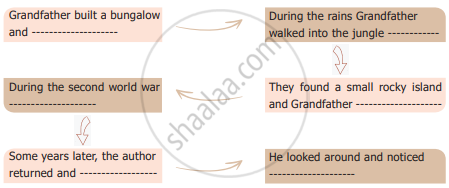
Read the story on your own. Discuss in a group and complete the story map below.
| A story map is the main events of the story given in a flow chart. |
Who came to India from Portugal in search of pepper?
Read the lines and answer the question given below.
Faster than fairies, faster than witches,
Bridges and houses, hedges and ditches;
- What is faster than fairies and witches?
- Why does the poet mention ‘bridges and houses, hedges and ditches’? Where are the
Find example of alliteration and write them in the blank.
Spring Is pretty
but short and sweet
| Mr. Murugan is a farmer. He has a small piece of land and two bulls. He takes good care of his bulls as they help him in farming. Every morning, he takes the bulls for grazing. When it rains he ploughs the land with the bulls. As he has no one to help he starts sowing the seed before sunrise. He irrigates the crop till it grows. He reaps and binds the crop then takes it to thrash the paddy. Finally, with the help of the bulls, he takes the paddy to his house. |
Choose the main idea of the passage.
The robot did not obey his master.
Recite the poem 'My Robot' with correct intonation.
The pigeon flew away for dry twigs.
What was the lesson learnt by Uthaman?
Answer the following yes or no question.
Did Appu share guava?
Three waves hit the village.
The official was transferred.
Write the rhyming word.
larder- ______.
What will help us grow?
Appa weaves beautiful sarees with______.
What do you think birds say to each other in the morning?
Choose the right word.
Chintha Chettu is a tamarind ______.
The passage given below is on Kabbadi. Read the passage and complete the activities that follow.
Kabbadi (கபடி - in Tamil) is a contact team sport that originated in Tamil Nadu, India. It is the national sport of Bangladesh. It is also popular in South Asia and is the state game of the Indian states of Tamil Nadu, Kerala, Andhra Pradesh, Bihar, Haryana, Karnataka, Maharashtra, Punjab, and Telangana.
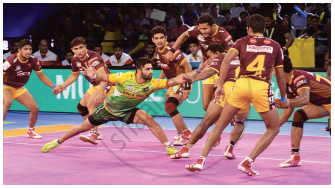
Kabbadi is played between two teams of seven players: the objective of the game is for a single player on offence referred to as a 'raider', to run in to the opposing teams half of a court, tag out as many of their defenders as possible, and return to their own half of the court–all without being tackled by the defenders. Points are scored for each player tagged by the raider, while the opposing team earns a point for stopping the raider. Players are taken out of the game if they are tagged or tackled, but can be 'revived' for each point scored by their team from a tag or tackle. The raider should hold his breath and utter the words like 'kabbadi kabbadi, hututu hututu, chadu kudu' etc. while the opponents try to catch him. If he stops uttering these words, he is considered out.
The game is known by its regional names in different parts of the subcontinent, such as Kabbadi or Chedugudu in Andhra Pradesh, Kabbadi in Kerala and Telangana, Hadudu in Bangladesh, Bhavatik in Maldives, Kauddi or Kabbadi in the Punjab Region, Hu-Tu-Tu in Western India and Hu-Do-Do in Eastern India and Chadakudu in South India. The highest governing body of Kabbadi is the International Kabbadi Federation.
Given below is the visual presentation of the first paragraph.
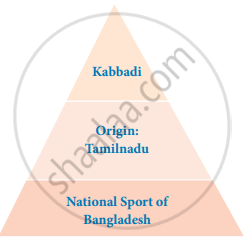
i) Represent the other paragraphs in a visual form of your choice(flow chart, mind-map, pie-chart, etc.).
ii) Choose the correct option.
1. A contact sport usually involves a ______contact between players.
- violent
- gentle
- physical
2. Kabbadi is a game played between ______.
- seven teams of two players
- two teams of seven players
- four teams of seven players
3. A single ______.
- player on offence is referred to as a raider
- offence is referred to as a raider
- raider is an offence by the player
iii) Answer the following.
- How does a raider score points for his team?
- When does a raider concede a point to the opponent team?
- Can a player be revived when he/she is out of the game? Explain your answer.
- Kabbadi is called by different names in different parts of India. Do you know how Pallankuzhi is called in Karnataka, Andhra Pradesh and Kerala?
