Advertisements
Advertisements
प्रश्न
Ratio of corresponding sides of two similar triangles is 4 : 7, then find the ratio of their areas = ?
Advertisements
उत्तर
Let the corresponding sides of similar triangles be s1 and s2.
Let A1 and A2 be their corresponding areas.
s1 : s2 = 4 : 7 ...[Given]
∴ `(s_1)/(s_2) = 4/7` ...(i)
`(A_1)/(A_2) = (s_1^2)/(s_2^2)` ...[Theorem of areas of similar triangles]
`(A_1)/(A_2) = (s_1/s_2)^2`
`(A_1)/(A_2) = (4/7)^2` ...[From (i)]
`(A_1)/(A_2) = 16/49`
∴ Ratio of areas of similar triangles = 16 : 49
APPEARS IN
संबंधित प्रश्न
The ratio of the areas of two triangles with the common base is 14 : 9. Height of the larger triangle is 7 cm, then find the corresponding height of the smaller triangle.
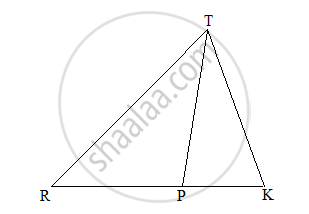
In the following figure RP : PK= 3 : 2, then find the value of A(ΔTRP) : A(ΔTPK).
The ratio of the areas of two triangles with common base is 6:5. Height of the larger triangle of 9 cm, then find the corresponding height of the smaller triangle.
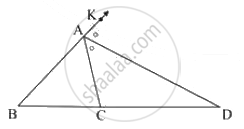
In the given figure, AD is the bisector of the exterior ∠A of ∆ABC. Seg AD intersects the side BC produced in D. Prove that:
In the given figure, BC ⊥ AB, AD ⊥ AB, BC = 4, AD = 8, then find `("A"(∆"ABC"))/("A"(∆"ADB"))`

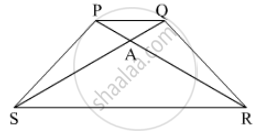
In trapezium PQRS, side PQ || side SR, AR = 5AP, AS = 5AQ then prove that, SR = 5PQ
In ∆ABC, B - D - C and BD = 7, BC = 20 then find following ratio.
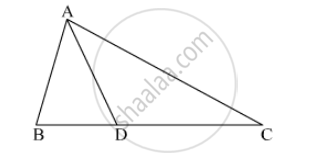
`"A(∆ ABD)"/"A(∆ ADC)"`
The ratio of the areas of two triangles with the common base is 4 : 3. Height of the larger triangle is 2 cm, then find the corresponding height of the smaller triangle.
In ∆ABC, B – D – C and BD = 7, BC = 20, then find the following ratio.
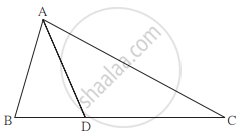
`(A(triangleABD))/(A(triangleABC))`
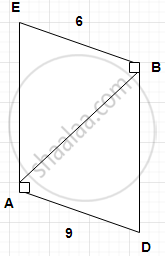
In the given, seg BE ⊥ seg AB and seg BA ⊥ seg AD.
if BE = 6 and AD = 9 find `(A(Δ ABE))/(A(Δ BAD))`.
If ΔXYZ ~ ΔPQR then `(XY)/(PQ) = (YZ)/(QR)` = ?
In fig., TP = 10 cm, PS = 6 cm. `(A(ΔRTP))/(A(ΔRPS))` = ?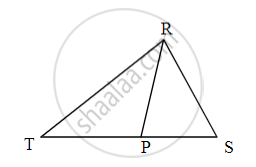
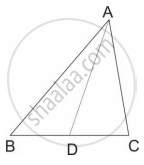
In fig. BD = 8, BC = 12, B-D-C, then `(A(ΔABC))/(A(ΔABD))` = ?
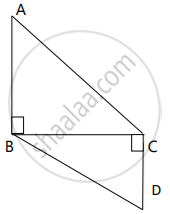
In fig., AB ⊥ BC and DC ⊥ BC, AB = 6, DC = 4 then `(A(ΔABC))/(A(ΔBCD))` = ?
In ΔABC, B-D-C and BD = 7, BC = 20, then find the following ratio.
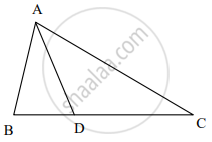
(i) `(A(ΔABD))/(A(ΔADC))`
(ii) `(A(ΔABD))/(A(ΔABC))`
(iii) `(A(ΔADC))/(A(ΔABC))`
In the figure, PQ ⊥ BC, AD ⊥ BC. To find the ratio of A(ΔPQB) and A(ΔPBC), complete the following activity.

Given: PQ ⊥ BC, AD ⊥ BC
Now, A(ΔPQB) = `1/2 xx square xx square`
A(ΔPBC) = `1/2 xx square xx square`
Therefore,
`(A(ΔPQB))/(A(ΔPBC)) = (1/2 xx square xx square)/(1/2 xx square xx square)`
= `square/square`
