Advertisements
Advertisements
प्रश्न
The ratio of the areas of two triangles with the common base is 14 : 9. Height of the larger triangle is 7 cm, then find the corresponding height of the smaller triangle.
Advertisements
उत्तर
Let the height of the larger triangle be h1 and that of the smaller triangle be h2.
The ratio of the areas of two triangles with a common base is equal to the ratio of their corresponding heights.
`"Area(larger Triangle)"/"Area(smaller Triangle)"="h"_1/"h"_2`
`14/9=7/"h"_2`
`14xx "h"_2=9xx7`
`therefore"h"_2=(9xx7)/14=9/2`
`therefore"h"_2=4.5" cm"`
The corresponding height of the smaller triangle is 4.5 cm.
APPEARS IN
संबंधित प्रश्न
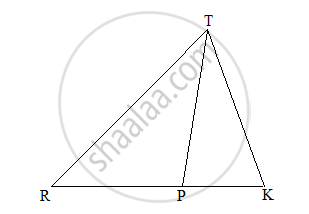
In the following figure RP : PK= 3 : 2, then find the value of A(ΔTRP) : A(ΔTPK).
The ratio of the areas of two triangles with common base is 6:5. Height of the larger triangle of 9 cm, then find the corresponding height of the smaller triangle.
In adjoining figure, PQ ⊥ BC, AD ⊥ BC then find following ratios.
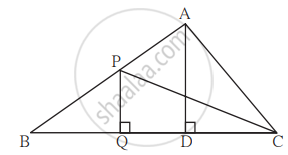
- `("A"(∆"PQB"))/("A"(∆"PBC"))`
- `("A"(∆"PBC"))/("A"(∆"ABC"))`
- `("A"(∆"ABC"))/("A"(∆"ADC"))`
- `("A"(∆"ADC"))/("A"(∆"PQC"))`
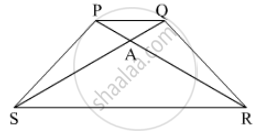
In trapezium PQRS, side PQ || side SR, AR = 5AP, AS = 5AQ then prove that, SR = 5PQ
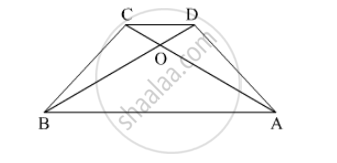
In trapezium ABCD, side AB || side DC, diagonals AC and BD intersect in point O. If AB = 20, DC = 6, OB = 15 then Find OD.
In ∆ABC, B - D - C and BD = 7, BC = 20 then find following ratio.
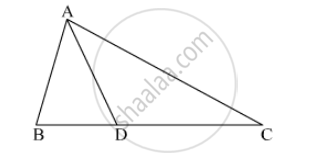
`"A(∆ ABD)"/"A(∆ ADC)"`
Ratio of areas of two triangles with equal heights is 2 : 3. If base of the smaller triangle is 6 cm then what is the corresponding base of the bigger triangle ?
In the given figure, ∠ABC = ∠DCB = 90° AB = 6, DC = 8 then `(A(Δ ABC))/(A(Δ DCB))` = ?
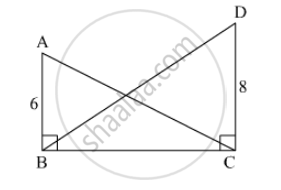
The ratio of the areas of two triangles with the common base is 4 : 3. Height of the larger triangle is 2 cm, then find the corresponding height of the smaller triangle.
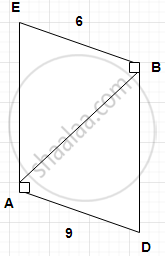
In the given, seg BE ⊥ seg AB and seg BA ⊥ seg AD.
if BE = 6 and AD = 9 find `(A(Δ ABE))/(A(Δ BAD))`.
If ΔXYZ ~ ΔPQR then `(XY)/(PQ) = (YZ)/(QR)` = ?
Areas of two similar triangles are in the ratio 144 : 49. Find the ratio of their corresponding sides.
In fig., TP = 10 cm, PS = 6 cm. `(A(ΔRTP))/(A(ΔRPS))` = ?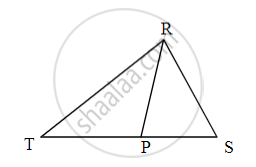
Ratio of corresponding sides of two similar triangles is 4 : 7, then find the ratio of their areas = ?
In fig. BD = 8, BC = 12, B-D-C, then `(A(ΔABC))/(A(ΔABD))` = ?
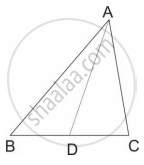
In ΔABC, B-D-C and BD = 7, BC = 20, then find the following ratio.
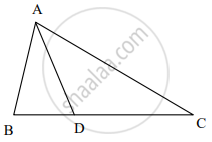
(i) `(A(ΔABD))/(A(ΔADC))`
(ii) `(A(ΔABD))/(A(ΔABC))`
(iii) `(A(ΔADC))/(A(ΔABC))`
If ΔABC ∼ ΔDEF, length of side AB is 9 cm and length of side DE is 12 cm, then find the ratio of their corresponding areas.
In the figure, PQ ⊥ BC, AD ⊥ BC. To find the ratio of A(ΔPQB) and A(ΔPBC), complete the following activity.

Given: PQ ⊥ BC, AD ⊥ BC
Now, A(ΔPQB) = `1/2 xx square xx square`
A(ΔPBC) = `1/2 xx square xx square`
Therefore,
`(A(ΔPQB))/(A(ΔPBC)) = (1/2 xx square xx square)/(1/2 xx square xx square)`
= `square/square`
