If ΔXYZ ~ ΔPQR then (XY)/(PQ) = (YZ)/(QR) = ?
Advertisements
प्रश्न
If ΔXYZ ~ ΔPQR then `(XY)/(PQ) = (YZ)/(QR)` = ?
पर्याय
`(XZ)/(PR)`
`(XZ)/(PQ)`
`(XZ)/(QR)`
`(YZ)/(PQ)`
Advertisements
उत्तर
`bb((XZ)/(PR))`
Explanation:
In ΔXYZ and ΔPQR,
ΔXYZ ~ ΔPQR ...(Given)
`(XY)/(PQ) = (YZ)/(QR) = (XZ)/(PR)` ...[Corresponding sides of similar triangles.]
APPEARS IN
संबंधित प्रश्न
The ratio of the areas of two triangles with the common base is 14 : 9. Height of the larger triangle is 7 cm, then find the corresponding height of the smaller triangle.
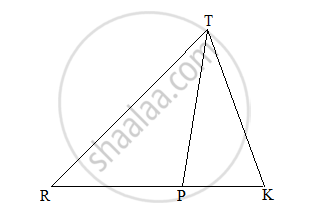
In the following figure RP : PK= 3 : 2, then find the value of A(ΔTRP) : A(ΔTPK).
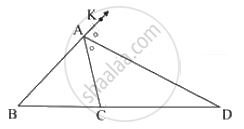
In the given figure, AD is the bisector of the exterior ∠A of ∆ABC. Seg AD intersects the side BC produced in D. Prove that:
Base of a triangle is 9 and height is 5. Base of another triangle is 10 and height is 6. Find the ratio of areas of these triangles.
In the given figure, BC ⊥ AB, AD ⊥ AB, BC = 4, AD = 8, then find `("A"(∆"ABC"))/("A"(∆"ADB"))`

In adjoining figure, PQ ⊥ BC, AD ⊥ BC then find following ratios.
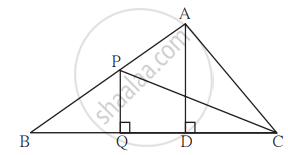
- `("A"(∆"PQB"))/("A"(∆"PBC"))`
- `("A"(∆"PBC"))/("A"(∆"ABC"))`
- `("A"(∆"ABC"))/("A"(∆"ADC"))`
- `("A"(∆"ADC"))/("A"(∆"PQC"))`
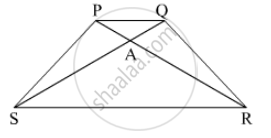
In trapezium PQRS, side PQ || side SR, AR = 5AP, AS = 5AQ then prove that, SR = 5PQ
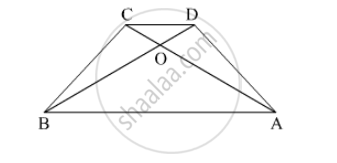
In trapezium ABCD, side AB || side DC, diagonals AC and BD intersect in point O. If AB = 20, DC = 6, OB = 15 then Find OD.
Ratio of areas of two triangles with equal heights is 2 : 3. If base of the smaller triangle is 6 cm then what is the corresponding base of the bigger triangle ?
The ratio of the areas of two triangles with the common base is 4 : 3. Height of the larger triangle is 2 cm, then find the corresponding height of the smaller triangle.
In ∆ABC, B – D – C and BD = 7, BC = 20 then Find following ratio.
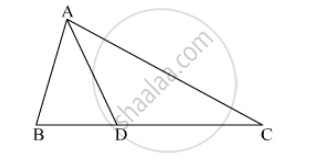
\[\frac{A\left( ∆ ADC \right)}{A\left( ∆ ABC \right)}\]
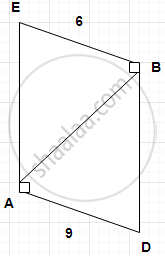
In the given, seg BE ⊥ seg AB and seg BA ⊥ seg AD.
if BE = 6 and AD = 9 find `(A(Δ ABE))/(A(Δ BAD))`.
A roller of diameter 0.9 m and the length 1.8 m is used to press the ground. Find the area of the ground pressed by it in 500 revolutions.
`(pi=3.14)`
In fig., AB ⊥ BC and DC ⊥ BC, AB = 6, DC = 4 then `(A(ΔABC))/(A(ΔBCD))` = ?
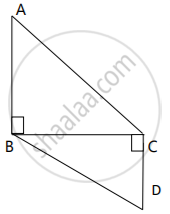
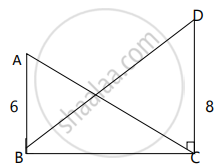
From adjoining figure, ∠ABC = 90°, ∠DCB = 90°, AB = 6, DC = 8, then `(A(ΔABC))/(A(ΔBCD))` = ?
Prove that, The areas of two triangles with the same height are in proportion to their corresponding bases. To prove this theorem start as follows:
- Draw two triangles, give the names of all points, and show heights.
- Write 'Given' and 'To prove' from the figure drawn.
In the figure, PQ ⊥ BC, AD ⊥ BC. To find the ratio of A(ΔPQB) and A(ΔPBC), complete the following activity.

Given: PQ ⊥ BC, AD ⊥ BC
Now, A(ΔPQB) = `1/2 xx square xx square`
A(ΔPBC) = `1/2 xx square xx square`
Therefore,
`(A(ΔPQB))/(A(ΔPBC)) = (1/2 xx square xx square)/(1/2 xx square xx square)`
= `square/square`
