Advertisements
Advertisements
प्रश्न
Observe the following picture and write a paragraph in about 150 word about each one of them.

Advertisements
उत्तर
Animals in captivity always long for freedom even if they are fed regularly. But, they don’t like it. Animals love to hunt and eat their prey alive. Cats roam freely and chase the rats and eat them. Even if domesticated they don’t want to be kept in a cage-like object showcased for an audience. They want to roam inside the house and even share the pillow of the mistress of the house. The canary’ bird we find in the picture is a singing bird. It is sure that if the cat were out, it would try to make a meal of him. Yet, the bird feels sorry for the caged cat. It tries to appeal to the mistress of the house to let the cat free.
APPEARS IN
संबंधित प्रश्न
Your friend has not fared well in the recent examinations. Write a letter to him/her expressing your concern. Give him/her some advice on how to score better marks and offer to help him/her to improve his/her performance.
Fill in the blank with the suitable word.
The burglars broke _____________ the house when the family was away.
Do you consider the title apt?
Can we say that the poet has succeeded in conveying his point? How?
What was the great victory? Who had won the victory?
Write a short story that ends with the words “……………… I really doubt if things could have turned out any better.”
Fill in each of the numbered blanks with the correct form of the word given in brackets. Do not copy the passage, but write in correct serial order the word or phrase appropriate to the blank space.
Example:
(0) beginning
Alice was (0)__________(begin) to get very tired of (1)__________(sit) by her sister on the bank and of having nothing to do: once or twice she had (2)__________(peep) into the book her sister was reading, but it (3)__________ (have) no pictures or conversations in it, "and what is the use of a book," (4)__________(think) Alice, "without pictures or conversations?" Alice wondered whether the pleasure of (5)__________(make) a daisy-chain would be worth the trouble of getting up and picking the daisies when suddenly a White Rabbit with pink eyes (6)__________(run) close by her. Alice did not think this was very remarkable, until the Rabbit actually (7)__________ (take) a watch out of its waistcoat-pocket, and (8) (look) at it, and then hurried on.
Re-write the following sentence according to the instructions are given. Make other changes that may be necessary, but do not change the meaning of the sentence.
The monsoon is the best season in our country.
(Rewrite using ‘good’)
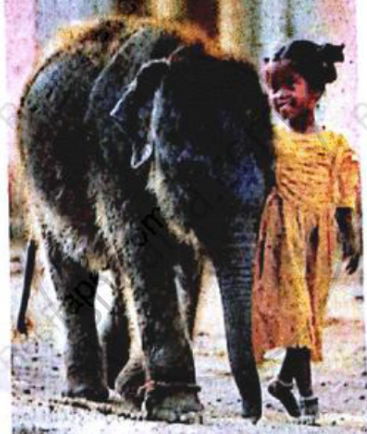
Study the picture given below. Write a story or a description or an account of what it suggests to you. Your composition may be about the subject of the picture or you may take suggestions from it; however, there must be a clear connection between the picture and your composition.
Below is a topic for essay writing. Follow the steps listed above to write on this topic.
Fascinating facts about water
Identify the words in the advertisement that gave away the fact that it was placed by John Garrideb.
There are many instances of gentle humour in the story. Point out some of these and state how this contributes to the interest of the narration.
You are the class representative and you have been asked by the Principal to conduct an interview of a cop. Frame 8-10 questions with the help of the following points, give introduction and conclusion.
- reasons for joining the department
- special training
- developing the skill to identify and locate criminals
- dealing with criminals
- achievements and awards.
Complete the following web diagram.

State whether the following statement is true or false. Correct the false statement.
Fraternity means common sense.
Write an appreciation of the poem considering the following points:
- About the poem, poet, and title.
- Theme/summary/gist of the poem.
- Poetic style/language, poetic devices used in the poem.
- Special features/novelties/focusing elements.
- Message/values/morals in the poem.
- Your opinion about the poem.
Compose a poem in an imaginary village. Try to maintain the rhyme scheme in the poem. You may begin like this….
Settled on the bank of a river
Like a queen
Is my beautiful village
Full of bushes green.
Form pairs. List the things on which you have the same opinion and also the ones on which you have different opinions. Prepare a list of ten things in all and see how far you agree or disagree with your friend. Some useful phrases are given alongside. You could talk about:
- Clothes, latest fashion.
- Performance of sportsmen and women.
- Traffic/Transport in your area.
- Cleanliness and hygiene in your area.
- Future occupations/Careers.
- Latest news items.
- TV programs
- Mobile Apps
- Any subject of your choice.
| Agreement | Ask for your friend’s opinion: | Disagreement |
| I totally agree with you. | Do you think ...? | No, I don’t think so. |
| Exactly/Absolutely! | Do you agree ...? | I totally disagree. |
| You are right. | What do you think? | Not necessarily. |
| I don’t know, I need to think about it. (partial agreement) | What is your opinion? | I’m not sure about that. |
| I suppose so. | How do you feel about that? | Let’s agree to disagree! |
Answer the following question :
Why should one be wary of opinions that flatter one’s self- esteem?
Write a short book review of any one of your favourite books. Your review should include the following things.
- Title of the book
- Name of the author/authors
- Name of the illustrator (artist)
- The central idea of the book (what the book is about)
- The important characters in the book and what they do
- What you like about the book
- Why you want others to read the book/what you learn from the book
Work in pairs and discuss the factors that contribute towards making a choice and make a presentation to the class.
Work in pairs. Create three slogans on ‘Saving Trees’.
Read this example Save a Tree Get Oxygen for Free.
- Use catchy, meaningful phrases.
- Do not write complete sentences.
- Ensure that the words at the end rhyme.
What did she consider her greatest achievement? Why?
What were the strange instruments the nurse carried to the surgery? How did the waiting patients interpret her act?
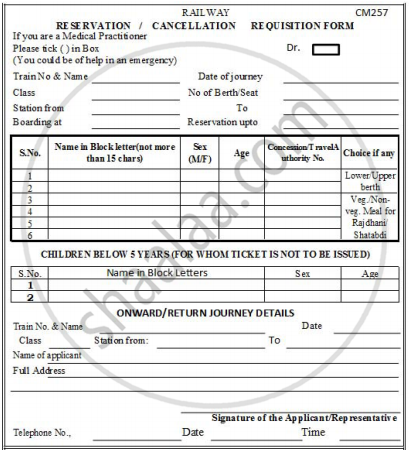
Fill in the following forms with imaginary details.
You have planned to organize a health camp at school. Write a letter to the Manager of a supermarket requesting sponsorship for the event. Name the event and explain how it will benefit both the community as well as the supermarket.
- What do you like best about your school?
- Do you think school is fun?
- Which is the part that you don’t like?
- How often should the teacher give you a test?
Write a composition (in approximately 400-450 words) on the following subject:
Music
How does John Brown convey his firsthand experience of war to his mother and evoke a deep emotional response in the readers? Justify your answer in about 200-250 words with supporting details from the poem, by John Brown.
