Advertisements
Advertisements
प्रश्न
List the steps taken by the captain
(i) to protect the ship when rough weather began.
(ii) to check the flooding of the water in the ship.
Advertisements
उत्तर
(i) When the rough weather began, the captain slowed down the boat by dropping the storm jib. He lashed heavy mooring rope in a loop across the stern. They prepared themselves for the worst-case scenario by double lashing everything, going through the life-raft drill, attaching lifelines and donning life jackets, and oilskins. Later, the narrator managed to stretch canvas and secure waterproof hatch covers across the gaping holes.
(ii) To check the flooding of water in the ship, he put waterproof hatch covers across the gaping holes which diverted the water to the side. When the hand pump got blocked, he connected a spare electric pump to an out-pipe in order to drain out the water. After 36 hours of continuous pumping, they reached the last few centimeters of water.
APPEARS IN
संबंधित प्रश्न
How important was the presence of Miss Anne Sullivan in Helen’s life?
Attempt the following in 150-200 words.
What was the incident of the Frost King? How did it affect Helen?
Answer any four of the following questions in 30-40 words each:
(a) Why did Franz not want to go to school that day?
(b) What was Sophie's ambition in life? How did she hope to achieve that?
(c) What kind of pain does Kamala Das feel in 'My Mother at Sixty-six'?
(d) How can 'mighty dead' be things of beauty?
(e) Why was the Maharaja once in danger of losing his kingdom?
(f) What was the basic plot of each story told by Jack?
Answer the following question in 120-150 words :
Mrs. Hall is greedy but efficient in her business.
Attempt a character sketch of Mrs. Hall.
Complete the call-outs:
A.1)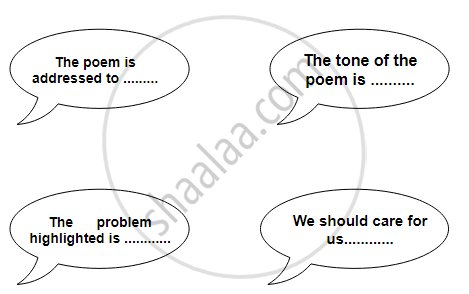
Our world is an institution
Of environmental pollution
We choose not to care
For our future generations
And I for one am guilty
For buying the hundreds of electronic gadgets
That attracts the industries to produce like maggots
environmental pollution is at the heart of our planet
The forests are dying
Wildlife is crying
Millions of fish are dying
Mother earth is sighing
Tell me is it right
That we sleep well at night
Replenishing ourselves
For tomorrow’s greedy fight
Overcrowded trains
Overloaded brains
Where is the light? What is our plight?
While the river break their banks
And greedy industries play their polluted pranks.
A.2) Find the examples that show that we do not care for our future generation
A.3) Match:
Match the lines in Column ‘A’ with the figures of speech in Column ‘B’:
| Column ‘A’ | Column ‘B’ | ||
| (i) | Our world is an institution | (a) | Personification |
| (ii) | Mother earth is sighing | (b) | Simile |
| (c) | Metaphor |
Does the poem talk of an exclusively personal experience or is it fairly universal?
Discuss in small groups.
‘On reading Shelley’s A Defence of Poetry, the question insistently occurs why there is no similar A Defence of Science written by a scientist of equal endowment.’
Comment on the use of the phrase ‘fresh-peeled voice’.
Which are the lines in the poem that impressed you the most and why?
Qua story’: what does the word mean? Find other expressions using the word qua.
Discuss the following in pairs or in small groups.
Exceptionally talented people are born so; talent cannot be cultivated
What are the unpleasant aspects of the human condition that the poet wants to escape from?
How does the poet bring out the immortality of the bird?
Fill in the gap, choosing a word from the bracket to make an appropriate comparison.
(tall / quiet / humble / merry / busy / slippery / fast / sly / slow / big)
as ______ as a snail
Comment on the given statement after reading the given dialogue -
I wouldn’t be in your shoes if he rewards me ten times as much. People generally fall victim to incentives. Some people stick to values. They _________________.
The man in the moon is mentioned in many nursery rhymes and stories. When people see the spots on the surface of the moon, they imagine that it’s a human face or the figure of a man who lives on the moon. Sometimes, other characters like rabbits are also imagined to live with the man. Here are two nursery rhymes about the man on the moon.
What two basic rules were followed in the Science Fair?
Make as many 5 to 8 letter words as you can within 5 minutes, from the name.
| TESHUMAI TEWINDROW | |||
| Five-letter words | Six-letter words | Seven-letter words | Eight-letter words |
Correct the following sentence and rewrite it.
Papa Panov saw the sweeper, the young mother, and the beggars he had helped only once in the morning.
Present Mr. Wilson’s story as it would be shown in a comic strip. Write what picture you will show in each frame along with the dialogues. Write the dialogue with the help of the story. Examples:
 |
 |
 |
Fill in the blank choosing the appropriate word/idiom from the lesson.
In the examination, I did not know the answer, so I ______.
Listen carefully and guess how the sentence would end.
This step is broken. Please be ______.
Find the meaning of the following word.
delicious
Choose a suitable heading for each announcement from those given below.
(Change in School Hours, Cleanliness, Story-telling Competition, Lost and Found, Warning, Football Match)
1.
|
6 July 2015 It has been observed by the Head Boy and Head Girl that certain classes do not clean up their classrooms before leaving. If any class is found untidy and littered after school, that class will be detained the next day after school hours up to 4 pm. Please take note of this. |
2.
| Tomorrow, that is, on the 10th of July, the school will close an hour earlier, as the teachers have to attend an important P. T. A. meeting. So please inform your parents to arrange to pick you up at 2 pm instead of 3 pm. |
3.
| On Sunday, 12th July 2015 there is a football match between classes VIII and IX, on the school ground. The match will begin at 9 am. All students are invited to come and cheer their favorite team. Please come on time, so that the players are not distracted. |
4.
|
The school has organized a Story-telling Competition for Classes V, VI, and VII from 21st to 25th of July. The competition will be held in the school hall at 10 in the morning. Children may select -
Three prizes will be given for each category. The time limit is 3-5 minutes. Those who wish to participate may contact Mrs. Sanjana Mohite for other details. They must register their names with her before the 16th of July. |
5.
|
Construction work to extend the school building will start next week. All students are cautioned not to cross over the fence at the construction site. It is dangerous and may cause you injury. Please stay away from that fence. |
6.
| A cycle key with a blue key chain has been found on the ground. Whoever has lost it can contact the clerk Mrs. Neena Pinto and see if it belongs to him/her. |
Guess the meaning of the following word.
barefoot
Discuss how you will measure the worth of a friend.
Who is a ‘netizen’?
Guess the meaning of on the wing.
Read the following line from the poem and answer the question that follow.
In the dim past, nor holding back in fear From what the future veils; but with a whole And happy heart, that pays its toll To Youth and Age, and travels on with cheer.
- What does the poet mean by the phrase ‘in the dim past’?
- Is the poet afraid of future?
- How can one travel on with cheer?
Identify the character or speaker.
I will tie you neck and feet together.
Who used the zither and how?
Read the incident again and answer the following question.
What did Gilson want the writer to bring for him?
The author left the ties in the taxi.
What did Usha buy in the market? List them.
Read the poem and fill in the blanks with the correct option.
It is better far to rule by ______, than ______.
- soft
- vain
- fear
- joy
- love
- heard
- toiled
- mild
- good
- sand
- life
- harsh
Pick out the rhyming words from the first stanza of the poem.
Vasantha made a lot of noise because ______
_____ is called the red planet.
The ________ are trying to terraform Mars.
In the Earth, we get water from ______.
Why does the poet fly out of the universe?
How did the aliens know the boys' language?
How should we treat everyone?
Who asked the Robot to charge the phone?
Fruits and shadows are free under the _______.
The bird-catcher decided to sit under the ________.
What was his master’s advice?
Why did she pick up her pace?
Try your own.
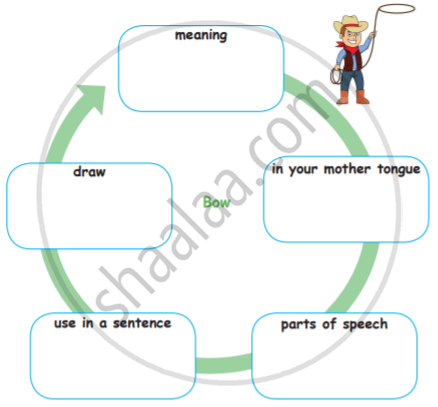
Choose and write the adverbs to complete the sentence.

She coloured the picture ____.
Sparrow tied the elephant and the crocodile with a ______.
The sparrow solved the problem with her _____.
Where did the tanker man take the water from the village?
Recite the poem with correct intonation.
Secondly the greedy merchant is ready to offer______.
If the fisher draws his net soon, he won’t get ______ in the net.
Recite the poem Never give up with correct intonation.
What does the earth do when the day is over?
Why did the animals think that the jackal was a king?
What is Gandhiji’s ideal?
