Advertisements
Advertisements
प्रश्न
Identify and explain steps ‘A’, ‘B’ and ‘C’ in the PCR diagram given below.

Advertisements
उत्तर
A - Denaturation
B - Annealing
C - Extension of primers
APPEARS IN
संबंधित प्रश्न
Name two commonly used bioreactors.
Draw a labelled sketch of sparged-stirred-tank bioreactor. Write its application.
Can you list 10 recombinant proteins which are used in medical practice? Find out where they are used as therapeutics (use the internet).
From what you have learnt, can you tell whether enzymes are bigger or DNA is bigger in molecular size? How did you know?
Besides better aeration and mixing properties, what other advantages do stirred tank bioreactors have over shake flasks?
Explain briefly:
Chitinase
Describe the process of amplification of the “gene of interest” using the PCR technique.
______ plays an important role in blood clotting.
The first step in recombinant DNA technology is
In addition to the Taq polymerase enzyme, which other thermostable DNA polymerases have been isolated to be used in PCR?
Which of the following steps are catalysed by Taq DNA polymerase in a PCR reaction?
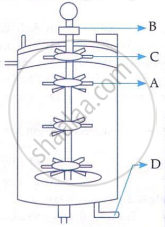
Identify the part of a bio-reactor which is used as a foam braker from the given figure.
Which enzyme is specifically used to break open fungal cells during the isolation of genetic material?
Which enzymes act as 'molecular scissors' to cut purified DNA precisely at specific target sites?
In agarose gel electrophoresis, why do DNA fragments move toward the positive electrode?
In the provided agarose gel electrophoresis image, what is represented in lane 1 compared to lanes 2 through 4?
Which enzyme is utilized in Polymerase Chain Reaction (PCR) because it remains active at high temperatures?
Which series of operations is collectively referred to as 'downstream processing'?
