Advertisements
Advertisements
प्रश्न
Give Scientific reason
In the electric equipment producing heat e.g. iron, electric heater, boiler, toaster etc, an alloy such as Nichrome is used, not pure metals.
Advertisements
उत्तर
In the electric equipment producing heat, such as iron, electric heater, boiler, toaster etc., an alloy such as Nichrome is used, not pure metals because of the following reasons:
(i) Resistivity of Nichrome is more compared to pure metal.
(ii) Melting point of Nichrome is high as compared to pure metal.
(iii) Nichrome does not get oxidised when heated in air whereas metal does.
APPEARS IN
संबंधित प्रश्न
Name any two effects of electric current.
An electric heater is connected to the 230 V mains supply. A current of 8 A flows through the heater.
(a) How much charge flows around the circuit each second?
An electric room heater draws a current of 2.4 A from the 120 V supply line. What current will this room heater draw when connected to 240 V supply line?
What is nichrome? State its one use.
Explain why, tungsten is used for making the filaments of electric bulbs.
A heating coil has a resistance of 200 Ω. At what rate will heat be produced in it when a current of 2.5 A flows through it?
A resistance of 25 Ω is connected to a 12 V battery. Calculate the heat energy in joules generated per minute.
Name the material which is used for making the filaments of an electric bulb.
The current passing through an electric kettle has been doubled. The heat produced will become:
(a) half
(b) double
(c) four time
(d) one-fourth
The elements of electrical heating devices are usually made of:
(a) tungsten
(b) bronze
(c) nichrome
(d) argon
Two exactly similar heating resistances are connected (i) in series, and (ii) in parallel, in two different circuits, one by one. If the same current is passed through both the combinations, is more heat obtained per minute when they are connected in series or when they are connected in parallel? Give reason for your answer.
Identify the figure and give its use.
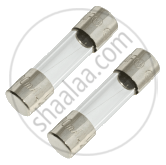
Identify the figure and give its use.

Solve the following example.
Two tungsten bulbs of wattage 100 W and 60 W power work on 220 V potential difference. If they are connected in parallel, how much current will flow in the main conductor?
Statement 1 : Electric current ( flow of electrons ) creates heat in the resistor.
Statement 2 : Heat in the resistor is created according to the rule of energy conservation.
Explain Statement 1 with the help of Statement 2.
Why does tungsten metal used to make solenoid type coil in an electric bulb?
Write the mathematical expression for Joule’s law of heating.
Compute the heat generated while transferring 96000 coulombs of charge in two hours through a potential difference of 40 V.
The ‘live’ and the ‘neutral’ wires have potential difference of _______.
Which metal is used to make the filament of an electric bulb?
What is a short circuit?
What is used to turn off the sudden increase in current in the electrical circuit of the house nowadays?
Live wire and neutral wires have a 220 V potential difference.
What does overloading cause?
An electric iron draws a current of 4 A when connected to 220 V mains. Its resistance must be:
Why is parallel arrangement used in domestic wiring?
Three incandescent bulbs of 100 W each are connected in series in an electric circuit. In another circuit another set of three bulbs of the same wattage are connected in parallel to the same source.
- Will the bulb in the two circuits glow with the same brightness? Justify your answer.
- Now let one bulb in both the circuits get fused. Will the rest of the bulbs continue to glow in each circuit? Give reason.
Name two electric devices for each where
- heating effect of current is used and
- magnetic effect of current is used.
Explain the working of an electric fuse.
Copper wire offers very little ______ and does not get heated up quickly.
Match the following
| 1. | Bulb | a. | Conductor |
| 2. | Electroplating | b. |
Insulator |
| 3. | Pure water | c. | Heating effect of current |
| 4. | Salt solution | d. | Chemical effect of current |
An electrochemical cell converts ______ energy into ______ energy.
The electric fuse works on the Joule heating principle.
Two students decided to investigate the effect of water and air on iron object under identical experimental conditions. They measured the mass of each object before placing it partially immersed in 10 ml of water. After a few days, the object were removed, dried and their masses were measured. The table shows their results.
| Student | Object | Mass of Object before Rusting in g |
Mass of the coated object in g |
| A | Nail | 3.0 | 3.15 |
| B | Thin plate | 6.0 | 6.33 |
What might be the reason for the varied observations of the two students?
