Advertisements
Advertisements
प्रश्न
Explain the following:
PbX2 is more stable than PbX4.
Advertisements
उत्तर
Due to inert pair effect, +2 oxidation state of Pb is more stable than its +4 oxidation state. Consequently, PbX2 in which the oxidation state of Pb is +2 is more stable than PbX4 in which the oxidation state of Pb is +4.
APPEARS IN
संबंधित प्रश्न
How can you explain higher stability of BCl3 as compared to TlCl3?
Suggest reasons why the B–F bond lengths in BF3 (130 pm) and `"BF"_4^(-)` (143 pm) differ.
The geometry of a complex species can be understood from the knowledge of type of hybridisation of orbitals of central atom. The hybridisation of orbitals of central atom in [Be(OH)4]– and the geometry of the complex are respectively.
The exhibition of highest co-ordination number depends on the availability of vacant orbitals in the central atom. Which of the following elements is not likely to act as central atom in \[\ce{MF^{3-}6}\]?
Ionisation enthalpy (∆iH1kJ mol–1) for the elements of Group 13 follows the order.
Cement, the important building material is a mixture of oxides of several elements. Besides calcium, iron and sulphur, oxides of elements of which of the group (s) are present in the mixture?
Which of the following statements are correct. Answer on the basis of Figure.
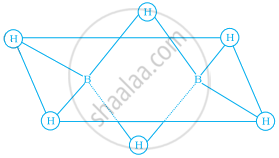
(i) The two birdged hydrogen atoms and the two boron atoms lie in one plane;
(ii) Out of six B – H bonds two bonds can be described in terms of 3 centre 2-electron bonds.
(iii) Out of six B – H bonds four B – H bonds can be described in terms of 3 centre 2 electron bonds;
(iv) The four-terminal B – H bonds are two centre-two electron regular bonds.
Explain why the following compounds behave as Lewis acids?
AlCl3
Explain the following:
Boron does not exist as B3+ ion.
Explain the following:
Pb4+ acts as an oxidising agent but Sn2+ acts as a reducing agent.
Identify the compounds A, X and Z in the following reactions:
\[\ce{A + 2HCl + 5H2O -> 2NaCl + X}\]
Match the species given in Column I with properties given in Column II.
| Column I | Column II |
| (i) Diborane | (a) Used as a flux for soldering metals |
| (ii) Galluim | (b) Crystalline form of silica |
| (iii) Borax | (c) Banana bonds |
| (iv) Aluminosilicate | (d) Low melting, high boiling, useful for measuring high temperatures |
| (v) Quartz | (e) Used as catalyst in petrochemical industries |
Describe the general trends in the following properties of the elements in Groups 13 and 14.
Metallic character
Describe the general trends in the following properties of the elements in Groups 13 and 14.
Oxidation states
Three pairs of compounds are given below. Identify that compound in each of the pairs which has group 13 element in more stable oxidation state. Give reason for your choice. State the nature of bonding also.
TlCl3, TlCl
Which one of the following is the correct statement?
