Advertisements
Advertisements
प्रश्न
Advertisements
उत्तर
We have,
\[\frac{dy}{dx} = x \log x\]
\[ \Rightarrow dy = \left( x \log x \right)dx\]
Integrating both sides, we get
\[\int dy = \int\left( x \log x \right)dx\]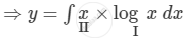
\[ \Rightarrow y = \log x\int x\ dx - \int\left[ \frac{d}{dx}\left( \log x \right)\int x\ dx \right]dx\]
\[ \Rightarrow y = \log x \times \frac{x^2}{2} - \int\left( \frac{1}{x} \times \frac{x^2}{2} \right)dx\]
\[ \Rightarrow y = \frac{1}{2} x^2 \log x - \int\frac{x}{2}dx\]
\[ \Rightarrow y = \frac{1}{2} x^2 \log x - \frac{x^2}{4} + C\]
\[ \text{ Hence, }y = \frac{1}{2} x^2 \log x - \frac{x^2}{4} + \text{C is the solution to the given differential equation.}\]
APPEARS IN
संबंधित प्रश्न
Solve the equation for x: `sin^(-1) 5/x + sin^(-1) 12/x = π/2, x ≠ 0`
Verify that y = log \[\left( x + \sqrt{x^2 + a^2} \right)^2\] satisfies the differential equation \[\left( a^2 + x^2 \right)\frac{d^2 y}{d x^2} + x\frac{dy}{dx} = 0\]
xy (y + 1) dy = (x2 + 1) dx
x cos2 y dx = y cos2 x dy
(1 − x2) dy + xy dx = xy2 dx
Solve the following initial value problem:-
\[y' + y = e^x , y\left( 0 \right) = \frac{1}{2}\]
Solve the following initial value problem:
\[x\frac{dy}{dx} + y = x \cos x + \sin x, y\left( \frac{\pi}{2} \right) = 1\]
The surface area of a balloon being inflated, changes at a rate proportional to time t. If initially its radius is 1 unit and after 3 seconds it is 2 units, find the radius after time t.
At every point on a curve the slope is the sum of the abscissa and the product of the ordinate and the abscissa, and the curve passes through (0, 1). Find the equation of the curve.
A curve is such that the length of the perpendicular from the origin on the tangent at any point P of the curve is equal to the abscissa of P. Prove that the differential equation of the curve is \[y^2 - 2xy\frac{dy}{dx} - x^2 = 0\], and hence find the curve.
The rate of increase of bacteria in a culture is proportional to the number of bacteria present and it is found that the number doubles in 6 hours. Prove that the bacteria becomes 8 times at the end of 18 hours.
The equation of the curve whose slope is given by \[\frac{dy}{dx} = \frac{2y}{x}; x > 0, y > 0\] and which passes through the point (1, 1) is
The differential equation \[x\frac{dy}{dx} - y = x^2\], has the general solution
Solve the following differential equation.
`x^2 dy/dx = x^2 +xy - y^2`
Solve the following differential equation.
y dx + (x - y2 ) dy = 0
Solve the differential equation sec2y tan x dy + sec2x tan y dx = 0
Solve: `("d"y)/("d"x) + 2/xy` = x2
State whether the following statement is True or False:
The integrating factor of the differential equation `("d"y)/("d"x) - y` = x is e–x
Find the particular solution of the following differential equation
`("d"y)/("d"x)` = e2y cos x, when x = `pi/6`, y = 0.
Solution: The given D.E. is `("d"y)/("d"x)` = e2y cos x
∴ `1/"e"^(2y) "d"y` = cos x dx
Integrating, we get
`int square "d"y` = cos x dx
∴ `("e"^(-2y))/(-2)` = sin x + c1
∴ e–2y = – 2sin x – 2c1
∴ `square` = c, where c = – 2c1
This is general solution.
When x = `pi/6`, y = 0, we have
`"e"^0 + 2sin pi/6` = c
∴ c = `square`
∴ particular solution is `square`
The differential equation of all non horizontal lines in a plane is `("d"^2x)/("d"y^2)` = 0
Solve the differential equation
`x + y dy/dx` = x2 + y2
