Advertisements
Advertisements
Question
Advertisements
Solution
We have,
\[\frac{dy}{dx} = x \log x\]
\[ \Rightarrow dy = \left( x \log x \right)dx\]
Integrating both sides, we get
\[\int dy = \int\left( x \log x \right)dx\]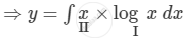
\[ \Rightarrow y = \log x\int x\ dx - \int\left[ \frac{d}{dx}\left( \log x \right)\int x\ dx \right]dx\]
\[ \Rightarrow y = \log x \times \frac{x^2}{2} - \int\left( \frac{1}{x} \times \frac{x^2}{2} \right)dx\]
\[ \Rightarrow y = \frac{1}{2} x^2 \log x - \int\frac{x}{2}dx\]
\[ \Rightarrow y = \frac{1}{2} x^2 \log x - \frac{x^2}{4} + C\]
\[ \text{ Hence, }y = \frac{1}{2} x^2 \log x - \frac{x^2}{4} + \text{C is the solution to the given differential equation.}\]
APPEARS IN
RELATED QUESTIONS
Form the differential equation representing the family of ellipses having centre at the origin and foci on x-axis.
Hence, the given function is the solution to the given differential equation. \[\frac{c - x}{1 + cx}\] is a solution of the differential equation \[(1+x^2)\frac{dy}{dx}+(1+y^2)=0\].
Show that y = ex (A cos x + B sin x) is the solution of the differential equation \[\frac{d^2 y}{d x^2} - 2\frac{dy}{dx} + 2y = 0\]
For the following differential equation verify that the accompanying function is a solution:
| Differential equation | Function |
|
\[x\frac{dy}{dx} + y = y^2\]
|
\[y = \frac{a}{x + a}\]
|
\[x^2 \frac{dy}{dx} = x^2 + xy + y^2 \]
2xy dx + (x2 + 2y2) dy = 0
In a culture, the bacteria count is 100000. The number is increased by 10% in 2 hours. In how many hours will the count reach 200000, if the rate of growth of bacteria is proportional to the number present?
If the marginal cost of manufacturing a certain item is given by C' (x) = \[\frac{dC}{dx}\] = 2 + 0.15 x. Find the total cost function C (x), given that C (0) = 100.
Show that all curves for which the slope at any point (x, y) on it is \[\frac{x^2 + y^2}{2xy}\] are rectangular hyperbola.
The equation of the curve whose slope is given by \[\frac{dy}{dx} = \frac{2y}{x}; x > 0, y > 0\] and which passes through the point (1, 1) is
The differential equation \[x\frac{dy}{dx} - y = x^2\], has the general solution
Find the equation of the plane passing through the point (1, -2, 1) and perpendicular to the line joining the points A(3, 2, 1) and B(1, 4, 2).
Find the differential equation whose general solution is
x3 + y3 = 35ax.
Solve the following differential equation.
`dy /dx +(x-2 y)/ (2x- y)= 0`
Solve the following differential equation.
`dy/dx + y = e ^-x`
Solve the following differential equation.
y dx + (x - y2 ) dy = 0
Choose the correct alternative.
The differential equation of y = `k_1 + k_2/x` is
The solution of `dy/ dx` = 1 is ______.
Solve the differential equation:
`e^(dy/dx) = x`
Solve: `("d"y)/("d"x) + 2/xy` = x2
Verify y = log x + c is the solution of differential equation `x ("d"^2y)/("d"x^2) + ("d"y)/("d"x)` = 0
Solve the differential equation `"dy"/"dx"` = 1 + x + y2 + xy2, when y = 0, x = 0.
The differential equation of all non horizontal lines in a plane is `("d"^2x)/("d"y^2)` = 0
Solve the differential equation
`x + y dy/dx` = x2 + y2
What distinguishes an ordinary differential equation from other types of differential equations?
In mathematics and science, what primary purpose do differential equations serve?
