Advertisements
Advertisements
प्रश्न
Advertisements
उत्तर
We have,
\[\frac{dy}{dx} = x \log x\]
\[ \Rightarrow dy = \left( x \log x \right)dx\]
Integrating both sides, we get
\[\int dy = \int\left( x \log x \right)dx\]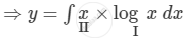
\[ \Rightarrow y = \log x\int x\ dx - \int\left[ \frac{d}{dx}\left( \log x \right)\int x\ dx \right]dx\]
\[ \Rightarrow y = \log x \times \frac{x^2}{2} - \int\left( \frac{1}{x} \times \frac{x^2}{2} \right)dx\]
\[ \Rightarrow y = \frac{1}{2} x^2 \log x - \int\frac{x}{2}dx\]
\[ \Rightarrow y = \frac{1}{2} x^2 \log x - \frac{x^2}{4} + C\]
\[ \text{ Hence, }y = \frac{1}{2} x^2 \log x - \frac{x^2}{4} + \text{C is the solution to the given differential equation.}\]
APPEARS IN
संबंधित प्रश्न
Show that the differential equation of which \[y = 2\left( x^2 - 1 \right) + c e^{- x^2}\] is a solution is \[\frac{dy}{dx} + 2xy = 4 x^3\]
For the following differential equation verify that the accompanying function is a solution:
| Differential equation | Function |
|
\[x\frac{dy}{dx} = y\]
|
y = ax |
x cos y dy = (xex log x + ex) dx
tan y dx + sec2 y tan x dy = 0
In a bank principal increases at the rate of 5% per year. An amount of Rs 1000 is deposited with this bank, how much will it worth after 10 years (e0.5 = 1.648).
Solve the following differential equations:
\[\frac{dy}{dx} = \frac{y}{x}\left\{ \log y - \log x + 1 \right\}\]
Find the particular solution of the differential equation \[\frac{dy}{dx} = \frac{xy}{x^2 + y^2}\] given that y = 1 when x = 0.
The rate of growth of a population is proportional to the number present. If the population of a city doubled in the past 25 years, and the present population is 100000, when will the city have a population of 500000?
The decay rate of radium at any time t is proportional to its mass at that time. Find the time when the mass will be halved of its initial mass.
Find the equation of the curve which passes through the point (2, 2) and satisfies the differential equation
\[y - x\frac{dy}{dx} = y^2 + \frac{dy}{dx}\]
Find the curve for which the intercept cut-off by a tangent on x-axis is equal to four times the ordinate of the point of contact.
At every point on a curve the slope is the sum of the abscissa and the product of the ordinate and the abscissa, and the curve passes through (0, 1). Find the equation of the curve.
Find the equation of the curve that passes through the point (0, a) and is such that at any point (x, y) on it, the product of its slope and the ordinate is equal to the abscissa.
Find the solution of the differential equation
\[x\sqrt{1 + y^2}dx + y\sqrt{1 + x^2}dy = 0\]
Solve the following differential equation : \[y^2 dx + \left( x^2 - xy + y^2 \right)dy = 0\] .
Form the differential equation representing the family of parabolas having vertex at origin and axis along positive direction of x-axis.
Solve the differential equation:
`"x"("dy")/("dx")+"y"=3"x"^2-2`
Find the equation of the plane passing through the point (1, -2, 1) and perpendicular to the line joining the points A(3, 2, 1) and B(1, 4, 2).
The solution of `dy/dx + x^2/y^2 = 0` is ______
Choose the correct alternative.
The solution of `x dy/dx = y` log y is
A solution of a differential equation which can be obtained from the general solution by giving particular values to the arbitrary constants is called ___________ solution.
The integrating factor of the differential equation `dy/dx - y = x` is e−x.
State whether the following is True or False:
The degree of a differential equation is the power of the highest ordered derivative when all the derivatives are made free from negative and/or fractional indices if any.
`dy/dx = log x`
Solve the following differential equation y log y = `(log y - x) ("d"y)/("d"x)`
Verify y = `a + b/x` is solution of `x(d^2y)/(dx^2) + 2 (dy)/(dx)` = 0
y = `a + b/x`
`(dy)/(dx) = square`
`(d^2y)/(dx^2) = square`
Consider `x(d^2y)/(dx^2) + 2(dy)/(dx)`
= `x square + 2 square`
= `square`
Hence y = `a + b/x` is solution of `square`
Solve the following differential equation `("d"y)/("d"x)` = cos(x + y)
Solution: `("d"y)/("d"x)` = cos(x + y) ......(1)
Put `square`
∴ `1 + ("d"y)/("d"x) = "dv"/("d"x)`
∴ `("d"y)/("d"x) = "dv"/("d"x) - 1`
∴ (1) becomes `"dv"/("d"x) - 1` = cos v
∴ `"dv"/("d"x)` = 1 + cos v
∴ `square` dv = dx
Integrating, we get
`int 1/(1 + cos "v") "d"v = int "d"x`
∴ `int 1/(2cos^2 ("v"/2)) "dv" = int "d"x`
∴ `1/2 int square "dv" = int "d"x`
∴ `1/2* (tan("v"/2))/(1/2)` = x + c
∴ `square` = x + c
The differential equation of all non horizontal lines in a plane is `("d"^2x)/("d"y^2)` = 0
A man is moving away from a tower 41.6 m high at a rate of 2 m/s. If the eye level of the man is 1.6 m above the ground, then the rate at which the angle of elevation of the top of the tower changes, when he is at a distance of 30 m from the foot of the tower, is
