Topics
Chemical Reactions and Equations
- Chemical Reactions in Daily Life
- Chemical Equations
- Balancing Chemical Equation
- Types of Chemical Reactions > Combination Reaction
- Types of Chemical Reactions > Decomposition Reaction
- Types of Chemical Reactions > Single Displacement Reaction
- Types of Chemical Reactions > Double Displacement Reaction
- Chemical Properties of Carbon Compounds > Oxidation
- The Effects of Oxidation Reactions in Everyday Life
Acids, Bases and Salts
- Acids and Bases in Daily Life
- Acids and Bases in the Laboratory
- Acids and Bases React with Metals
- Reaction of Metal Carbonates with Acids
- Acids and Bases Reaction with each other
- Reaction of Metallic Oxides with Acids
- Reaction of a Non-metallic Oxide with Base
- Common Properties of Acids and Bases
- The pH Scale
- Importance of pH in Everyday Life
- Salts > Family of Salts
- Salts > pH of Salts
- Salts > Chemicals from Common Salt
- Salts > Water in Salt Crystals
Metals and Non-metals
Carbon and its Compounds
- Importance of Carbon
- The Covalent Bond
- Allotropes of Carbon > Diamond
- Allotropes of Carbon > Graphite
- Allotropes of Carbon > Fullerene
- Carbon: A Versatile Element
- Organic Compounds
- Classification of Hydrocarbons
- Carbon Compounds: Chains, Branches, Rings
- Homologous Series
- Nomenclature
- Chemical Properties of Carbon Compounds > Combustion
- Ethanol
- Ethanoic Acid
- Soaps and Detergents
Life Processes
- Life Processes in Living Organisms
- Nutrition
- Autotrophic Nutrition
- Heterotrophic Nutrition
- Nutrition in Human Beings
- Dental Caries
- Production of ATP
- Blood Circulatory System
- Blood Vessels Entering and Leaving The Heart
- Valves of the Heart
- Tissue Fluid (Or Intercellular Fluid)
- Transportation in Plants
- Transportation of Water
- Excretion
- Excretion in Human Beings
- Kidney and Its Internal Structure
- Structure of a Kidney Tubule (Nephrons)
- Dialysis and Artificial Kidney
- Excretion in Plants
- Organ and Body Donation
Control and Co-ordination
How do Organisms Reproduce?
Heredity
Light – Reflection and Refraction
- Light and Its Straight-Line Propagation
- Reflection of Light
- Spherical Mirrors
- Image Formation by Spherical Mirrors
- Representation of Images Formed by Spherical Mirrors
- Image Formation by Concave Mirror
- Image Formation by a Convex Mirror
- Sign Convention for Reflection by Spherical Mirrors
- Ray Optics - Mirror Formula
- Refraction of Light
- Refraction through a Rectangular Glass Slab
- The Refractive Index
- Refraction by Spherical Lenses
- Image Formation by Lenses
- Image Formation in Lenses Using Ray Diagrams
- Sign Convention for Spherical Lenses
- Lens Formula
- Power of a Lens
The Human Eye and the Colourful World
- Human Eye
- Defects of Vision and Their Correction
- Defects of Vision and Their Corrections > Myopia
- Defects of Vision and Their Corrections > Hypermetropia
- Defects of Vision and Their Corrections > Presbyopia
- Refraction of Light Through a Prism
- Dispersion of Light
- Atmosphere Refraction
- Scattering of Light
Electricity
Magnetic Effects of Electric Current
- Magnetic Effect of Electric Current
- Applications of Biot-Savart's Law > Magnetic Field due to a Finite Straight Current-Carrying Wire
- Magnetic Field Due to a Current-Carrying Conductor
- Right-hand Thumb Rule
- Applications of Biot-Savart's Law > Magnetic Field at the Centre of a Circular Loop
- Applications of Ampere’s Circuital Law > Magnetic Field of a Long Straight Solenoid
- Force on a Current Carrying Conductor in a Magnetic Field
- Fleming’s Left Hand Rule
- Magnetism in Medicine
- Domestic Electric Circuits
Our Environment
Introduction
The circulatory system moves blood all around the body. It transports oxygen from the lungs to the rest of the body. It also carries nutrients from the food we eat to all parts of the body. The circulatory system helps remove waste products like carbon dioxide from the body. The heart is the main organ of the circulatory system, pumping blood through blood vessels (arteries and veins) to keep everything working properly.
- A network that consists of tubes or ‘vessels’ that carry blood away from the heart and those that bring it back to the heart is spread throughout the body.
- The process of keeping the blood flowing through all parts of the body is called ‘blood circulation.’
- Apart from oxygen, blood carries innumerable other substances from one part of the body to another all the time. That, too, is made possible by the circulation of blood.
- The heart and the network of blood vessels together form the ‘circulatory system.’
- The circulatory system performs the function of transporting various substances like water, hormones, oxygen, soluble nutrients, and waste materials through different organs.
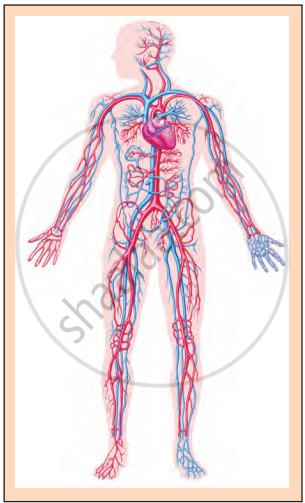
Blood vascular system
The blood vascular system includes the heart, blood vessels, and blood. The heart works like a pump, pushing blood throughout the body. Blood vessels are like tubes that carry blood everywhere. There are two types:
- Arteries carry blood away from the heart.
- Veins bring blood back to the heart.
Blood moves through the vessels, carrying important things like oxygen and nutrients to all parts of the body. It also carries waste away from the body to be removed.
Blood Composition
Blood is made up of two main parts: plasma and formed elements.
- Plasma is the liquid part of the blood that carries nutrients, hormones, and waste.
- Formed Elements: The solid parts of blood, which include blood cells.
Types of Formed Elements:
- Red Blood Cells (RBCs): They carry oxygen from the lungs to all parts of the body. They also take carbon dioxide (a waste product) from the body back to the lungs to be breathed out.
- White Blood Cells (WBCs): They help the body fight infections and protect against germs. And act like the body’s soldiers, defending us from diseases.
- Platelets: They help form clots when we get a cut or injury. This stops bleeding and helps wounds heal.
Blood Coagulation (Clotting):
Blood coagulation is the process that helps stop bleeding when you get a cut or injury. Platelets in the blood gather at the site of the cut to form a clot. The clot acts like a plug, blocking the injury to stop the blood from leaking out. This helps protect the body and allows the wound to heal properly. Without blood clotting, even small cuts could cause us to lose too much blood.
