Please select a subject first
Advertisements
Advertisements
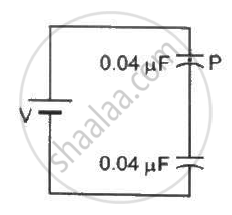
The particle P shown in figure has a mass of 10 mg and a charge of −0⋅01 µC. Each plate has a surface area 100 cm2 on one side. What potential difference V should be applied to the combination to hold the particle P in equilibrium?
Concept: undefined >> undefined
An iron needle is attracted to the ends of a bar magnet but not to the middle region of the magnet. Is the material making up the ends of a bare magnet different from that of the middle region?
Concept: undefined >> undefined
Advertisements
Two bar magnets are placed close to each other with their opposite poles facing each other. In absence of other forces, the magnets are pulled towards each other and their kinetic energy increases. Does it contradict our earlier knowledge that magnetic forces cannot do any work and hence cannot increase kinetic energy of a system?
Concept: undefined >> undefined
A bar magnet of length 1 cm and cross-sectional area 1.0 cm2 produces a magnetic field of 1.5 × 10⁻⁴ T at a point in end-on position at a distance 15 cm away from the centre. (a) Find the magnetic moment M of the magnet. (b) Find the magnetisation I of the magnet. (c) Find the magnetic field B at the centre of the magnet.
Concept: undefined >> undefined
To convert mechanical energy into electrical energy, one can use
(a) DC dynamo
(b) AC dynamo
(c) motor
(d) transformer
Concept: undefined >> undefined
When a Coolidge tube is operated for some time it becomes hot. Where does the heat come from?
Concept: undefined >> undefined
In a Coolidge tube, electrons strike the target and stop inside it. Does the target get more and more negatively charged as time passes?
Concept: undefined >> undefined
Can X-rays be used for photoelectric effect?
Concept: undefined >> undefined
Can X-rays be polarised?
Concept: undefined >> undefined
X-ray and visible light travel at the same speed in vacuum. Do they travel at the same speed in glass?
Concept: undefined >> undefined
Characteristic X-rays may be used to identify the element from which they are being emitted. Can continuous X-rays be used for this purpose?
Concept: undefined >> undefined
Is it possible that in a Coolidge tube characteristic Lα X-rays are emitted but not Kα X-rays?
Concept: undefined >> undefined
Can Lα X-ray of one material have shorter wavelength than Kα X-ray of another?
Concept: undefined >> undefined
Can a hydrogen atom emit characteristic X-rays?
Concept: undefined >> undefined
Why is exposure to X-rays injurious to health but not exposure to visible light, when both are electromagnetic waves?
Concept: undefined >> undefined
An X-ray beam can be deflected
Concept: undefined >> undefined
Consider a photon of a continuous X-ray coming from a Coolidge tube. Its energy comes from
Concept: undefined >> undefined
The energy of a photon of a characteristic X-ray from a Coolidge tube comes from
Concept: undefined >> undefined
If the potential difference applied to the tube is doubled and the separation between the filament and the target is also doubled, the cutoff wavelength
Concept: undefined >> undefined
If the current in the circuit for heating the filament is increased, the cutoff wavelength
Concept: undefined >> undefined
