Advertisements
Advertisements
प्रश्न
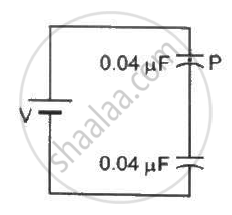
The particle P shown in figure has a mass of 10 mg and a charge of −0⋅01 µC. Each plate has a surface area 100 cm2 on one side. What potential difference V should be applied to the combination to hold the particle P in equilibrium?
Advertisements
उत्तर
The particle is balanced when the electrical force on it is balanced by its weight.
Thus,
`mg = qE`
`mg = q xx V^'/d.............(1)`
Here,
d = Separation between the plates of the capacitor
V' = Potential difference across the capacitor containing the particle
We know that the capacitance of a capacitor is given by
`C = (∈_0A)/d`
`⇒ d = (∈_0A)/c`
Thus, eq. (1) becomes
`mg = q xx V^' xx C/(∈_0A)`
`⇒ V^' = (mg∈_0A)/(q xx c)`
`⇒ V^' = (10^-6 xx 9.8 xx (8.85 xx 10^-12) xx (100 xx 10^-4))/((0.01 xx 10^-6) xx (0.04 xx 10^-6)`
`⇒ V^' = 21.68 "mV"`
Since the values of both the capacitors are the same,
`V = 2V = 2 xx 21.86 ≈ 43 "mV"`
