Please select a subject first
Advertisements
Advertisements
The plate current in a triode can be written as \[i_p = k \left( V_g + \frac{V_p}{\mu} \right)^{3/2}\] Show that the mutual conductance is proportional to the cube root of the plate current.
Concept: undefined >> undefined
Concept: undefined >> undefined
Advertisements
Name the phenomenon which shows the quantum nature of electromagnetic radiation.
Concept: undefined >> undefined
A device 'X' is connected to an ac source V = V0 sin ωt. The variation of voltage, current and power in one cycle is shown in the following graph:
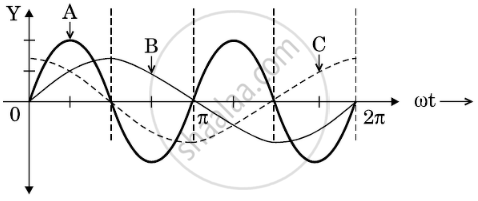
(a) Identify the device 'X'.
(b) Which of the curves A, B and C represent the voltage , current and the power consumed in the circuit? Justify your answer.
(c) How does its impedance vary with frequency of the ac source? Show graphically.
(d) Obtain an expression for the current in the circuit and its phase relation with ac voltage.
Concept: undefined >> undefined
Consider a plane wave front incident on a thin convex lens. Draw a proper diagram to show how the incident wave front traverses through the lens and after refraction focusses on the focal point of the lens, giving the shape of the emergent wave front.
Concept: undefined >> undefined
Use Huygens' principle to verify the laws of refraction.
Concept: undefined >> undefined
Define the distance of closest approach. An α-particle of kinetic energy 'K' is bombarded on a thin gold foil. The distance of the closest approach is 'r'. What will be the distance of closest approach for an α-particle of double the kinetic energy?
Concept: undefined >> undefined
Write two important limitations of Rutherford's nuclear model of the atom.
Concept: undefined >> undefined
How does one explain the emission of electrons from a photosensitive surface with the help of Einstein's photoelectric equation?
Concept: undefined >> undefined
The work function of the following metals is given : Na 2.75 ev, K = 2.3 eV, Mo = 4.17 eV and Ni = 5.15 eV. Which of these metals will not cause photoelectric emission for radiation of wavelength 3300 Å from a laser source placed 1 m away from these metals? What happens if the laser source is brought nearer and placed 50 cm away?
Concept: undefined >> undefined
Predict the polarity of the capacitor in the situation described below :
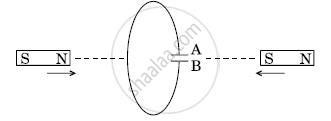
Concept: undefined >> undefined
State Huygens’s principle. Show, with the help of a suitable diagram, how this principle is used to obtain the diffraction pattern by a single slit.
Draw a plot of intensity distribution and explain clearly why the secondary maxima becomes weaker with increasing order (n) of the secondary maxima.
Concept: undefined >> undefined
Huygens' principle of secondary wavelets may be used to
(a) find the velocity of light in vacuum
(b) explain the particle behaviour of light
(c) find the new position of a wavefront
(d) explain Snell's Law
Concept: undefined >> undefined
Light waves travel in vacuum along the X-axis. Which of the following may represent the wave fronts?
Concept: undefined >> undefined
One of your friends says that he has read in the previous chapters that there can be no electric field inside a conductor. Consequently, there can be no current through it. What is the fallacy of this argument?
Concept: undefined >> undefined
A fan with copper winding in its motor consumes less power compared to a similar fan with aluminium winding. Explain.
Concept: undefined >> undefined
Does a conductor become charged when a current is passed through it?
Concept: undefined >> undefined
The amount of charge that passes in time t through a cross-section of a wire is
Q(t) = At2 + Bt + C.
(a) Write the dimensional formulae for A, B and C.
(b) If the numerical values of A, B and C are 5, 3 and 1, respectively, in S.I units, find the value of the current at t = 5 s.
Concept: undefined >> undefined
Take the potential of the point B in figure to be zero. (a) Find the potentials at the points C and D. (b) If a capacitor is connected between C and D, what charge will appear on this capacitor?
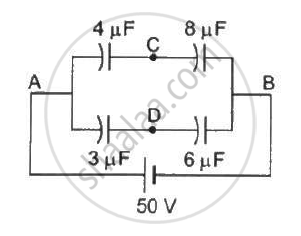
Concept: undefined >> undefined
