Please select a subject first
Advertisements
Advertisements
Explain why:
Objects fall to the earth.
Concept: undefined >> undefined
What do you understand by the free fall?
Concept: undefined >> undefined
Advertisements
Represent the location of an object described as at 15 m, 45o west of north, on a graph paper.
Concept: undefined >> undefined
Represent the position of a body described as at 15 m, 30o north of west, on a graph paper.
Concept: undefined >> undefined
The area under a speed-time graph in a given intervals gives the total distance covered by a body irrespective of its motion being uniform or non-uniform.
Concept: undefined >> undefined
The area of the right triangle under a speed-time graph is 500 m, in a time interval of 20 s. What is the speed of the body? Is the motion uniform or non-uniform?
Concept: undefined >> undefined
Name the physical quantity which is equal to the area under speed-time graph.
Concept: undefined >> undefined
How does the slope of a speed-time graph give the acceleration of a body moving along a straight line?
Concept: undefined >> undefined
How will you use a speed-time graph to find whether the acceleration of the body is uniform or not?
Concept: undefined >> undefined
The graph of one quantity versus another result in a straight line. How are the quantities related to each other?
Concept: undefined >> undefined
Given on th e side are a few speed - time graphs for various objects moving along a stra ight line. Refer below figure. (a), (b), (c) and (d).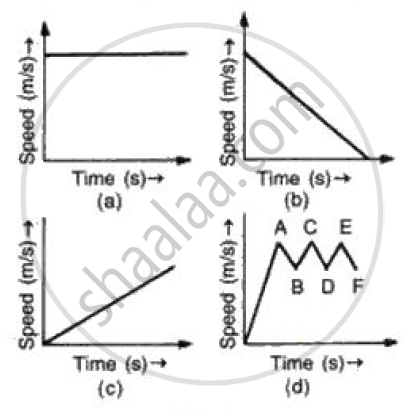
Which of these graphs represent
(a) Uni form motion
(b) Motion with speed increasing
(c) Motion with speed decreasing and
(d) Motion with speed oscillating.?
Concept: undefined >> undefined
Draw the speed-time graph of a body when its initial speed is not zero and the speed increases uniformly with time.
Concept: undefined >> undefined
Draw the speed-time graph of a body starting from some point P, gradually picking up speed, then running at a uniform speed and finally slowing down to stop at some point Q.
Concept: undefined >> undefined
What can you conclude if the speed-time graph of a body is a curve moving upwards starting from the origin?
Concept: undefined >> undefined
What can you conclude if the speed-time graph of a body is a straight line sloping upwards and not passing through the origin?
Concept: undefined >> undefined
Draw the following graph:
Speed versus time for a stepped motion
Concept: undefined >> undefined
Draw the following graph:
Speed versus time for a non-uniform acceleration.
Concept: undefined >> undefined
Draw the following graph:
Distance versus time for a body at rest.
Concept: undefined >> undefined
Draw the following graph:
Speed versus time for a fluctuating speed.
Concept: undefined >> undefined
Draw the following graph:
Speed versus time for a uniformly retarded motion.
Concept: undefined >> undefined
