Please select a subject first
Advertisements
Advertisements
Figure (a) shows the velocity-time graph for the motion of a body. Use it to find the displacement of the body at t = 1 s, 2 s, 3 s and 4 s, then draw on Figure (b), the displacement-time graph for it.
 |
 |
| (a) | (b) |
Concept: undefined >> undefined
Figure given below shows a velocity-time graph for a car starting from rest. The graph has three parts AB, BC and CD.
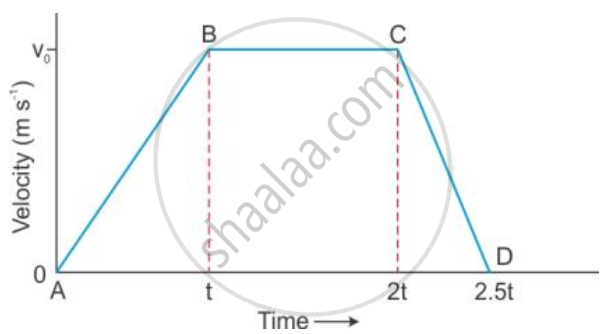
Compare the distance travelled in part BC with the distance travelled in part AB.
Concept: undefined >> undefined
Advertisements
Figure given below shows a velocity-time graph for a car starting from rest. The graph has three parts AB, BC and CD.
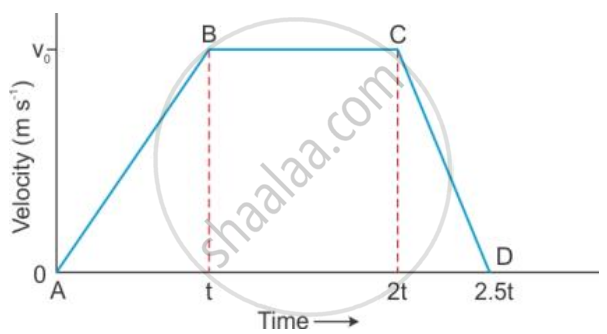
State how is the distance travelled in any part determined from this graph .
Concept: undefined >> undefined
A ball moves on a smooth floor in a straight line with uniform velocity 10 m s-1 for 6 s. At t = 6 s, the ball hits a wall and comes back along the same line to the starting point with the same speed. Draw the velocity-time graph and use it to find the total distance travelled by the ball and its displacement.
Concept: undefined >> undefined
Figure shows the velocity-time graph of a particle moving in a straight line.
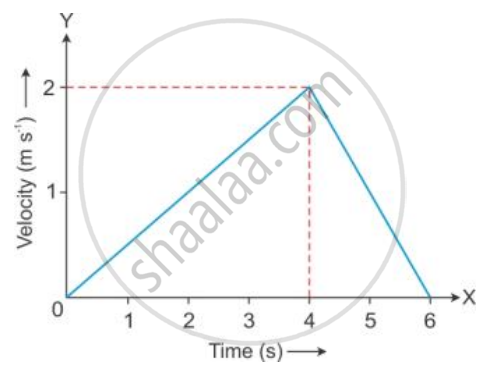
(i) State the nature of motion of particle.
(ii) Find the displacement of particle at t = 6 s.
(iii) Does the particle change its direction of motion?
(iv) Compare the distance travelled by the particle from 0 to 4 s and from 4 s to 6 s.
(v) Find the acceleration from 0 to 4 s and retardation from 4 s to 6 s.
Concept: undefined >> undefined
Write an expression for the distance S covered in time t by a body which is initially at rest and starts moving with a constant acceleration a.
Concept: undefined >> undefined
A car starting from rest accelerates uniformly to acquire a speed 20 km h-1 in 30 min. The distance travelled by a car in this time interval will be _____________
Concept: undefined >> undefined
A body starts from rest with uniform acceleration 2 m s-2. Find the distance covered by the body in 2 s.
Concept: undefined >> undefined
A body starts with an initial velocity of 10m s-1 and acceleration 5 m s-2. Find the distance covered by it in 5 s.
Concept: undefined >> undefined
When brakes are applied to a bus, retardation produced is 25 cm s-2 and the bus takes 20 s to stop. Calculate -
- The initial velocity of the bus
- The distance travelled by bus during this time.
Concept: undefined >> undefined
A car travels a distance 100 m with constant acceleration and average velocity of 20 ms-1. The final velocity acquired by the car is 25 ms-1.
Find
(i) The initial velocity.
(ii) Acceleration of the car.
Concept: undefined >> undefined
State Newton's first law of motion.
Concept: undefined >> undefined
State and explain the law of inertia (or Newton's first law of motion).
Concept: undefined >> undefined
Give qualitative definition of force on the basic of Newton's first law of motion.
Concept: undefined >> undefined
Explain the following :
After alighting from a moving bus , one has to run for some distance in the direction of bus in order to avoid falling .
Concept: undefined >> undefined
How does Newton's second law of motion differ from the first law of motion?
Concept: undefined >> undefined
State the two laws of reflection of light.
Concept: undefined >> undefined
State the laws of reflection and describe an experiment to verify them.
Concept: undefined >> undefined
Differentiate between a real and a virtual image.
Concept: undefined >> undefined
According to the law of reflection :
Concept: undefined >> undefined
