Advertisements
Advertisements
A radioactive source emits three type of radiations. Give the charge and mass of particles composing the alpha radiations.
Concept: undefined >> undefined
A radioactive source emits three type of radiations.
When the alpha particle becomes neutral, it is found to be the atom of a rare gas. Name this rare gas and draw a model of its neutral atom.
Concept: undefined >> undefined
Advertisements
Name the phenomenon involved in tunning a radio set to a particular station.
Concept: undefined >> undefined
In the diagram below, A, B, C, D are four pendulums suspended from the same elastic string PQ. The lengths of A and C are equal to each other, while the length of pendulum B is smaller than that of D. Pendulum A is set into a mode of vibrations.
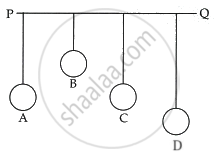
- Name the type of vibrations taking place in pendulums B and D.
- What is the state of pendulum C?
- State the reason for the type of vibrations in pendulums B and C.
Concept: undefined >> undefined
The adjacent diagram shows three different modes of vibrations P, Q and R of the same string.
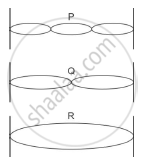
(i) Which vibration will produce a louder sound and why?
(ii) The sound of which string will have maximum shrillness?
(iii) State the ratio of wavelengths of P and R.
Concept: undefined >> undefined
Identify the following wires used in a household circuit: The wire is connected to the top terminal of a three pin socket.
Concept: undefined >> undefined
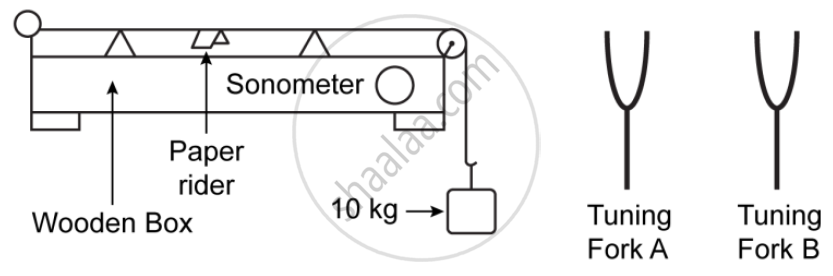
The diagram above shows a wire stretched over a sonometer. Stems of two vibrating tuning forks A and Bare touched to the wooden box of the sonometer. It is observed that the paper rider (a small piece of paper folded at the centre) present on the wire flies off when the stem of vibrating tuning fork B is touched to the wooden box but the paper just vibrates when the stem of vibrating tuning fork A is touched to the wooden box.
1) Name the phenomenon when the paper rider just vibrates.
2) Name the phenomenon when the paper rider flies off.
3) Why does the paper rider fly off when the stem of tuning fork B is touched to the box?
Concept: undefined >> undefined
How does the medium affect the amplitude of free/natural vibrations of a body?
Concept: undefined >> undefined
Distinguish between the free (or natural) and forced vibrations.
Concept: undefined >> undefined
Give one example to illustrate forced vibrations.
Concept: undefined >> undefined
Describe a simple experiment to illustrate the phenomenon of resonance and explain it.
Concept: undefined >> undefined
Resonance is a special case of ______ vibrations, when frequency of the driving force is ______ natural frequency of the body.
Concept: undefined >> undefined
Differentiate between the forced and resonant vibrations.
Concept: undefined >> undefined
Why is a loud sound heard at resonance?
Concept: undefined >> undefined
In following figure shows two tuning forks A and B of the same frequency mounted on two separate sound boxes with their open ends facing each other. The fork A is set into vibration.
- Describe your observation.
- State the principle illustrated by this experiment.

Concept: undefined >> undefined
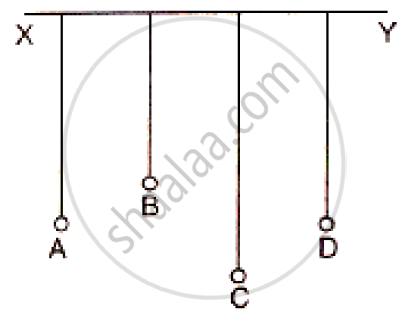
In following figure shows A, B, C and D are four pendulums suspended from the same elastic string XY. Lengths of pendulum A and D are equal, while the length of pendulum B is smaller and the pendulum C is longer. The pendulum A is set into vibration.
(a) what is your observation? (b) Give reason for your observation.
Concept: undefined >> undefined
A vibrating tuning fork, held over an air column of a given length with its one end closed, produces a loud audible sound. Name the phenomenon responsible for it and explain the observation.
Concept: undefined >> undefined
