Advertisements
Advertisements
What conclusion can you draw about the speed of a body from the following distance-time graph ?
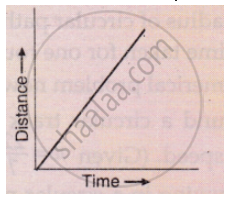
Concept: undefined >> undefined
What can you say about the motion of a body whose distance-time graph is a straight line parallel to the time axis ?
Concept: undefined >> undefined
Advertisements
Fill in the following blank with suitable word :
The slope of a distance-time graph indicates ………………….. of a moving body.
Concept: undefined >> undefined
Fill in the following blank with suitable word :
The slope of a speed-time graph of a moving body gives its………………………..
Concept: undefined >> undefined
What is the other name of Newton’s first law of motion ?
Concept: undefined >> undefined
Name the scientist who gave the laws of motion.
Concept: undefined >> undefined
Fill in the following blank with suitable word :
Newton’s first law of motion is also called Galileo’s law of ………………………
Concept: undefined >> undefined
Name the two quantities, the slope of whose graph give speed .
Concept: undefined >> undefined
State Newton’s first law of motion. Give two examples to illustrate Newton’s first law of motion.
Concept: undefined >> undefined
A moving bicycle comes to rest after sometime if we stop pedalling it. But Newton’s first law of motion says that a moving body should continue to move for ever, unless some external force acts on it. How do you explain the bicycle case ?
Concept: undefined >> undefined
Define one newton force.
Concept: undefined >> undefined
Name the physical quantity whose unit is ‘newton’.
Concept: undefined >> undefined
A cyclist is travelling at 15 m s-1. She applies brakes so that she does not collide with a wall 18 m away. What deceleration must she have ?
Concept: undefined >> undefined
Find the acceleration produced by a force of 5 N acting on a mass of 10 kg.
Concept: undefined >> undefined
The graph given alongside shows the positions of a body at different times. Calculate the speed of the body as it moves from :
(1) A to B,
(2) B to C, and
(3) C to D.
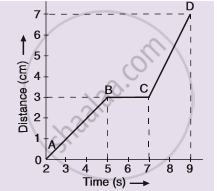
Concept: undefined >> undefined
Name the law involved in the following situation :
if there were no friction and no air resistance, then a moving bicycle would go on moving for ever.
Concept: undefined >> undefined
A car is travelling at 20 m/s along a road. A child runs out into the road 50 m ahead and the car driver steps on the brake pedal. What must the car’s deceleration be if the car is to stop just before it reaches the child ?
Concept: undefined >> undefined
State whether the following statement is true or false :
The buoyant force depends on the nature of object immersed in the liquid
Concept: undefined >> undefined
In which direction does the buoyant force on an object due to a liquid act ?
Concept: undefined >> undefined
What is the other name of buoyant force ?
Concept: undefined >> undefined
