Advertisements
Advertisements
प्रश्न
A cyclist is travelling at 15 m s-1. She applies brakes so that she does not collide with a wall 18 m away. What deceleration must she have ?
Advertisements
उत्तर
We have to find the deceleration. We have the following information given,
Initial velocity, (u) = 15 m/s
Final velocity, (v) = 0 m/s
Distance travelled, (s) = 18 m
Let the acceleration be (a)
We can calculate acceleration by using the 3rd equation of motion,
`a = (v^2 - u^2)/(2s)`
Put the values in above equation to find the deceleration,
a = (0-225)/(36)
⇒ `a =-6.25 "m/s"^2`
Thus , the deceleration is 6.25 `"m/s"^2`
APPEARS IN
संबंधित प्रश्न
What can you say about the motion of an object if its speed-time graph is a straight line parallel to the time axis?
A driver of a car travelling at 52 km h−1 applies the brakes and accelerates uniformly in the opposite direction. The car stops in 5 s. Another driver going at 3 km h−1 in another car applies his brakes slowly and stops in 10 s. On the same graph paper, plot the speed versus time graphs for the two cars. Which of the two cars travelled farther after the brakes were applied?
What conclusion can you draw about the speed of a body from the following distance-time graph ?
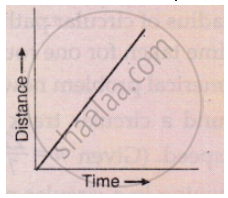
Name the two quantities, the slope of whose graph give speed .
A student draws a distance-time graph for a moving scooter and finds that a section of the graph is horizontal line parallel to the time axis. Which of the following conclusion is correct about this section of the graph?
Show the shape of the distance – time graph for the motion in the following cases.
- A bus moving with a constant speed.
- A car parked on a road side.
Starting from A, Paheli moves along a rectangular path ABCD as shown in figure. She takes 2 minutes to travel each side. Plot a distance-time graph and explain whether the motion is uniform or non-uniform.

Distance between Bholu’s and Golu’s house is 9 km. Bholu has to attend Golu’s birthday party at 7 o’clock. He started from his home at 6 o’clock on his bicycle and covered a distance of 6 km in 40 minutes. At that point, he met Chintu and he spoke to him for 5 minutes and reached Golu’s birthday party at 7 o’clock. With what speed did he cover the second part of the journey? Calculate his average speed for the entire journey.
The area under velocity time graph represents ______.
Assertion: The position-time graph of a uniform motion in one dimension of a body can have a negative slope
Reason: When the speed of the body decreases with time then, the position-time graph of the moving body has a negative slope.
