Please select a subject first
Advertisements
Advertisements
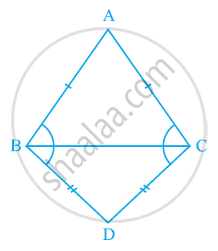
ABC and DBC are two isosceles triangles on the same base BC (see the given figure). Show that ∠ABD = ∠ACD.
Concept: undefined >> undefined
ΔABC is an isosceles triangle in which AB = AC. Side BA is produced to D such that AD = AB (see the given figure). Show that ∠BCD is a right angle.

Concept: undefined >> undefined
Advertisements
Show that the angles of an equilateral triangle are 60° each.
Concept: undefined >> undefined
A chord of a circle is equal to the radius of the circle. Find the angle subtended by the chord at a point on the minor arc and also at a point on the major arc.
Concept: undefined >> undefined
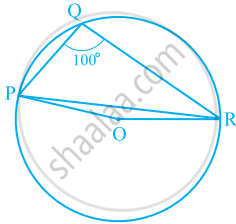
In the given figure, ∠PQR = 100°, where P, Q and R are points on a circle with centre O. Find ∠OPR.
Concept: undefined >> undefined
ABCD is a cyclic quadrilateral whose diagonals intersect at a point E. If ∠DBC = 70°, ∠BAC is 30°, find ∠BCD. Further, if AB = BC, find ∠ECD.
Concept: undefined >> undefined
If diagonals of a cyclic quadrilateral are diameters of the circle through the vertices of the quadrilateral, prove that it is a rectangle.
Concept: undefined >> undefined
If the non-parallel sides of a trapezium are equal, prove that it is cyclic.
Concept: undefined >> undefined
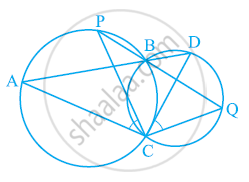
Two circles intersect at two points B and C. Through B, two line segments ABD and PBQ are drawn to intersect the circles at A, D and P, Q respectively (see the given figure). Prove that ∠ACP = ∠QCD.
Concept: undefined >> undefined
If circles are drawn taking two sides of a triangle as diameters, prove that the point of intersection of these circles lie on the third side.
Concept: undefined >> undefined
ABC and ADC are two right triangles with common hypotenuse AC. Prove that ∠CAD = ∠CBD.
Concept: undefined >> undefined
Prove that a cyclic parallelogram is a rectangle.
Concept: undefined >> undefined
Prove that the line of centres of two intersecting circles subtends equal angles at the two points of intersection.
Concept: undefined >> undefined
Let the vertex of an angle ABC be located outside a circle and let the sides of the angle intersect equal chords AD and CE with the circle. Prove that ∠ABC is equal to half the difference of the angles subtended by the chords AC and DE at the centre.
Concept: undefined >> undefined
Prove that the circle drawn with any side of a rhombus as diameter passes through the point of intersection of its diagonals.
Concept: undefined >> undefined
ABCD is a parallelogram. The circle through A, B and C intersect CD (produced if necessary) at E. Prove that AE = AD.
Concept: undefined >> undefined
AC and BD are chords of a circle which bisect each other. Prove that (i) AC and BD are diameters; (ii) ABCD is a rectangle.
Concept: undefined >> undefined
Two congruent circles intersect each other at points A and B. Through A any line segment PAQ is drawn so that P, Q lie on the two circles. Prove that BP = BQ.
Concept: undefined >> undefined
In any triangle ABC, if the angle bisector of ∠A and perpendicular bisector of BC intersect, prove that they intersect on the circumcircle of the triangle ABC.
Concept: undefined >> undefined
Two chords AB and CD of lengths 5 cm 11cm respectively of a circle are parallel to each other and are on opposite sides of its centre. If the distance between AB and CD is 6 cm, find the radius of the circle.
Concept: undefined >> undefined
