Advertisements
Advertisements
A free neutron decays to a proton but a free proton does not decay to a neutron. This is because
Concept: undefined >> undefined
When a photon is emitted from an atom, the atom recoils. The kinetic energy of recoil and the energy of the photon come from the difference in energies between the states involved in the transition. Suppose, a hydrogen atom changes its state from n = 3 to n = 2. Calculate the fractional change in the wavelength of light emitted, due to the recoil.
Concept: undefined >> undefined
Advertisements
Consider an excited hydrogen atom in state n moving with a velocity υ(ν<<c). It emits a photon in the direction of its motion and changes its state to a lower state m. Apply momentum and energy conservation principles to calculate the frequency ν of the emitted radiation. Compare this with the frequency ν0 emitted if the atom were at rest.
Concept: undefined >> undefined
Suppose Swarglok (heaven) is in constant motion at a speed of 0.9999c with respect to the earth. According to the earth's frame, how much time passes on the earth before one day passes on Swarglok?
Concept: undefined >> undefined
If a person lives on the average 100 years in his rest frame, how long does he live in the earth frame if he spends all his life on a spaceship going at 60% of the speed of light.
Concept: undefined >> undefined
Calculate the energy released by 1g of natural uranium assuming 200 MeV is released in each fission event and that the fissionable isotope 235U has an abundance of 0.7% by weight in natural uranium.
Concept: undefined >> undefined
A uranium reactor develops thermal energy at a rate of 300 MW. Calculate the amount of 235U being consumed every second. Average released per fission is 200 MeV.
Concept: undefined >> undefined
Calculate the Q-value of the fusion reaction 4He + 4He = 8Be. Is such a fusion energetically favourable? Atomic mass of 8Be is 8.0053 u and that of 4He is 4.0026 u.
(Use Mass of proton mp = 1.007276 u, Mass of `""_1^1"H"` atom = 1.007825 u, Mass of neutron mn = 1.008665 u, Mass of electron = 0.0005486 u ≈ 511 keV/c2,1 u = 931 MeV/c2.)
Concept: undefined >> undefined
Calculate the energy that can be obtained from 1 kg of water through the fusion reaction 2H + 2H → 3H + p. Assume that 1.5 × 10⁻²% of natural water is heavy water D2O (by number of molecules) and all the deuterium is used for fusion.
(Use Mass of proton mp = 1.007276 u, Mass of `""_1^1"H"` atom = 1.007825 u, Mass of neutron mn = 1.008665 u, Mass of electron = 0.0005486 u ≈ 511 keV/c2,1 u = 931 MeV/c2.)
Concept: undefined >> undefined
A town has a population of 1 million. The average electric power needed per person is 300 W. A reactor is to be designed to supply power to this town. The efficiency with which thermal power is converted into electric power is aimed at 25%. (a) Assuming 200 MeV to thermal energy to come from each fission event on an average, find the number of events that should take place every day. (b) Assuming the fission to take place largely through 235U, at what rate will the amount of 235U decrease? Express your answer in kg per day. (c) Assuming that uranium enriched to 3% in 235U will be used, how much uranium is needed per month (30 days)?
Concept: undefined >> undefined
A plate current of 10 mA is obtained when 60 volts are applied across a diode tube. Assuming the Langmuir-Child relation \[i_p \infty V_p^{3/2}\] to hold, find the dynamic resistance rp in this operating condition.
Concept: undefined >> undefined
The plate current in a diode is 20 mA when the plate voltage is 50 V or 60 V. What will be the current if the plate voltage is 70 V?
Concept: undefined >> undefined
The power delivered in the plate circular of a diode is 1.0 W when the plate voltage is 36 V. Find the power delivered if the plate voltage is increased to 49 V. Assume Langmuir-Child equation to hold.
Concept: undefined >> undefined
A triode value operates at Vp = 225 V and Vg = −0.5 V.
The plate current remains unchanged if the plate voltage is increased to 250 V and the grid voltage is decreased to −2.5 V. Calculate the amplification factor.
Concept: undefined >> undefined
The dynamic plate resistance of a triode value is 10 kΩ. Find the change in the plate current if the plate voltage is changed from 200 V to 220 V.
Concept: undefined >> undefined
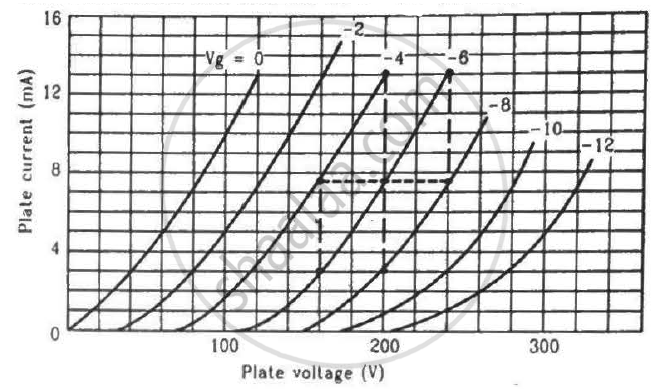
Find the values of rp, µ and gm of a triode operating at plate voltage 200 V and grid voltage −6. The plate characteristics are shown in the figure.
Concept: undefined >> undefined
The gain factor of an amplifier in increased from 10 to 12 as the load resistance is changed from 4 kΩ to 8 kΩ. Calculate (a) the amplification factor and (b) the plate resistance.
Concept: undefined >> undefined
Use Einstein’s photoelectric equation to show how from this graph,
(i) Threshold frequency, and (ii) Planck’s constant can be determined.
Concept: undefined >> undefined
How does one explain the emission of electrons from a photosensitive surface with the help of Einstein’s photoelectric equation?
Concept: undefined >> undefined
Answer the following question.
Why photodiodes are required to operate in reverse bias? Explain.
Concept: undefined >> undefined
