Advertisements
Advertisements
प्रश्न
Use Einstein’s photoelectric equation to show how from this graph,
(i) Threshold frequency, and (ii) Planck’s constant can be determined.
Advertisements
उत्तर
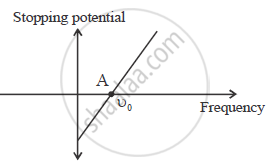
eV0 =hυ - hυ0
`V_0 = h/e(υ - v_0)`
Point A on the graph shows threshold frequency.
eV0 = hv - Φ0
`V_0 = h/e υ - (phi _0)/e`
Slope of the given graphs gives `h/e`
Slope `= h/e`
h = e × slope of the graph
APPEARS IN
संबंधित प्रश्न
In an accelerator experiment on high-energy collisions of electrons with positrons, a certain event is interpreted as annihilation of an electron-positron pair of total energy 10.2 BeV into two γ-rays of equal energy. What is the wavelength associated with each γ-ray? (1BeV = 109 eV)
Is p − E/c valid for electrons?
A non-monochromatic light is used in an experiment on photoelectric effect. The stopping potential
A monochromatic light source of intensity 5 mW emits 8 × 10¹⁵ photons per second. This light ejects photoelectrons from a metal surface. The stopping potential for this setup is 2.0 V. Calculate the work function of the metal.
(Use h = 6.63 × 10⁻³⁴J-s = 4.14 × 10⁻¹⁵ eV-s, c = 3 × 10⁸ m/s and me = 9.1 × 10⁻³¹kg)
The minimum energy required to remove an electron is called ______.
A student performs an experiment on photoelectric effect, using two materials A and B. A plot of Vstop vs ν is given in Figure.

- Which material A or B has a higher work function?
- Given the electric charge of an electron = 1.6 × 10⁻¹⁹ C, find the value of h obtained from the experiment for both A and B.
Comment on whether it is consistent with Einstein’s theory:
If c is the velocity of light in free space, the correct statements about photon among the following are:
- The energy of a photon is E = hv.
- The velocity of a photon is c.
- The momentum of a photon, ρ = `(h v)/c`.
- In a photon-electron collision, both total energy and total momentum are conserved.
- Photon possesses positive charge.
Choose the correct answer from the options given below:
In \[E=h\nu\], what does \[E\] represent?
What condition must be met for photoelectric emission to occur?
How is the work function related to the threshold frequency \[\nu_0\]?
