Please select a subject first
Advertisements
Advertisements
Name the material which is used for making the heating element of an electric iron.
Concept: undefined >> undefined
How does the resistance of a pure metal change if its temperature decreases?
Concept: undefined >> undefined
Advertisements
How does the presence of impurities in a metal affect its resistance?
Concept: undefined >> undefined
Write down an expression for the resistance of a metallic wire in terms of the resistivity.
Concept: undefined >> undefined
Give one example to show how the resistance depends on the nature of material of the conductor.
Concept: undefined >> undefined
Calculate the resistance of an aluminium cable of length 10 km and diameter 2.0 mm if the resistivity of aluminium is 27 × 10−8 Ωm.
Concept: undefined >> undefined
How does the resistance of a wire change when:
its length is tripled?
Concept: undefined >> undefined
How does the resistance of a wire change when:
its diameter is tripled?
Concept: undefined >> undefined
Give the law of combination of resistances in series.
Concept: undefined >> undefined
If five resistances, each of value 0.2 ohm, are connected in series, what will be the resultant resistance?
Concept: undefined >> undefined
V = IRTwo resistances X and Y are connected turn by turn : (i) in parallel, and (ii) series. In which case the resultant resistance will be less than either of the individual resistances?R = R1+ R2+ R3
Concept: undefined >> undefined
What possible values of resultant resistance one can get by combining two resistances, one of value 2 ohm and the other 6 ohm?
Concept: undefined >> undefined
Calculate the combined resistance in each case:
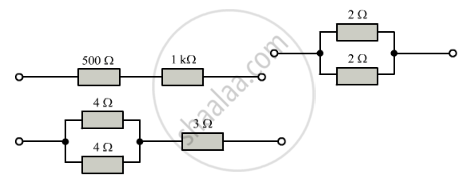
Concept: undefined >> undefined
A p.d. of 4 V is applied to two resistors of 6 Ω and 2 Ω connected in series. Calculate:
(a) the combined resistance
(b) the current flowing
(c) the p.d. across the 6 Ω resistor
Concept: undefined >> undefined
If two resistors of 25 Ω and 15 Ω are joined together in series and then placed in parallel with a 40 Ω resistor, the effective resistance of the combination is :
(a) 0.1 Ω
(b) 10 Ω
(c) 20 Ω
(d)40 Ω
Concept: undefined >> undefined
The diagram below shows part of a circuit:
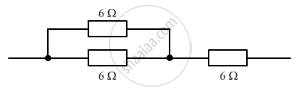
If this arrangement of three resistors was to be replaced by a single resistor, its resistance should be:
(a) 9 Ω
(b) 4 Ω
(c) 6 Ω
(d) 18 Ω
Concept: undefined >> undefined
What is (a) highest, and (b)Ω lowest, resistance which can be obtained by combining four resistors having the following resistances?
4 Ω, 8 Ω, 12 Ω, 24 Ω
Concept: undefined >> undefined
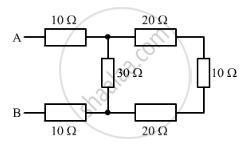
You are supplied with a number of 100 Ω resistors. How could you combine some of these resistors to make a 250 Ω resistor?
Concept: undefined >> undefined
What concealed do you get from the observation that a current-carrying wire deflects a compass needle placed near it?
Concept: undefined >> undefined
