Advertisements
Advertisements
(i) Define critical angle.
(ii) State one important factor which affects the critical angle of a given medium.
Concept: Total Internal Reflection
(i) What is the relation between the refractive index of water with respect to air `("_aμ_\text(w))` and the refractive index of air with respect to water `("_\text(w)μ_ a)` .
(ii) If the refractive index of water with respect to air `("_aμ_\text(w))` is`5/3`. Calculate the refractive index of air with respect to water `("_\text(w)μ_ a)` .
Concept: Refraction of Light Through a Rectangular Glass Block
The diagram below shows a light source P embedded in a rectangular glass block ABCD of critical angle 42°. Complete the path of the ray PQ till it emerges out of the block. [Write necessary angles].

Concept: Total Internal Reflection
When a ray of light travels normal to the given surface, then the angle of refraction is ______.
Concept: Refraction of Light
Small air bubbles rising up a fish tank appear silvery when viewed from some particular angle is due to the ______.
Concept: Total Internal Reflection
The diagram below shows two parallel rays A (Orange) & B (Blue) incident from air, on air-glass boundary.

- Copy and complete the path of the rays A and B.
- How do the speeds of these rays differ in glass?
- Are the two refracted rays in glass parallel? Give a reason.
Concept: Refraction of Light Through a Rectangular Glass Block
A coin kept inside water [µ = 4/3] when viewed from air in a vertical direction appears to be raised by 3.0 mm. Find the depth of the coin in water.
Concept: Real and Apparent Depth
Light travels a distance of '10x' units in time 't1' in vacuum and it travels a distance of 'x' units in time 't2' in a denser medium. Using this information answer the question that follows:
'Light covers a distance of '20x' units in time 't1' in diamond'. State true or false.
Concept: Speed of Light in Different Media
An endoscope uses optic fiber to transmit high resolution images of internal organs without loss of information. The principle of light that is used by the optic fiber is based on ______.
Concept: Total Internal Reflection
State two differences between normal reflection and total internal reflection.
Concept: Total Internal Reflection
O is a luminescent particle trapped inside a glass block. A student traces the path of rays coming out of it and reflecting over a plane mirror as shown in the diagram below.

Complete the table, using the labels from the figure. The first label is done for you.
| Sr. No. | Description | Label |
| a. | An angle of reflection on the mirror | a |
| b. | A partially reflected ray in the glass slab | |
| c. | A critical angle | |
| d. | A refracted ray | |
| e. | An angle of refraction of the ray R |
Concept: Multiple Images in a Thick Mirror
A lens forms an upright and diminished image of an object when the object is placed at its focal point. Name the lens and draw a ray diagram to show the image formation.
Concept: Images Formed by Convex Lenses
Ranbir claims to have obtained an image twice the size of the object with a concave lens. Is he correct? Give a reason for your answer.
Concept: Power of a Lens
A lens forms an erect, magnified, and virtual image of an object. Draw a labelled ray diagram to show the image formation.
Concept: Images Formed by Convex Lenses
The lens mentioned in 6(b) above is of focal length 25cm. Calculate the power of the lens.
Concept: Power of a Lens
Is it possible for a concave lens to form an image of size two times that of the object? Write Yes or No.
Concept: Images Formed by Concave Lenses
A convex lens of focal length 10 cm is placed at a distance of 60 cm from a screen. How far from the lens should an object be placed so as to obtain a real image on the screen?
Concept: Lens Formula and Magnification
A block of glass is pushed into the path of the light as shown below. Then the converging point x will:
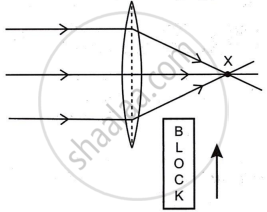
Concept: Action of a Lens as a Set of Prisms
The image of a candle flame placed at a distance of 36 cm from a spherical lens, is formed on a screen placed at a distance of 72 cm from the lens. Calculate the focal length of the lens and its power.
Concept: Lens Formula and Magnification
Mixture of red + blue + green is passed through a convex lens as shown in the diagram below. State whether the ray passes through a single point or through different points on the principal axis after refraction.

Concept: Technical Terms Related to a Lens
