CBSE Science (English Medium) कक्षा १२ Important Questions for Physics - Atoms
Advertisements
Advertisements
Chapter wise important questions with answers and solutions for Physics in CBSE Science (English Medium) कक्षा १२.
Find the wavelength of the electron orbiting in the first excited state in hydrogen atom.
अध्याय: [12] Atoms
How would the ionization energy change when the electron in the hydrogen atom is replaced by a particle of mass 200 times that of the electron but having the same charge?
अध्याय: [12] Atoms
Using Bohr's postulates, derive the expression for the orbital period of the electron moving in the nth orbit of hydrogen atom ?
अध्याय: [12] Atoms
State Bohr postulate of hydrogen atom that gives the relationship for the frequency of emitted photon in a transition.
अध्याय: [12] Atoms
An electron jumps from fourth to first orbit in an atom. How many maximum number of spectral lines can be emitted by the atom? To which series these lines correspond?
अध्याय: [12] Atoms
A 12.9 eV beam of electronic is used to bombard gaseous hydrogen at room temperature. Upto which energy level the hydrogen atoms would be excited ?
Calculate the wavelength of the first member of Paschen series and first member of Balmer series.
अध्याय: [12] Atoms
A 12.3 eV electron beam is used to bombard gaseous hydrogen at room temperature. Upto which energy level the hydrogen atoms would be excited?
Calculate the wavelengths of the second member of Lyman series and second member of Balmer series.
अध्याय: [12] Atoms
An electron in an atom revolves round the nucleus in an orbit of radius r with frequency v. Write the expression for the magnetic moment of the electron.
अध्याय: [12] Atoms
Using Bohr’s postulates, obtain the expressions for (i) kinetic energy and (ii) potential energy of the electron in stationary state of hydrogen atom.
Draw the energy level diagram showing how the transitions between energy levels result in the appearance of Lymann Series.
अध्याय: [12] Atoms
Using Bohr’s postulates, obtain the expression for the total energy of the electron in the stationary states of the hydrogen atom. Hence draw the energy level diagram showing how the line spectra corresponding to Balmer series occur due to transition between energy levels.
अध्याय: [12] Atoms
Using Bohr’s postulates, obtain the expression for total energy of the electron in the nth orbit of hydrogen atom.
अध्याय: [12] Atoms
Draw the energy level diagram showing how the line spectra corresponding to Paschen series occur due to transition between energy levels.
अध्याय: [12] Atoms
In a Geiger-Marsden experiment, calculate the distance of closest approach to the nucleus of Z = 80, when a α-particle of 8Mev energy impinges on it before it comes momentarily to rest and reverses its direction.
How will the distance of closest approach be affected when the kinetic energy of the α-particle is doubles?
अध्याय: [12] Atoms
In a Geiger-Marsden experiment, calculate the distance of closest approach to the nucleus of Z = 75, when a α-particle of 5 MeV energy impinges on it before it comes momentarily to rest and reverses its direction.
How will the distance of closest approach be affected when the kinetic energy of the α-particle is doubles?
अध्याय: [12] Atoms
Write the expression for Bohr’s radius in hydrogen atom ?
अध्याय: [12] Atoms
The energy levels of an atom are as shown below. Which of them will result in the transition of a photon of wavelength 275 nm?
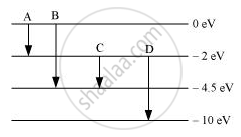
अध्याय: [12] Atoms
Which transition corresponds to emission of radiation of maximum wavelength?
अध्याय: [12] Atoms
Plot a graph showing the variation of de Broglie wavelength (X) associated with a charged a particle of mass m, versus `1/sqrtV` where V is the potential difference through which the particle is accelerated. How does this graph give us information regarding the magnitude of the charge of the particle?
अध्याय: [12] Atoms
Answer the following question.
A charged particle q is moving in the presence of a magnetic field B which is inclined to an angle 30° with the direction of the motion of the particle. Draw the trajectory followed by the particle in the presence of the field and explain how the particle describes this path.
अध्याय: [12] Atoms
Answer the following question.
Explain briefly how Rutherford scattering of α-particle by a target nucleus can provide information on the size of the nucleus.
