Advertisements
Advertisements
प्रश्न
Answer the following question.
A charged particle q is moving in the presence of a magnetic field B which is inclined to an angle 30° with the direction of the motion of the particle. Draw the trajectory followed by the particle in the presence of the field and explain how the particle describes this path.
Advertisements
उत्तर
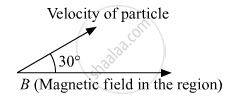
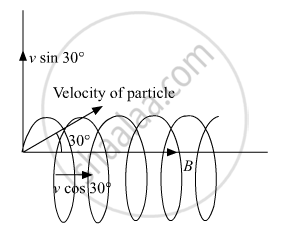
Lorentz force will be exerted on the particle because of the Sine component of particle velocity thereby making the particle move in a helical path.
Time period = `("Total distance")/("speed") = (2"πR")/("v"_"y") (2"πR")/("v" sin 30°) = (4"πR")/("v")`
Pitch = speed along x-axis × time period
`= "v"_x xx (2"πR")/("v"_"y")`
`= "v"_x xx (2"πR")/("v"sin30°) = "v"_x xx (2"πR" xx 2)/("v")`
= `"v" cos 30° xx (4"πR")/("v") = sqrt(3)/(2) xx 4"πR" = 2sqrt(3)"πR"`
R = `(mv sin 30°)/(q"B")`
Pitch = `(2sqrt(3)"πmv" sin 30°)/(q"B")`
= `(2sqrt(3)"πmv")/(q"B" xx2)`
= `(sqrt(3)"πmv")/(q"B")`
The vertical component of velocity will make the charged particle to move in a circular path whereas the horizontal component of velocity will provide Pitch = `(sqrt(3)"πmv")/(q"B")` Hence the motion of the particle will be helical with the Pitch= `(sqrt(3)"πmv")/(q"B")`.
APPEARS IN
संबंधित प्रश्न
Using Rutherford's model of the atom, derive the expression for the total energy of the electron in hydrogen atom. What is the significance of total negative energy possessed by the electron?
Thorium 90Th232 is disintegrated into lead 82Pb200. Find the number of α and β particles emitted in disintegration.
The size of the atom in Thomson’s model is ______ the atomic size in Rutherford’s model.
Alpha particles used in Geiger-Marsden experiment were obtained from ______.
As compared to 12C atom, 14C atom has ______.
The Bohr model for the H-atom relies on the Coulomb’s law of electrostatics. Coulomb’s law has not directly been verified for very short distances of the order of angstroms. Supposing Coulomb’s law between two opposite charge + q1, –q2 is modified to |F| = `(q_1q_2)/((4πε_0)) 1/r^2, r ≥ R_0 = (q_1q_2)/(4πε_0) 1/R_0^2 (R_0/r)^ε, r ≤ R_0` Calculate in such a case, the ground state energy of a H-atom, if ε = 0.1, R0 = 1Å.
What is the nuclear radius of 125Fe, if that of 27Al is 3.6 fermi?
Choose the correct option from the following options given below:
An alpha nucleus of energy `1/2`mv2 bombards a heavy nuclear target of charge Ze. Then the distance of closest approach for the alpha nucleus will be proportional to ______.
- v2
- `1/"m"`
- `1/"v"^2`
- `1/"Ze"`
Determine the distance of the closest approach when an alpha particle of kinetic energy 3.95 MeV approaches a nucleus of Z = 79, stops and reverses its directions.
