Advertisements
Advertisements
Question
Answer the following question.
A charged particle q is moving in the presence of a magnetic field B which is inclined to an angle 30° with the direction of the motion of the particle. Draw the trajectory followed by the particle in the presence of the field and explain how the particle describes this path.
Advertisements
Solution
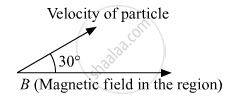
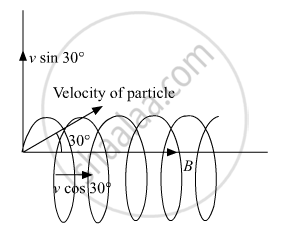
Lorentz force will be exerted on the particle because of the Sine component of particle velocity thereby making the particle move in a helical path.
Time period = `("Total distance")/("speed") = (2"πR")/("v"_"y") (2"πR")/("v" sin 30°) = (4"πR")/("v")`
Pitch = speed along x-axis × time period
`= "v"_x xx (2"πR")/("v"_"y")`
`= "v"_x xx (2"πR")/("v"sin30°) = "v"_x xx (2"πR" xx 2)/("v")`
= `"v" cos 30° xx (4"πR")/("v") = sqrt(3)/(2) xx 4"πR" = 2sqrt(3)"πR"`
R = `(mv sin 30°)/(q"B")`
Pitch = `(2sqrt(3)"πmv" sin 30°)/(q"B")`
= `(2sqrt(3)"πmv")/(q"B" xx2)`
= `(sqrt(3)"πmv")/(q"B")`
The vertical component of velocity will make the charged particle to move in a circular path whereas the horizontal component of velocity will provide Pitch = `(sqrt(3)"πmv")/(q"B")` Hence the motion of the particle will be helical with the Pitch= `(sqrt(3)"πmv")/(q"B")`.
APPEARS IN
RELATED QUESTIONS
Using Rutherford's model of the atom, derive the expression for the total energy of the electron in hydrogen atom. What is the significance of total negative energy possessed by the electron?
An automobile moves on a road with a speed of 54 km h−1. The radius of its wheels is 0.45 m and the moment of inertia of the wheel about its axis of rotation is 3 kg m2. If the vehicle is brought to rest in l 5s, the magnitude of average torque transmitted by its brakes to the wheel is:
The ratio of minimum to maxm wavelength in ballmer series is:-
The shortest wavelength of the Brackett series of a hydrogen like atom of atomic number Z is same as the shortest wavelength of the Balmer series of hydrogen atom, then the value of Z is ______.
How was the small detector positioned to detect scattered alpha-particles?
Where was the radioactive source of alpha-particles placed?
Approximately what percentage of incident alpha-particles were scattered by more than \[1^\circ\]?
Why is the nucleus treated as stationary during scattering?
Why is an alpha-particle assumed to suffer only a single scattering?
If the atomic number of an element is \[Z\], what is the charge on its nucleus?
