Advertisements
Advertisements
प्रश्न
Answer the following question.
A charged particle q is moving in the presence of a magnetic field B which is inclined to an angle 30° with the direction of the motion of the particle. Draw the trajectory followed by the particle in the presence of the field and explain how the particle describes this path.
Advertisements
उत्तर
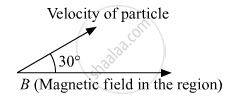
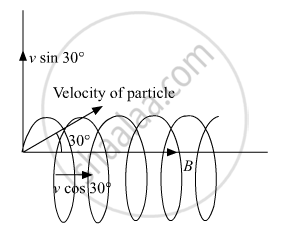
Lorentz force will be exerted on the particle because of the Sine component of particle velocity thereby making the particle move in a helical path.
Time period = `("Total distance")/("speed") = (2"πR")/("v"_"y") (2"πR")/("v" sin 30°) = (4"πR")/("v")`
Pitch = speed along x-axis × time period
`= "v"_x xx (2"πR")/("v"_"y")`
`= "v"_x xx (2"πR")/("v"sin30°) = "v"_x xx (2"πR" xx 2)/("v")`
= `"v" cos 30° xx (4"πR")/("v") = sqrt(3)/(2) xx 4"πR" = 2sqrt(3)"πR"`
R = `(mv sin 30°)/(q"B")`
Pitch = `(2sqrt(3)"πmv" sin 30°)/(q"B")`
= `(2sqrt(3)"πmv")/(q"B" xx2)`
= `(sqrt(3)"πmv")/(q"B")`
The vertical component of velocity will make the charged particle to move in a circular path whereas the horizontal component of velocity will provide Pitch = `(sqrt(3)"πmv")/(q"B")` Hence the motion of the particle will be helical with the Pitch= `(sqrt(3)"πmv")/(q"B")`.
APPEARS IN
संबंधित प्रश्न
With the help of a neat labelled diagram, describe the Geiger- Marsden experiment
A classical atom based on ______ is doomed to collapse.
Suppose you are given a chance to repeat the alpha-particle scattering experiment using a thin sheet of solid hydrogen in place of the gold foil. (Hydrogen is a solid at temperatures below 14 K.) What results do you expect?
Answer the following question, which help you understand the difference between Thomson’s model and Rutherford’s model better.
In which model is it completely wrong to ignore multiple scattering for the calculation of average angle of scattering of α-particles by a thin foil?
Write two important limitations of Rutherford's nuclear model of the atom.
Alpha particles used in Geiger-Marsden experiment were obtained from ______.
O2 molecule consists of two oxygen atoms. In the molecule, nuclear force between the nuclei of the two atoms ______.
A narrow beam of protons, each having 4.1 MeV energy is approaching a sheet of lead (Z = 82). Calculate:
- the speed of a proton in the beam, and
- the distance of its closest approach
The energy of hydrogen atom in an orbit is −1.51 eV. What are the kinetic and potential energies of the electron in this orbit?
In the Rutherford experiment, α-particles are scattered from a nucleus as shown. Out of the four paths, which path is not possible?

