Advertisements
Advertisements
प्रश्न
Plot a graph showing the variation of de Broglie wavelength (X) associated with a charged a particle of mass m, versus `1/sqrtV` where V is the potential difference through which the particle is accelerated. How does this graph give us information regarding the magnitude of the charge of the particle?
Advertisements
उत्तर
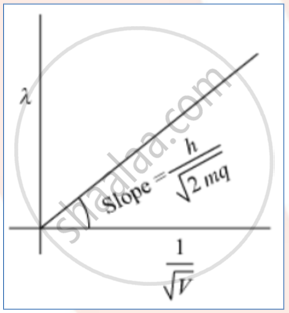
The slope of the graph is `h/sqrt(2mq)`considering we know the slope and mass of the charged particle we can easily calculate the charge.
APPEARS IN
संबंधित प्रश्न
Show that the radius of the orbit in hydrogen atom varies as n2, where n is the principal quantum number of the atom.
A uniform magnetic field B exist in a region. An electron projected perpendicular to the field goes in a circle. Assuming Bohr's quantization rule for angular momentum, calculate (a) the smallest possible radius of the electron (b) the radius of the nth orbit and (c) the minimum possible speed of the electron.
Answer the following question.
State Bohr's quantization condition of angular momentum. Calculate the shortest wavelength of the Bracket series and state to which part of the electromagnetic spectrum it belongs.
The simple Bohr model is not applicable to He 4 atom because ______.
- He4 is an inert gas.
- He4 has neutrons in the nucleus.
- He4 has one more electron.
- electrons are not subject to central forces.
What does the de Broglie hypothesis propose about material particles such as electrons?
Who experimentally verified the wave nature of electrons in 1927?
Which condition must a particle wave satisfy in the \[n\]-th circular orbit?
What does the condition \[2\pi r_n=n\lambda\] require of the orbit?
Which radiation frequencies does Bohr’s model predict especially well for hydrogenic atoms?
Which two-electron atom cannot be explained by extending Bohr’s model?
