CBSE Science (English Medium) कक्षा १२ Important Questions for Physics - Electric Charges and Fields
Advertisements
Advertisements
Chapter wise important questions with answers and solutions for Physics in CBSE Science (English Medium) कक्षा १२.
Two charges of magnitudes −3Q and + 2Q are located at points (a, 0) and (4a, 0) respectively. What is the electric flux due to these charges through a sphere of radius ‘5a’ with its centre at the origin?
अध्याय: [1] Electric Charges and Fields
Two charges of magnitudes +4Q and − Q are located at points (a, 0) and (− 3a, 0) respectively. What is the electric flux due to these charges through a sphere of radius ‘2a’ with its centre at the origin?
अध्याय: [1] Electric Charges and Fields
Define electric dipole moment.
अध्याय: [1] Electric Charges and Fields
A thin straight infinitely long conducting wire having charge density λ is enclosed by a cylindrical surface of radius r and length l, its axis coinciding with the length of the wire. Find the expression for the electric flux through the surface of the cylinder.
अध्याय: [1] Electric Charges and Fields
Figure shows three point charges +2q, −q and + 3q. Two charges + 2q and −q are enclosed within a surface ‘S’. What is the electric flux due to this configuration through the surface ‘S’?
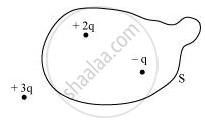
अध्याय: [1] Electric Charges and Fields
In which orientation, a dipole placed in a uniform electric field is in (i) stable, (ii) unstable equilibrium?
अध्याय: [1] Electric Charges and Fields
A thin conducting spherical shell of radius R has charge Q spread uniformly over its surface. Using Gauss’s law, derive an expression for an electric field at a point outside the shell.
अध्याय: [1] Electric Charges and Fields
Draw a graph of electric field E(r) with distance r from the centre of the shell for 0 ≤ r ≤ ∞.
अध्याय: [1] Electric Charges and Fields
State Gauss’s law for magnetism. Explain its significance.
अध्याय: [1] Electric Charges and Fields
Answer the following question.
State Gauss's law for magnetism. Explain its significance.
अध्याय: [1] Electric Charges and Fields
Deduce the expression for the torque `vec"τ"` acting on a planar loop of area `vec"A"` acting on a planar loop of area `vec"B"`. If the loop is free to rotate, what would be its orientation in stable equilibrium?
अध्याय: [1] Electric Charges and Fields
State Gauss's law in electrostatics. Show, with the help of a suitable example along with the figure, that the outward flux due to a point charge 'q'. in vacuum within a closed surface, is independent of its size or shape and is given by `q/ε_0`
अध्याय: [1] Electric Charges and Fields
State Gauss’s law on electrostatics and drive expression for the electric field due to a long straight thin uniformly charged wire (linear charge density λ) at a point lying at a distance r from the wire.
अध्याय: [1] Electric Charges and Fields
An electric dipole is placed at an angle of 30° with an electric field intensity of 2 × 10⁵ N/C. It experiences a torque equal to 4 Nm. The charge on the dipole, if the dipole length is 2 cm, is ______.
अध्याय: [1] Electric Charges and Fields
The electric potential V as a function of distance X is shown in the figure.
The graph of the magnitude of electric field intensity E as a function of X is ______.
अध्याय: [1] Electric Charges and Fields
Two large, thin metal plates are parallel and close to each other. On their inner faces, the plates have surface charge densities of opposite signs and of magnitude 17.7 × 10⁻²² C/m2. What is electric field intensity E:
- in the outer region of the first plate, and
- between the plates?
अध्याय: [1] Electric Charges and Fields
An electric dipole of dipole moment 2 × 10⁻⁸ C-m in a uniform electric field experiences a maximum torque of 6 × 10⁻⁴ N-m. The magnitude of the electric field is ______.
अध्याय: [1] Electric Charges and Fields
A charge Q is placed at the centre of a cube. The electric flux through one of its faces is ______.
