CBSE Science (English Medium) कक्षा १२ Important Questions for Physics - Moving Charges and Magnetism
Advertisements
Advertisements
Chapter wise important questions with answers and solutions for Physics in CBSE Science (English Medium) कक्षा १२.
Explain, giving reasons, the basic difference in converting a galvanometer into (i) a voltmeter and (ii) an ammeter?
अध्याय: [4] Moving Charges and Magnetism
Two long straight parallel conductors carrying steady currents I1 and I2 are separated by a distance 'd'. Explain briefly, with the help of a suitable diagram, how the magnetic field due to one conductor acts on the other. Hence deduce the expression for the force acting between the two conductors. Mention the nature of this force.
अध्याय: [4] Moving Charges and Magnetism
Draw a labelled diagram of a moving coil galvanometer and explain its working. What is the function of radial magnetic field inside the coil?
अध्याय: [4] Moving Charges and Magnetism
Solve the following question.
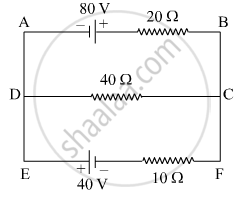
Using Kirchhoff’s rules, calculate the current through the 40 Ω and 20 Ω resistors in the following circuit.
अध्याय: [4] Moving Charges and Magnetism
Define the term ‘current sensitivity’ of a moving coil galvanometer.
अध्याय: [4] Moving Charges and Magnetism
Beams of electrons and protons move parallel to each other in the same direction. They ______.
अध्याय: [4] Moving Charges and Magnetism
A long straight wire of radius 'a' carries a steady current 'I'. The current is uniformly distributed across its area of cross-section. The ratio of the magnitude of magnetic field `vecB_1` at `a/2` and `vecB_2` at distance 2a is ______.
अध्याय: [4] Moving Charges and Magnetism
Two long parallel wires kept 2 m apart carry 3A current each, in the same direction. The force per unit length on one wire due to the other is ______.
अध्याय: [4] Moving Charges and Magnetism
Write Maxwell's generalization of Ampere's circuital law. Show that in the process of charging a capacitor, the current produced within the plates of the capacitor is `I=varepsilon_0 (dphi_E)/dt,`where ΦE is the electric flux produced during charging of the capacitor plates.
अध्याय: [4] Moving Charges and Magnetism
Why does a galvanometer show a momentary deflection at the time of charging or discharging a capacitor? Write the necessary expression to explain this observation.
अध्याय: [4] Moving Charges and Magnetism
Electron drift speed is estimated to be of the order of mm s−1. Yet large current of the order of few amperes can be set up in the wire. Explain briefly.
अध्याय: [4] Moving Charges and Magnetism
Derive the expression for the magnetic field due to a solenoid of length ‘2l’, radius ‘a’ having ’n’ number of turns per unit length and carrying a steady current ‘I’ at a point
on the axial line, distance ‘r’ from the centre of the solenoid. How does this expression compare with the axial magnetic field due to a bar magnet of magnetic moment ‘m’?
अध्याय: [4] Moving Charges and Magnetism
Define the term self-inductance of a solenoid.
अध्याय: [4] Moving Charges and Magnetism
How does one understand this motional emf by invoking the Lorentz force acting on the free charge carriers of the conductor? Explain.
अध्याय: [4] Moving Charges and Magnetism
Obtain the expression for the magnetic energy stored in an inductor of self-inductance L to build up a current I through it.
अध्याय: [4] Moving Charges and Magnetism
The figure shows three infinitely long straight parallel current carrying conductors. Find the
- magnitude and direction of the net magnetic field at point A lying on conductor 1,
- magnetic force on conductor 2.

अध्याय: [4] Moving Charges and Magnetism
Depict the behaviour of magnetic field lines in the presence of a diamagnetic material?
अध्याय: [4] Moving Charges and Magnetism
Two identical coils P and Q each of radius R are lying in perpendicular planes such that they have a common centre. Find the magnitude and direction of the magnetic field at the common centre of the two coils, if they carry currents equal to I and \[\sqrt{3}\] I respectively.

अध्याय: [4] Moving Charges and Magnetism
A point charge q moving with speed v enters a uniform magnetic field B that is acting into the plane of the paper as shown. What is the path followed by the charge q and in which plane does it move?
