Advertisements
Advertisements
Draw the equipotential surfaces due to an electric dipole.
Concept: Equipotential Surfaces
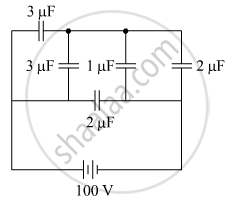
The figure shows a network of five capacitors connected to a 100 V supply. Calculate the total energy stored in the network.
Concept: Combination of Capacitors
An ac circuit consists of a series combination of circuit elements X and Y. The current is ahead of the voltage in phase by `pi/4`. If element X is a pure resistor of 100 Ω,
(a) name the circuit element Y.
(b) calculate the rms value of current, if rms of voltage is 141 V.
(c) what will happen if the ac source is replaced by a dc source
Concept: Combination of Capacitors
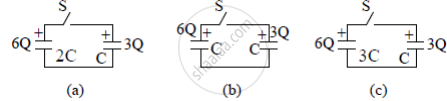
Three circuits, each consisting of a switch 'S' and two capacitors, are initially charged, as shown in the figure. After the switch has been closed, in which circuit will the charge on the left-hand capacitor
(i) increase,
(ii) decrease, and
(iii) remains the same? Give reasons.
Concept: Capacitors and Capacitance
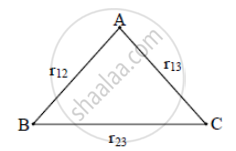
Define electrostatic potential at a point. Write its S.I. unit. Three-point charges q1, q2 and q3 are kept respectively at points A, B, and C as shown in the figure, Derive the expression for the electrostatic potential energy of the system.
Concept: Electrostatics of Conductors
Depict the equipotential surface due to
(i) an electric dipole,
(ii) two identical positive charges separated by a distance.
Concept: Equipotential Surfaces
Obtain the expression for capacitance for a parallel plate capacitor.
Concept: Capacitors and Capacitance
Which of the following is NOT the property of equipotential surface?
Concept: Equipotential Surfaces
- Assertion (A): An electron has a high potential energy when it is at a location associated with a more negative value of potential, and a low potential energy when at a location associated with a more positive potential.
- Reason (R): Electrons move from a region of higher potential to region of lower potential.
Select the most appropriate answer from the options given below:
Concept: Potential Energy of a System of Charges
Draw equipotential surfaces for (i) an electric dipole and (ii) two identical positive charges placed near each other.
Concept: Equipotential Surfaces
A point P lies at a distance x from the midpoint of an electric dipole on its axis. The electric potential at point P is proportional to ______.
Concept: Potential Due to an Electric Dipole
A parallel plate capacitor (A) of capacitance C is charged by a battery to voltage V. The battery is disconnected and an uncharged capacitor (B) of capacitance 2C is connected across A. Find the ratio of final charges on A and B.
Concept: Capacitors and Capacitance
A parallel plate capacitor (A) of capacitance C is charged by a battery to voltage V. The battery is disconnected and an uncharged capacitor (B) of capacitance 2C is connected across A. Find the ratio of total electrostatic energy stored in A and B finally and that stored in A initially.
Concept: Energy Stored in a Charged Capacitor
Depict the orientation of an electric dipole in (a) stable and (b) unstable equilibrium in an external uniform electric field. Write the potential energy of the dipole in each case.
Concept: Potential Energy in an External Field >> Potential Energy of a Dipole in an External Field
Charges (+q) and (–q) are placed at points A and B respectively which are a distance 2L apart. C is the midpoint between A and B. What is the work done in moving a charge +Q along the semicircle CRD?

Concept: Potential Energy of a System of Charges
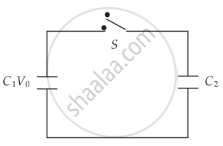
A capacitor of capacity C1 is charged to the potential of V0. On disconnecting with the battery, it is connected with an uncharged capacitor of capacity C2 as shown in the adjoining figure. Find the ratio of energies before and after the connection of switch S.
Concept: Combination of Capacitors
Obtain the equivalent capacitance of the network shown in the figure. For a 300 V supply, determine the charge on each capacitor.

Concept: Capacitors and Capacitance
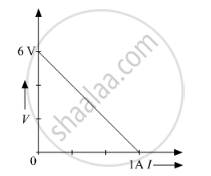
The plot of the variation of potential difference across a combination of three identical cells in series, versus current is shown below. What is the emf and internal resistance of each cell ?
Concept: Cells, EMF, and Internal Resistance
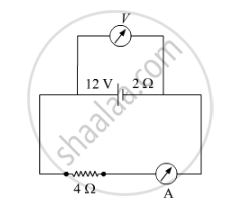
A battery of emf 12 V and internal resistance 2 Ω is connected to a 4 Ω resistor as shown in the figure.
(a) Show that a voltmeter when placed across the cell and across the resistor, in turn, gives the same reading.
(b) To record the voltage and the current in the circuit, why is voltmeter placed in parallel and ammeter in series in the circuit?
Concept: Cells, EMF, and Internal Resistance
What is its relation with relaxation time?
Concept: Drift of Electrons and the Origin of Resistivity
