Please select a subject first
Advertisements
Advertisements
Why does a galvanometer when connected in series with a capacitor show a momentary deflection, when it is being charged or discharged?
How does this observation lead to modifying the Ampere's circuital law?
Hence write the generalised expression of Ampere's law.
Concept: Moving Coil Galvanometer
An electron moving horizontally with a velocity of 4 ✕ 104 m/s enters a region of uniform magnetic field of 10−5 T acting vertically upward as shown in the figure. Draw its trajectory and find out the time it takes to come out of the region of magnetic
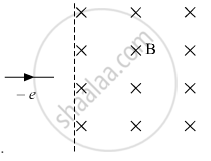
field.
Concept: Force on a Moving Charge in Uniform Magnetic and Electric Fields
A straight wire of mass 200 g and length 1.5 m carries a current of 2 A. It is suspended in mid air by a uniform magnetic field B. What is the magnitude of the magnetic field?
Concept: Force on a Moving Charge in Uniform Magnetic and Electric Fields
Use Biot-Savart's law to find the expression for the magnetic field due to a circular loop of radius 'r' carrying current 'I', at its centre ?
Concept: Magnetic Field on the Axis of a Circular Current Loop
A flexible wire of irregular shape, abcd, as shown in the figure, turns into a circular shape when placed in a region of magnetic field which is directed normal to the plane of the loop away from the reader. Predict the direction of the induced current in the wire.
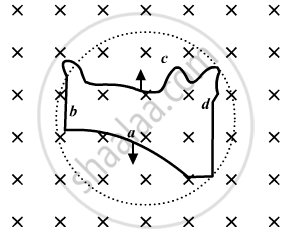
Concept: Force on a Moving Charge in Uniform Magnetic and Electric Fields
A wire AB is carrying a steady current of 12 A and is lying on the table. Another wire CD carrying 5 A is held directly above AB at a height of 1 mm. Find the mass per unit length of the wire CD so that it remains suspended at its position when left free. Give the direction of the current flowing in CD with respect to that in AB. [Take the value of g = 10 ms−2]
Concept: Solenoid and the Toroid - the Solenoid
A wire AB is carrying a steady current of 10 A and is lying on the table. Another wire CD carrying 6 A is held directly above AB at a height of 2 mm. Find the mass per unit length of the wire CD so that it remains suspended at its position when left free. Give the direction of the current flowing in CD with respect to that in AB. [Take the value of g = 10 ms−2]
Concept: Solenoid and the Toroid - the Solenoid
A wire AB is carrying a steady current of 6 A and is lying on the table. Another wire CD carrying 4 A is held directly above AB at a height of 1 mm. Find the mass per unit length of the wire CD so that it remains suspended at its position when left free. Give the direction of the current flowing in CD with respect to that in AB. [Take the value of g = 10 ms−2]
Concept: Solenoid and the Toroid - the Solenoid
Two identical circular wires P and Q each of radius R and carrying current ‘I’ are kept in perpendicular planes such that they have a common centre as shown in the figure. Find the magnitude and direction of the net magnetic field at the common centre of the two coils.
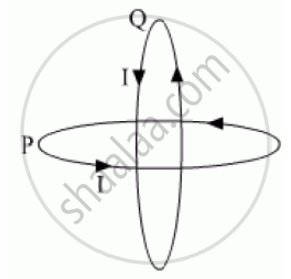
Concept: Motion in a Magnetic Field
A rectangular loop of wire of size 4 cm × 10 cm carries a steady current of 2 A. A straight long wire carrying 5 A current is kept near the loop as shown. If the loop and the wire are coplanar, find
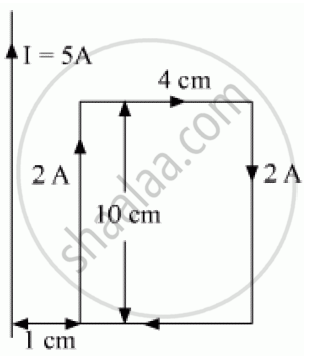
(i) the torque acting on the loop and
(ii) the magnitude and direction of the force on the loop due to the current carrying wire.
Concept: Torque on a Rectangular Current Loop in a Uniform Magnetic Field
A rectangular loop of wire of size 2 cm × 5 cm carries a steady current of 1 A. A straight long wire carrying 4 A current is kept near the loop as shown. If the loop and the wire are coplanar, find (i) the torque acting on the loop and (ii) the magnitude and direction of the force on the loop due to the current carrying wire.
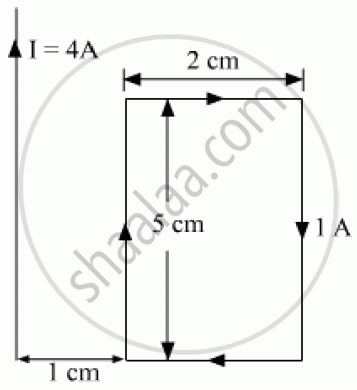
Concept: Torque on a Rectangular Current Loop in a Uniform Magnetic Field
A rectangular loop of wire of size 2.5 cm × 4 cm carries a steady current of 1 A. A straight wire carrying 2 A current is kept near the loop as shown. If the loop and the wire are coplanar, find the (i) torque acting on the loop and (ii) the magnitude and direction of the force on the loop due to the current carrying wire.
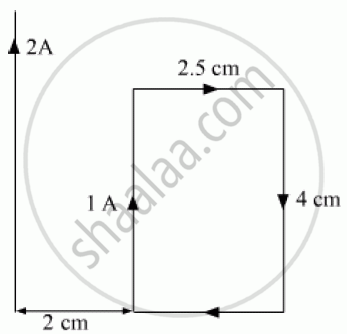
Concept: Torque on a Rectangular Current Loop in a Uniform Magnetic Field
A short bar magnet of magnetic moment 0.9 J/T is placed with its axis at 30° to a uniform magnetic field. It experiences a torque of 0.063 J.
(i) Calculate the magnitude of the magnetic field.
(ii) In which orientation will the bar magnet be in stable equilibrium in the magnetic field?
Concept: Force on a Current - Carrying Conductor in a Uniform Magnetic Field
A magnetised needle of magnetic moment 4.8 × 10⁻² JT−1 is placed at 30° with the direction of uniform magnetic field of magnitude 3 × 10⁻² T. Calculate the torque acting on the needle.
Concept: Torque on a Rectangular Current Loop in a Uniform Magnetic Field
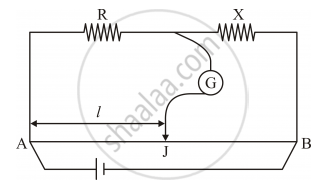
In the meter bridge experiment, balance point was observed at J with AJ = l.
(i) The values of R and X were doubled and then interchanged. What would be the new position of balance point?
(ii) If the galvanometer and battery are interchanged at the balance position, how will the alance point get affected?
Concept: Moving Coil Galvanometer
Write the expression for Lorentz magnetic force on a particle of charge ‘q’ moving with velocity `vecv` in a magnetic field`vecB`. Show that no work is done by this force on the charged particle.
Concept: Force on a Moving Charge in Uniform Magnetic and Electric Fields
State the principle of the working of a moving coil galvanometer, giving its labeled diagram ?
Concept: Moving Coil Galvanometer
Outline the necessary steps to convert a galvanometer of resistance RG into an ammeter of a given range ?
Concept: Moving Coil Galvanometer
Using Ampere’s circuital law, obtain the expression for the magnetic field due to a long solenoid at a point inside the solenoid on its axis ?
Concept: Ampere’s Circuital Law
In what respect is a toroid different from a solenoid?
Concept: Solenoid and the Toroid - the Solenoid
